Bikepacking Racks and Panniers: The Complete Guide to Rack-Based Carry
20+ years testing gear in Colorado backcountry
What Bikepacking Racks and Panniers Actually Buy You
Bikepacking racks and panniers carry more weight, more volume and more awkwardly shaped gear than strap-on soft bags, and they let you reach any of it in seconds. You pay for that in the weight of the rack, in bolts and welds that can loosen or break, and in some handling on rough ground. On a few frames, a rack is the only way to carry a real load at all.
That last sentence is the one most buying guides skip, and it is most of the reason this article exists.
Bikepacking spent a decade defining itself against panniers. The pitch was good, and it was largely right: strap the bags to the bike, lose the rack, lose the rattle, lose the boxes that snag every branch on singletrack. A generation of riders learned to run a complete soft-bag system and never owned a rack at all.
Then the limits showed up. Soft bags cap out on volume. They are slow to get into, because the thing you want is usually three items down a stuff sack. They droop, they sway, and they cannot carry a shape that refuses to compress. And on a bike with no usable frame triangle, or a dropper post, or a tyre that eats the space a seat pack wants, they simply run out of room.
So the hardware came back. According to the Adventure Cycling Association's 2026 bikepacking gear-trend coverage, "the best way to carry more gear on a bike is and always has been a rack (or two)" — and the same piece reports that, across the rider setups in its Baggregator collection, most off-pavement setups use at least one, which it calls "a huge change from roughly five years ago, when the industry was all-in on soft bags." We read that as a category correcting an over-correction, not as a verdict on soft bags. It is worth saying plainly that this is our reading of where the hardware is, not a measured trend.
Racks did not come back because touring won. They came back because soft bags hit ceilings nobody wanted to talk about.
So the useful question is not racks or bags as tribal identity. It is which loads and which bikes each system actually suits — and the answer changes with the trip, not with your politics.
Bikepacking Bags vs Panniers
The comparison that matters is not aesthetic. It is seven concrete tradeoffs, and each one points a different direction depending on the trip.
Volume. Soft bags top out. A frame bag, a seat pack and a bar roll give you a fixed envelope, and once it is full your only move is to strap more things to the outside. A rack scales: swap to larger panniers, or lash a dry bag to the deck. As BIKEPACKING.com's rear-rack index puts it, "unlike most seat bags, which have a limited maximum capacity, rear bike racks have the ability to expand their versatility depending on your needs."
Access speed. A pannier is a rigid-mouthed box you open from the top. A seat pack is a tube you unpack in order. In a car park in the dry that is a footnote; at a wet roadside with numb hands it is the difference between a two-minute stop and a fifteen-minute one.
Load security. Soft bags strapped tight to the frame move with the bike, which is their whole design argument. Panniers hang on hooks, and a hard enough hit can unship one. Good anti-sway hardware is the fix, and it is not optional off pavement.
Wind and brush. Panniers sit outboard of the frame. On an exposed gravel road that is drag you feel in a crosswind. On overgrown doubletrack it is a snag point, repeatedly, at thigh height.
Weight and cost. A rack is dead weight you carry loaded or empty. Against that, a rack plus two panniers is often cheaper per litre than an equivalent set of dedicated bikepacking bags. That is a straight trade of money against grams, and which side you want depends on whether your trips are measured in days or weeks.
Handling. Soft bags keep mass inside the wheelbase and near the centreline. Panniers put mass outboard and behind the rear axle, which shows up as yaw — a slow wag on a fast, loose descent.
The honest way to frame bikepacking bags versus panniers is not which one is better. It is which failure mode you would rather live with: running out of space, or carrying a rack you did not need.
Bikepacking With Panniers: What You Actually Gain
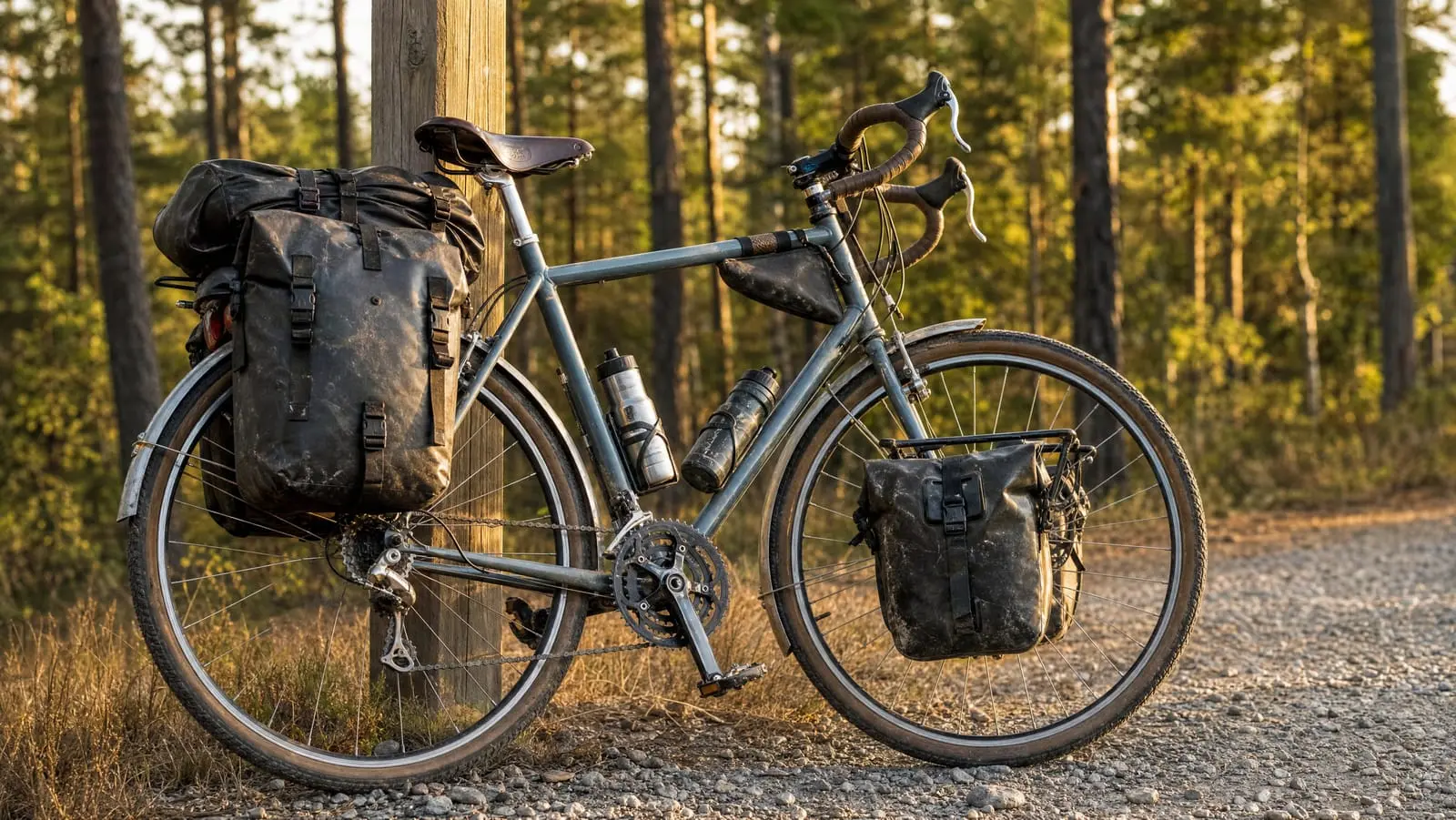
Panniers earn their keep the moment your kit stops being compressible. Bulky camp and cooking gear, four days of food out of a single resupply, a fuel bottle, a cook pot, a bear canister — these are shapes that fight a stuff sack and sit happily in a box. Panniers also make a bike loadable in the dark by feel, which matters more than it sounds.
This is the tradition that touring built, and it is worth knowing where the two cultures diverged before you pick a side. We covered that split in bikepacking vs bike touring.
Rear Racks: The Load-Bearing Core
Every rack system is really a rear rack plus optional extras. It carries the most weight, sits closest to the heaviest gear, and it is the component whose failure is genuinely dangerous rather than merely annoying. Get this choice right and the rest is shopping.
Three mounting interfaces cover almost everything:
- Eyelet-mounted. Two lower eyelets near the dropouts, two upper mounts on the seatstays. Four load paths into the frame. Strongest, quietest, and the reason bikes with mounts are worth seeking out.
- Seatpost-clamp. The rack cantilevers off the seatpost. Fast to fit, fits almost anything, and it has the lowest practical capacity of the three because all the load goes through one clamp. It also conflicts with a dropper post.
- Axle-mounted. The rack picks up the rear axle or thru-axle instead of dropout eyelets. This is the category that opened rack carry back up to modern frames, and it gets its own section below.
We cover the best rear racks for bikepacking separately, model by model, because the decision is driven far more by which interface your frame offers than by which badge is on the tubing.
Steel or Aluminium: A Repairability Trade
Steel racks are heavier and can be welded by any competent shop. Aluminium racks are lighter and effectively cannot be repaired away from a specialist. TravellingTwo's touring-bike primer makes the point about frames, and the logic carries straight over to racks: "You're more likely to find someone who can fix damage to your frame en route if it's made of steel, rather than aluminium."
We would take the steel rack for a long trip through places where the nearest bike shop is a rumour, and the aluminium one for a week of gravel with a car at both ends. Neither answer is clever. It is just a question of whether a field repair is plausible where you are going, and how much you mind carrying the difference.
What the Best Bikepacking Racks Get Right
Two details separate a rack that disappears from one you keep noticing. The first is disc-brake clearance: the caliper sits exactly where a rack leg wants to run, and a rack designed before disc brakes were universal will either foul it outright or need a spacer stack that becomes its own problem. Check the rack's disc compatibility against your frame before anything else.
The second is deck geometry — how long the platform is, how far back it puts a pannier, and whether your heel clears it at the bottom of the stroke. Short-chainstay gravel frames are the ones that bite here.
Where the load sits on that deck matters as much as the rack. We go into that in depth in our guide to weight distribution when you pack.
Choosing Panniers for Bikepacking
Panniers look interchangeable and are not. Four things decide whether a pair is any good off pavement.
Closure type. Roll-tops seal by compression and have no zip to fail, and they let you cinch a half-empty bag down so the contents stop moving. Flap closures are faster to raid one-handed and are the reason commuter bags feel civilised, but a velcro flap is not a roll-top in real rain. Cycling UK's pannier group test found roll-tops dominated the field: "all the products bar one was roll-top." For bikepacking we would take a roll-top every time and accept the slower access.
Mounting hooks and anti-sway. The top hooks have to match your rack's tube diameter, and the bottom needs a catch that grabs a rack stay. Cycling UK describes the pattern to look for — an "anti-sway catch at the bottom" that "slides into position and rotates fully so you can locate it to hook around one of your carrier stays." Without that lower anchor, a pannier pendulums on every square-edged hit, and the hooks wear out fast.
Waterproof, or Water-Resistant Plus a Rain Cover
Treat these as two different products. Genuinely waterproof panniers use welded seams and a roll-top. Water-resistant panniers use coated fabric and a zip or a flap, and they are — in Cycling UK's words about the bags in that test — "showerproof so they should protect your stuff from rain but not if you immerse them in water."
Our habit is to distrust the label either way and run a dry bag inside the pannier for the sleeping bag and the down layer. One dry bag weighs almost nothing and removes the whole category of problem, including the one where a rear pannier goes hub-deep in a ford.
Volume per side. Match the pannier to the rack deck, not to your ambitions. A tall bag on a short rack rides high and catches wind; a long bag on a short-chainstay frame meets your heel. If you are choosing between one big pair and two small pairs, the big pair on the rear is nearly always the better bike.
We look at the best panniers for bikepacking in a dedicated piece, because the closure-and-hook question deserves more room than a hub article can give it.
Front Racks and Low-Riders
A front rack changes how the bike steers, and the two common designs change it in opposite directions.
Low-riders bolt to fork-blade eyelets and hang panniers low, roughly at or behind the axle line. That keeps mass close to the ground and close to the steering axis, which is why CyclingAbout's front-rack primer notes that they "keep your pannier weight as low as possible to the ground" and that "by keeping your weight low, you reduce the bike's centre of gravity and therefore achieve better manoeuvrability."
Platform and porteur racks put a deck above and ahead of the wheel. That is a genuinely useful shape for bulky, light, awkward loads, and CyclingAbout is explicit that it is a load-limited one: for weight carried above wheel height, "light loads of less than 10kg (22lbs) are generally fine." The physics is not mysterious. Weight high and forward of the steering axis gives the load more leverage over your hands, so the bar feels heavier to initiate and keener to keep turning once it has started.
One practical rule for either design: run both sides or neither. A single front pannier makes the steering asymmetric in a way you will notice within a mile.
If your fork has three-pack bosses but no low-rider eyelets, the strapped route is often the better answer anyway. We cover it in fork bags and cargo cages, which keeps weight low without adding a rack to maintain.
We go deeper on front racks for bikepacking elsewhere in this series, including how lowriders and platforms pair with a loaded rear.
Mounting a Rack to a Bike Without Eyelets
This is the section that decides whether the rest of the article is theory for you. Plenty of capable gravel and mountain bikes shipped with no rack mounts at all, and for years that was the end of the conversation.
It is not any more. The Adventure Cycling coverage describes the fix as a "universal-mount rack" that can "attach to any bike without eyelets by mounting to a special axle, or sometimes seat stays or fork blades," and credits it with opening "the door to reliable, copious cargo space on the bikes we already love to ride." Makers like Old Man Mountain and Tailfin built their reputations in exactly this space.
Three approaches, in descending order of how much we trust them:
- Axle mounts. The rack's lower legs pick up a replacement thru-axle or skewer. Load goes into the axle, which is the strongest thing at the back of the bike, and nothing clamps a tube. This is the good answer.
- Seatstay or fork-blade clamps. Rubber-shimmed bands around the tube. Fine on steel or aluminium, and we would want the frame maker's blessing before putting one on a carbon stay.
- Seatpost clamps. Simple, cheap, and the lowest capacity of the three. Fine for a light load; not where you put four days of food.
Where we stop: a suspension fork, or a carbon fork with no mounts, is a stop sign rather than a puzzle. Some axle-mounted front racks are explicitly rated by their makers for suspension forks, and if yours is one of them, follow that instruction sheet exactly. If it is not — if you are improvising clamps onto stanchions, a carbon crown or an unrated carbon blade — the honest answer is that the bike does not take a front rack. Carry the load at the back, or carry less.
Pannier Racks for Gravel Bikes That Shipped Without Mounts
Gravel bikes are the most common case, and usually the easiest. Most have thru-axles, so an axle-mounted rear rack works, and many have at least seatstay bosses even when the dropouts are bare. Before you buy anything, read the frame's own documentation for a stated rack provision — some carbon frames say no, in writing, and that is the whole answer.
If you are earlier in the process, our guides to converting an existing bike for bikepacking and to which bikes come with mounts at which budget will save you the adapter-shopping stage entirely.
The full detail on mounting a rack without eyelets, including which kits cover which axle standards, gets its own article.
Weight Limits, Bolts and Torque
A rack has a manufacturer-rated capacity, and that number is a limit, not a target. Ratings vary widely between models and are stated on the assumption that the rack is correctly mounted, evenly loaded, and not being used as a jack point. We will not quote a figure here for any rack, because the only figure that governs your rack is the one its maker publishes.
Two things make that rating less protective than it sounds. The first is dynamic load: a 10 kg pannier is 10 kg on the workstand and considerably more each time your rear wheel slams a rock ledge. The second is asymmetry — most of the weight on one side concentrates stress in one leg and one weld.
Torque is the other half. Use the figure the rack or frame maker specifies, and use a torque wrench to hit it. Park Tool's guidance on why is worth internalising in both directions: "too little preload will mean the fastener will loosen with use," and "too much tightening will deform the threads or the parts." An eyelet stripped on a road ride is a bad afternoon. An eyelet stripped in a frame at the end of a dirt road is a trip.
A rated capacity tells you where the rack stops working. It does not tell you where you should stop packing.
We go further into rack weight limits, bolt hardware and threadlocker choices in a dedicated article, because this is the part of rack ownership that actually keeps people safe.
Hybrid Setups: Racks Plus Soft Bags
Here is the setup most experienced riders actually run, and it is neither of the two camps: a rear rack with a dry bag or a single pannier pair, plus a frame bag and a bar roll. No front rack, no four-pannier symmetry, no ideology.
It works because each part does what it is good at. The rack deck gives rigid support for bulky, light gear that a seat pack would let droop into your tyre. A frame bag keeps the dense items — tools, water, food, batteries — low and inside the wheelbase, where they do the least to your handling. The bar roll takes the shelter. Nothing is asked to do a job it is bad at.
It also solves the two problems that break pure systems. Against a pure soft-bag kit, you gain a hard surface and real volume. Against a pure four-pannier touring kit, you lose a front rack's worth of weight, drag and bolts, and you keep the bike narrow enough for brushy doubletrack.
The pattern we would start from on a gravel bike: rear rack with a single roll-top dry bag strapped to the deck for sleep kit, a half-frame bag for dense items and water, a bar roll for the shelter, and panniers added only for the trips where food or water carry demands them. That last clause is the whole point — panniers become a module you fit for a specific trip, not a permanent commitment.
The detail of combining racks with bikepacking bags, including which soft bags foul which rack decks, is its own article in this series.
Racks on Full-Suspension and Small-Frame Bikes
These two bikes have the same problem for different reasons: the places a bag normally goes are gone.
A full-suspension frame has no usable main triangle, usually runs a dropper post, and — the part people forget — has a rear triangle that moves relative to the seatpost through the travel. Anything bolted across that path either binds or breaks. That rules out seatpost-clamp racks and most bolt-on struts by default, and leaves two designs that work: racks that mount to the rear axle and travel with the swingarm, and racks that clamp only to the rear stays with no seatpost attachment at all — Aeroe, for instance, describes its stay-mounted rack as fastening independently of the seatpost and flexing at the feet to suit varying stay widths and angles.
The dropper is the other constraint, and it is the reason a rack can beat a bag here at all. BIKEPACKING.com's rear-rack index is blunt about the soft-bag version of this problem: "it's hard to avoid tire contact with even the smallest of dropper-compatible seat bags." A rack deck sits above the tyre regardless of where the saddle is, which is why Adventure Cycling's trend piece frames the minimalist cargo-cage rack as a dropper solution — "strap on a couple 5-liter dry bags, plus another 8 to 10 liters on the deck, and you have nearly 20 liters of stable, dropper-post-friendly capacity."
Small frames hit a milder version. Short seat tube, low standover and a compressed gap between saddle and tyre mean a seat pack of any real volume will make contact on a rough descent. The fix is the same: put the volume on a deck instead of hanging it off the saddle.
What is not possible is worth stating too. A full-suspension bike will not carry a four-pannier touring load, and it should not. The honest framing for racks on full-suspension bikes is that they are a capacity fix for a bike that had almost none, not a route to touring weights. Treat the rack as permission to carry a proper sleeping bag, not permission to carry everything.
How to Choose Bike Racks for Bikepacking, and When Not To
Three questions settle it, in this order.
Does the bike have mounts, and if not, does it have a thru-axle? Eyelets make a rack easy and cheap. A thru-axle makes it possible. Neither, plus carbon, usually means the answer is soft bags and you should stop shopping.
How long is the longest gap between resupplies? Two days of food fits in a soft-bag kit. Five days, or a dry stretch where you carry water, does not. Capacity is the single clearest signal that you want a rack.
How technical is the riding? If the route includes anything you would describe as singletrack, panniers are a liability and a rack deck with a strapped dry bag is the better half-measure. If it is gravel, dirt road and pavement, panniers are fine and their access speed is a real daily pleasure.
Our own default, stated plainly: a rear rack on any bike that will take one, soft bags for everything forward of the seat tube, and panniers fitted only for the trips that need them. That is not a compromise position. It is what happens when you stop asking which system is correct and start asking what each part of the bike is good at carrying.
The eight sections above are each a decision with enough depth to deserve its own article, and that is exactly what we are building them into. Start with whichever one is currently stopping you.
Explore the full series
- The Best Panniers for Bikepacking: Off-Road Ready Picks — Which panniers survive off-road bikepacking, and the mounting hardware that decides it.
- Front Racks for Bikepacking: Low-Riders, Porteurs and Fork Mounts — Front racks change how a loaded bike steers. Which style to run, and what it costs you.
- The Best Rear Racks for Bikepacking: Load-Bearing Picks Compared — The rear rack carries the most weight and fails the loudest. How to pick one that does not.
- Bikepacking Bags vs Panniers: Which Carry System Suits Your Trip — Strap-on bags or racks and panniers: the honest tradeoffs in weight, volume and handling.
- How to Mount a Rack to a Bike With No Eyelets — Eyelet-free frames and forks, and the mounting options that are actually safe under load.
- Bike Rack Weight Limits, Bolts and Torque: What Actually Fails — Rated capacities, bolt torque and the failure modes that strand riders. Read before you load.
- Hybrid Setups: Combining Racks With Bikepacking Bags — Most real setups are hybrids. Where a rack earns its weight alongside strap-on bags.
- Racks and Panniers on Full-Suspension and Small-Frame Bikes — No frame triangle, a dropper post and moving suspension: how to carry gear anyway.