Front Racks for Bikepacking: Low-Riders, Porteurs and Fork Mounts
20+ years testing gear in Colorado backcountry
The Best Front Rack for Bikepacking Is a Lowrider — If Your Fork Will Take One
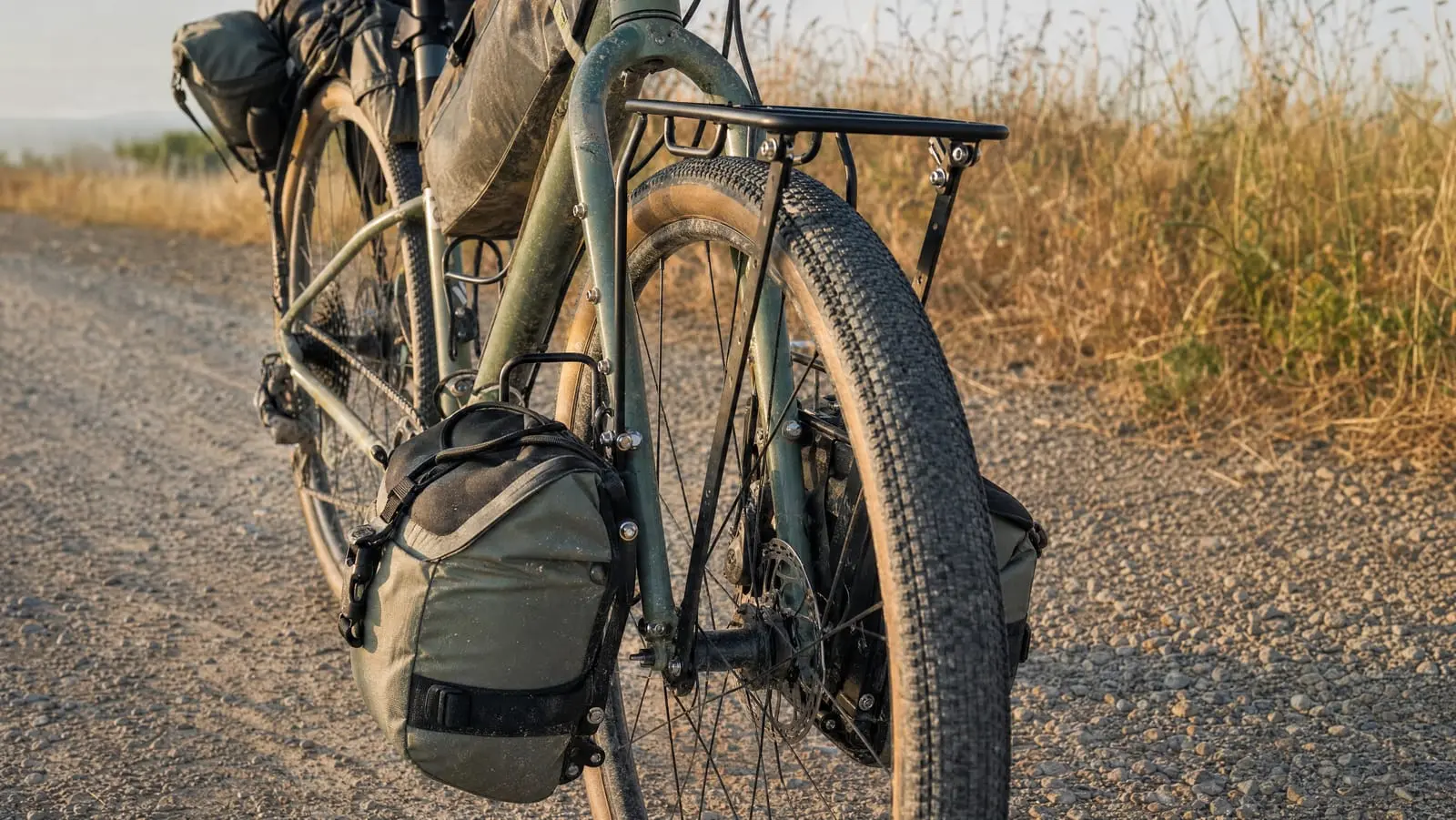
The best front rack for bikepacking is a lowrider bolted to a rigid fork with eyelets, and the Tubus Tara is the one we would buy. The catch arrives before the rack does: the Tara's own listing says it is not suitable for mounting on spring or carbon forks without eyelets. Check the fork before the price. We earn a commission on purchases made through the links below, at no extra cost to you.
Of all the rack-based carry systems you can bolt to a bike, the front rack is the only one that changes how the bike steers. A rear rack changes what the bike weighs. A front rack changes what the bike does when you take a hand off the bar at walking pace to open a gate.
So this guide runs handling first, fit second, price last — the reverse of how rack listings are written.
What a Front Rack Does to Your Bike: Why the Low Rider Front Rack Exists
A bicycle steers around the steering axis, the line through the head tube that the fork rotates about. Load hung ahead of that line and above the wheel sits on a longer lever than load hung low and close to the axle. Same kilograms, more influence over the bar. That is the whole reason the low rider front rack exists.
We will not put a number on it, because nobody has honestly measured it for your fork rake and your bar width. But the direction is not in dispute. CyclingAbout's front-rack primer frames the lowrider's purpose as keeping "your pannier weight as low as possible to the ground," which "allows heavily-laden touring bikes to feel as stable as possible at both low and high speeds."
The three things you actually feel
Low-speed wander. At the speed of a loose climbing pitch or a trailhead gate, a high forward load makes the bar want to fall to one side rather than sit centred. You correct, then correct back — a steady tax on attention over a long day.
Crosswinds. A dry bag strapped to a flat platform is a sail mounted on the part of the bike that steers, so a gust does not just shove the bike sideways — it shoves the steering. Panniers hung beside the wheel are lower, narrower and closer to the axis the fork turns about.
Standing up to climb. Out of the saddle you rock the bike under you, and a high front load rocks with it — a pendulum above the hub instead of a weight beside it. Riders read that as "the bike feels heavy," when what changed is where the mass sits. Our notes on hand numbness and handlebar comfort cover why front load and grip pressure are linked.
A front rack is not a capacity decision that happens to affect handling. It is a handling decision that happens to add capacity.
When a platform is the right answer anyway
None of that makes platforms wrong. It makes them specific. A platform wins when the load is bulky and light — a sleeping pad, a stuffed jacket, groceries from the one store in town. It wins when you want the cockpit clear, because it moves volume off the bar. And it wins for town errands at low speed over known ground.
CyclingAbout puts a useful ceiling on it: "light loads of less than 10kg (22lbs) are generally fine above the height of the wheels on both randonneur or porteur racks." Under that, with bulk rather than density, a platform is reasonable. Above it, or with dense gear, the lowrider is the better engineering.
The corollary matters more than the pick. A front rack is for splitting a load, not adding one. Moving a few kilos forward off an overstuffed rear end usually improves the ride; bolting one on and filling it usually does not. Our guide to packing and weight distribution covers the front-to-rear split, and the best panniers for bikepacking covers what hangs on the rails.
Will It Even Fit? The Fork Compatibility Gate
Front racks for bikepacking are the hardest rack on the bike to fit, and the reason is structural. Rear triangles have converged on rack eyelets; forks have not. Plenty of gravel and mountain forks ship with three-pack cargo bosses on the blades and nothing where a lowrider needs to bolt. So start here, before the product photos: the question is not which rack is best, but which rack your fork permits.
What a front pannier rack needs from a fork
A traditional lowrider bolts in two places per blade: an eyelet at or near the dropout, and a second mount partway up the blade. Both, on both sides. That pairing is what makes the rack a triangulated structure instead of a lever.
This is not a Tubus quirk. Surly's front rack instruction sheet sets the same two-point requirement: its racks are compatible with forks "that have threaded mounting points, and can accept bolts on mounts midblade and near the dropout", or that "can safely accept rubber-coated clamps around the fork blades (additional hardware will be needed)" (Surly instruction sheets). Note what that does and does not allow: two mounting points per blade are non-negotiable, while eyelets themselves are the clean way to get them and clamps on a rigid blade are the documented fallback. A fork with dropout eyelets and nothing mid-blade is half of a lowrider fork.
Two more checks while you are down there. Disc brake clearance: the caliper lives exactly where a lowrider's lower strut wants to be, so the rack has to be built or adjusted around it. Tire room: measure the gap where the rail will sit with the tire you actually ride. If you are choosing a bike rather than a rack, our roundups of bikepacking bikes at every budget and travel-friendly bikepacking bikes note which forks arrive with usable mounting points.
The Tara and the LM-1: the one pairing worth understanding
The most useful fully-sourced fact here comes from two Tubus listings sitting next to each other. The Tubus Tara listing says the rack is not suitable for mounting on spring or carbon forks without eyelets. The Tubus LM-1 Mounting Set is described as a Tubus lowrider adapter for rigid forks without eyelets, for fork blades of 20 to 32 mm diameter, fitting all Tubus lowrider racks except the Duo.
Read together, that is a clean answer with a hard boundary. The LM-1 solves exactly one of the Tara's two problems: it replaces missing eyelets on a rigid fork. It does not change what kind of fork the Tara may be mounted to. Tubus's own page for the LM-1 says it plainly — "Do not mount on suspension forks!" — and adds that the set is not approved for carbon forks (tubus.com).
One inconsistency to know before you order: the Amazon listing gives the LM-1 range as 20 to 32 mm, while Tubus's own page for the same part number lists 20 to 26 mm. Measure your fork blade at the clamp position and ask before you buy.
The Five Racks Worth Considering
Three full racks, then the platform, then the adapter. We have not ridden, mounted or weighed any of these — what follows is judgement about design intent, brand record and tradeoffs.
Tubus Tara Lowrider Pannier Rack — the default answer
The Tara is what we would buy when the fork allows it, because it is a dedicated lowrider that does one job. Tubus says the design has been in production more than 25 years and that the fork mounting was revised for wider compatibility, replacing three individual holes with one longitudinal slot — the maker's claims, not our measurements, but a slot rather than fixed holes is the detail that decides whether a rack clears your caliper. The tradeoffs: at $130.96 as of September 2026 it is the second-priciest pick, it needs the right fork mounts or the LM-1 below, and its listing rules out spring and carbon forks without eyelets.
Tubus Tara Lowrider Pannier Rack
A dedicated lowrider that keeps pannier weight low and beside the wheel, where it interferes least with steering. Tubus revised the fork mounting to a single longitudinal slot, so the rack can be positioned around a caliper. Not for spring or carbon forks without eyelets, per the listing.
- Fits 26 inch and 28 inch wheels
- Longitudinal slot for flexible positioning
- Fork mounting revised for wider compatibility
Blackburn Outpost Fat Front or Rear Bike Rack — the one that fits anything
Reach for the Outpost when the bike is the problem rather than the rack. Blackburn describes it as height and width adjustable, fitting 26 inch, 650b, 700c, 27.5 inch and 29 inch wheels and widths from 23c up to 3 inch, with a patent-pending adjustable width meant to suit most fat bike frame, hub and tire widths, disc brake compatible, in 6061-T6 aluminium — all Blackburn's own figures. The compromise is the versatility itself: a rack built to work at either end of the bike is not optimised as a low-mounted lowrider, so it carries higher than a Tara. At $150.07 as of September 2026 it is also the most expensive rack here.
Blackburn Outpost Fat Front or Rear Bike Rack
The rack for an awkward fork or fat tires. Blackburn's height and width adjustment covers a wide span of wheel and tire sizes, and it runs at either end of the bike. The price of that flexibility is that it carries higher than a dedicated lowrider.
- Mounts front or rear
- Height and width adjustable
- Disc brake compatible
- 6061-T6 aluminium
Blackburn Grid Front Basket Rack — the flat platform
Choose this one for shape, not for weight. The listing describes an extruded aluminium rack with a 10 kg load capacity, suitable for the BBN Wald 137 bag — so to be explicit, this is a rack, not a basket or a bag, and neither is included. Blackburn's stated 10 kg is the lowest ceiling here, and a flat deck puts that load high and forward, the opposite of what a lowrider is for. The feature list also notes no approval according to German Road Traffic Licensing; we report that as the listing states it. At $121.57 as of September 2026 it is the cheapest branded rack here.
Blackburn Grid Front Basket Rack
A front platform-style rack for awkward, light loads — the sleeping pad, the jacket, the resupply. Blackburn states a 10 kg capacity, the lowest here, and a flat deck carries weight high and forward, so treat it as a bulk solution, not a touring lowrider. No bag or basket is included.
- Extruded aluminium construction
- 10 kg stated load capacity
- Suitable for the BBN Wald 137 bag
- Compatible with many bikes
Gralara Gravel Bike Front Carrier — the value pick, with an asterisk
On paper this is the most capacity per dollar here. Gralara lists a welded aluminium alloy build, 780 g without accessories, a 15 kg load capacity, a three-layer hanging system with a large top surface, and brackets and spacers for both through-hole and non-through-hole fork bridges — that last item is the genuinely useful part, since spacer kits decide whether a rack sits square on your fork crown. Every figure is the seller's claim, and we would not turn a stated 15 kg into a recommended real-world load. The bigger tradeoff is reputational: a generic brand has no durability record and nothing to lose if a weld cracks, which matters more on a structural part than on a bag. At $58.29 as of September 2026 you are buying the saving instead of the record.
Gralara Gravel Bike Front Carrier
The budget option, and its hardware is the reason to look: Gralara lists brackets and spacers for through-hole and non-through-hole fork bridges, which often decides whether a rack fits at all. Every stated figure is the seller's claim, and a generic brand carries no durability record.
- Welded aluminium alloy construction
- 780 g claimed without accessories
- 15 kg stated load capacity
- Brackets and spacers for through-hole and non-through-hole fork bridges
Tubus LM-1 Mounting Set — the fix for one specific problem
Buy this only once you understand what it does. The LM-1 is a Tubus lowrider adapter for rigid forks without eyelets, listed on Amazon for blades of 20 to 32 mm diameter — Tubus's own page for the part says 20 to 26 mm, in aluminium or steel — fitting all Tubus lowrider racks except the Duo. On a rigid fork with no lowrider bosses it turns a no into a yes, and $37.01 as of September 2026 is cheap for that. If your fork is suspension or carbon, this is not your solution — Tubus says do not mount it on suspension forks and does not approve it for carbon, and there is no light-load exception to read into that.
Tubus LM-1 Mounting Set
An adapter set that lets a Tubus lowrider mount to a rigid fork with no eyelets — the missing piece for a lot of older steel and aluminium forks. It solves the eyelet problem only: Tubus says not to mount it on suspension forks and does not approve it for carbon.
- Adapter for rigid forks without eyelets
- Listed for rigid blades 20 to 32 mm; Tubus states 20 to 26 mm
- Fits all Tubus lowrider racks except the Duo
Mounting It So It Stays On
A front rack lives in the worst vibration environment on the bike. Every impact the front wheel takes arrives at four small bolts first, and unlike a rear rack, nothing about the frame damps it on the way.
Use the torque figure the rack or fork maker specifies, with a torque wrench if the fork is anything but steel. We are not printing a number: the right one depends on your fork material, the bolt and the rack, and a guessed figure on an aluminium mount is how threads get stripped.
Threadlocker at home, not on the road. A medium-strength removable threadlocker on the rack bolts is the highest-return five minutes in this article, and it wants clean dry threads and a workbench.
Check the bolts by hand at every resupply — a finger and a quarter turn, the way you check a bottle cage. A loose rack bolt found in a parking lot is a non-event; the same bolt found because the rack dropped into your spokes is not. Put it on your pre-trip bike inspection checklist, then on a loop at every stop.
Is a Front Rack Even the Right Answer?
Often, no — and this is the section the rack brands will not write for you. If a fork mounted rack is off the table, or you simply want low forward capacity, you can have most of it with no rack at all. Fork-mounted cargo cages with dry bags bolt to the three-pack bosses modern gravel forks already have, sit at roughly lowrider height, and skip the eyelet question entirely. Our guide to fork bags and cargo cages covers the systems in detail.
Cages and dry bags win when the fork has three-pack mounts but no lowrider eyelets, when you want fewer failure points, when the load is soft and stuffable, or when you travel and need the bike to pack small. They usually cost less than a rack plus panniers.
A rack and panniers win when you need real volume, when you want to open a bag without unstrapping it, when the load is dense and awkward, and when you want to lift a pannier off and carry it.
If the bike has no useful mounts at all, that is its own project — converting a bike without mounts covers the strap and clamp options and where they stop being sensible. A dedicated article on mounting a rack without eyelets is coming.
What We Would Buy
Look at your fork first. Rigid with eyelets at the dropout and mid-blade: buy the Tubus Tara. Rigid without eyelets: the Tara plus the LM-1 set, and measure the blade diameter before ordering. Suspension, or carbon without eyelets: buy neither, and use fork cages with dry bags or an axle-mounted rack designed for your fork.
Then look at the load. Dense gear on a lowrider. Bulky light gear on a platform like the Blackburn Grid. A strange fork or fat tires, and the Outpost's adjustability earns its price. A tight budget, and the Gralara buys capacity instead of a record.
Then remember what the rack is for. Front carry exists to take weight off an overloaded rear end, not to give you somewhere to put more. Most riders who fit a front rack and feel worse afterward added volume instead of moving it.
The pieces argue with each other — rails, bags, tire clearance and where the weight sits. Our full guide to choosing a rack and pannier setup works through the whole thing, and the companion article on rear racks for bikepacking covers the other half of a front-and-rear build.