How Much Battery Do You Actually Need? Bikepacking Power Budgeting
20+ years testing gear in Colorado backcountry
Your Bikepacking Power Budget in Watt-Hours, Start to Finish
Build a bikepacking power budget in watt-hours like this. List every device. Convert each battery with Wh = mAh / 1000 × V. Estimate the fraction you spend per day, sum those, then divide by the share of a power bank's label you actually receive. The rule we derive below: rated mAh is roughly 400 times your watt-hours per day times your days off-grid.
The uncomfortable part first: the number printed on the side of a power bank is not the number you get. It describes energy in the cells at about 3.7 V, not energy leaving the USB port at 5 V, and the conversion takes a cut. Riders who size a bank off the label run out on day three and conclude the bank was faulty.
One conversion, one table, one division. It is the step that makes every other decision about how a bikepacking charging system fits together answerable with a number instead of a hunch.
The One Conversion You Need: mAh to Watt-Hours
Milliamp-hours measure charge, not energy; charge becomes energy only when you multiply by a voltage. That is the whole trap — two batteries with the same mAh figure can hold very different amounts of electricity. The conversion is Wh = mAh / 1000 × V, and backwards, mAh = Wh / V × 1000.
Work one through. Apple leaves capacity out of its standard tech specs, but EU energy-label disclosures include it, and as reported by Notebookcheck those put the eSIM iPhone 17 Pro at 4,252 mAh. Macworld's comparison table converts that to 16.56 Wh — and lists the physical-SIM variant lower, at 3,988 mAh and 15.53 Wh, so check which version you own. Note that 16.56 divided by 4.252 implies a nominal voltage near 3.9 V, above the 3.7 V most capacity guides assume — the two conventions disagree by a few percent. We use published watt-hour figures where they exist and the 3.7 V convention where they do not.
Now the same arithmetic on a power bank. Anker's support pages work it explicitly: a 10,000 mAh bank holds about 37 Wh at 3.7 V, which at 5 V is only 7,400 mAh, and after roughly 82 percent circuit efficiency about 6,068 mAh. That is why banks advertising 10,000 mAh often carry a second, smaller rated figure near 6,000 mAh elsewhere on the label.
A power bank's headline number is a statement about its cells. It is not a promise about your phone.
What Your Devices Actually Draw Per Day
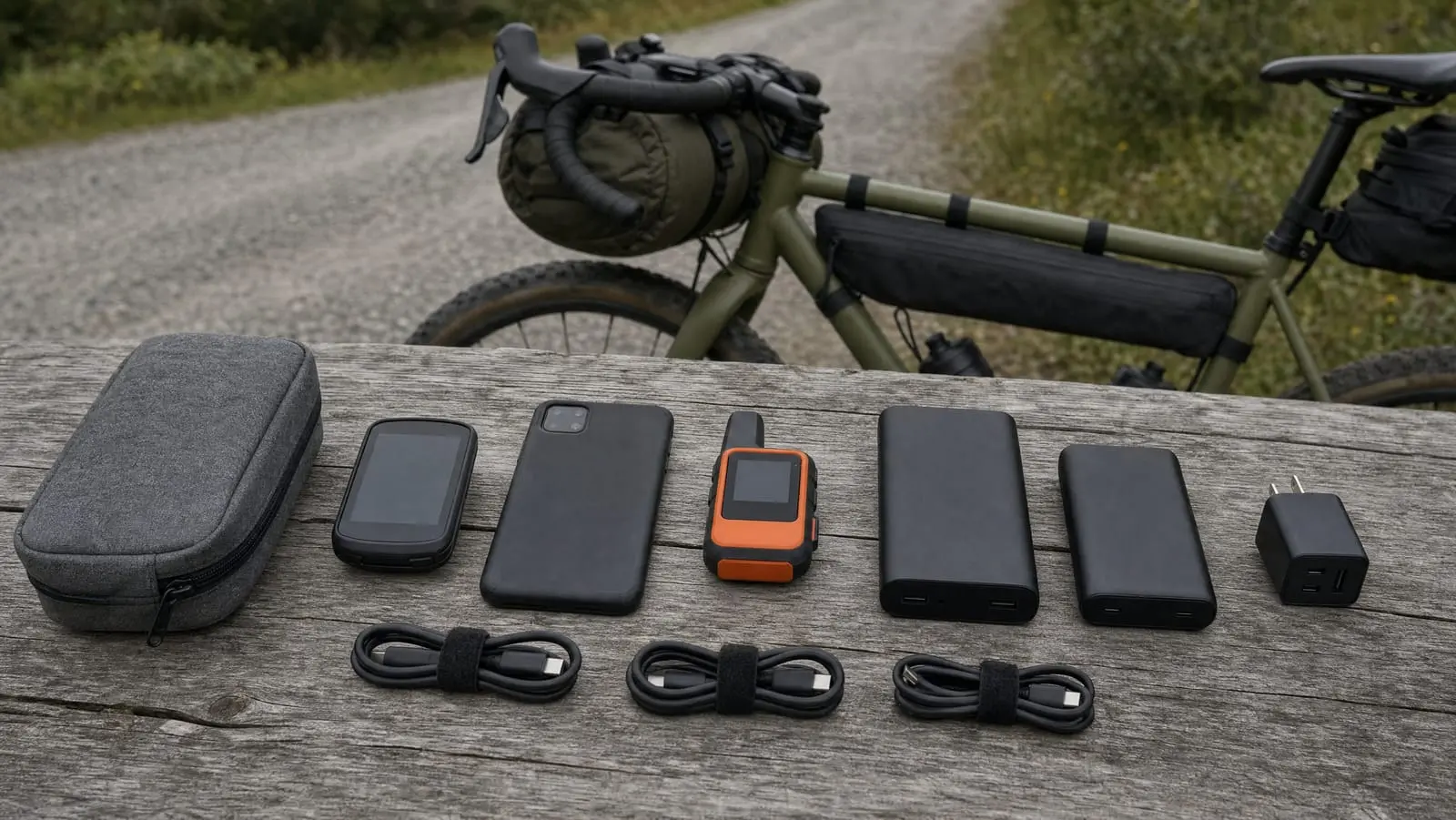
The awkward reality of bikepacking electronics is that the devices you worry about are rarely the ones emptying your battery. A head unit recording a track is a small, steady load. A phone used for live navigation with the screen lit is the largest line in most budgets, by a wide margin.
Makers also publish inconsistent things: phone capacities in mAh because of EU labelling, head units and messengers as claimed runtime with no cell capacity at all, lights somewhere between.
| Device class | Published figure we could find | Realistic daily use | Watt-hours per day |
|---|---|---|---|
| Phone, live navigation, screen on | iPhone 17 Pro, eSIM, at 4,252 mAh per Apple's EU energy label, 16.56 Wh per Macworld | 60 percent of the battery | about 10 |
| Phone, offline maps, screen mostly off | the same 16.56 Wh | 25 percent of the battery | about 4 |
| Head unit recording all day | Wahoo claims up to 20 hours for the Elemnt Bolt 3; no cell capacity published | 7 hours, about a third of a charge | about 3.5, assuming 10 Wh per charge |
| Satellite messenger, 10-minute tracking | Garmin's inReach Mini 2 specification: up to 14 days at 10-minute tracking with a full sky view | one charge per week | under 1, assuming 5 Wh per charge |
| Front light, one hour at a mid setting | Lezyne Macro Drive 1400+ listed at 5,200 mAh and about 3 hours in 1400-lumen Overdrive | 1 hour, well below full output | about 3 |
Two of those rows contain an assumption rather than a specification, and we would rather flag it than hide it. Neither Wahoo nor Garmin publishes a cell capacity for its head units — Garmin lists the Edge 1050 at up to 20 hours in demanding use and up to 60 hours in battery-saver mode, which tells you hours and nothing about watt-hours. The 10 Wh per charge above is our estimate and the softest number in this article. Claimed runtimes are not a ceiling either: Cyclists Hub measured about 26.7 hours from a Bolt 3 against the 20-hour claim, and the5krunner roughly 25 hours with the backlight off. Our cycling computer roundup collects the claimed figures across the field.
The light row is firmer because the capacity is published. A 5,200 mAh cell is about 19 Wh at 3.7 V, so if the listing gives roughly 3 hours at 1400 lumens, full output costs about 6.4 W. You will not ride on full output, and the same listing gives 950 lumens for 4 hours and 450 lumens for 12.5 hours — about 4.8 W and 1.5 W off that 19 Wh cell. That is why the hour at a usable setting in the table costs around 3 Wh rather than six. Bike Perfect's review of that light notes the quoted run times are optimistic — our guide to lights for overnight bikepacking goes through the modes that matter.
Sum the nav-heavy rider: 10 plus 3.5 plus 1 plus 3 is 17.5 Wh. Call it 18 Wh a day. Swap live navigation for offline maps and the same rider drops to about 11.5 Wh — a 36 percent cut from one behaviour change, worth more than any purchase. Our look at bikepacking navigation apps covers which ones make it cheap.
Usable Versus Rated Capacity: Sizing a Power Bank for Bikepacking
Sizing a power bank for bikepacking means working backwards from watt-hours into cells, and paying two taxes on the way. The first is the boost circuit: cells sit near 3.7 V and USB needs 5 V, so something steps the voltage up, and Anker's support material puts that conversion at roughly 80 to 85 percent efficient, the rest lost as heat and to internal resistance. The second is your own device, which loses roughly a further 15 percent while charging, per the same source.
Multiply those and about 70 percent of the printed energy ends up in a battery. Anker's worked example for a 20,000 mAh bank is 74 Wh at the cell and about 60.7 Wh after conversion — and once the receiving device takes its share, something near 52 Wh of stored charge.
These are a vendor's own figures, not independent lab measurements, and Anker notes real efficiency varies by device. Treat 70 percent as a planning number rather than a constant; for a cold or cheap bank it is probably optimistic.
The Worked Example: How Much Battery Capacity for a Week of Bikepacking
Here is the method on one rider — a worked example built from the published figures above, not a trip report. We have not metered these devices.
The assumptions. Seven-day gravel tour. Phone used for live navigation, head unit recording about 7 hours a day, satellite messenger tracking at 10-minute intervals, an hour of light most mornings. Daily total 18 Wh. The longest stretch without a wall socket is five days.
The sum. Five days at 18 Wh is 90 Wh that has to reach a cell. Two corrections apply, pulling opposite ways. You leave the last socket with every device full, worth roughly a day — true here, because each device holds at least one day of its own consumption. Then you add a day of reserve, worth the same.
Subtract the day your devices start full, add a day of reserve, and the two cancel. Size the bank as if it must carry every day of the trip.
The conversion. 90 Wh into cells, divided by 0.7, is about 129 Wh of printed capacity. At 3.7 V that is roughly 35,000 mAh. The shortcut — 400 times watt-hours per day times days off-grid — gives 18 times 5 times 400, or 36,000 mAh. Same answer.
Therefore: about 35,000 to 40,000 mAh of rated capacity, which in practice means two 20,000 mAh banks rather than one enormous one. That split is not only about redundancy. A 36,000 mAh bank is about 133 Wh, and the FAA's own PackSafe guidance puts the limit for carry-on without advance airline approval at 100 Wh per battery, with 101 to 160 Wh needing airline approval and a cap of two spare batteries. The FAA also notes airlines may set limits stricter than the federal baseline, so check your carrier before you book. Two 74 Wh banks each clear the line. One 133 Wh brick does not.
That total is also the moment to ask whether you should carry the energy at all. Thirty-five thousand mAh of lithium is a real weight penalty for five days of autonomy, and this is the crossover where choosing between a dynamo hub and a power bank stops being theoretical. Below three or four days off-grid the bank wins easily; above it, generating looks cheap. Once you have the number, our guide to picking a portable charger for your phone and GPS covers which bank to buy.
The weekend pass. Same rider, two days without a socket. 18 times 2 times 400 is 14,400 mAh, rounding up to a 20,000 mAh bank. But the formula over-buys on short trips, because the day your devices start full is half of a two-day window instead of a fifth of a five-day one. A 10,000 mAh bank delivers about 26 Wh into cells against 18 Wh of real need, covering the weekend with half a day spare. We would take the 10,000 and accept the thinner margin — and on offline maps at 11.5 Wh a day, it becomes genuinely comfortable.
The Reserve, and What Eats Your Budget Without Warning
Three things reliably spend power you never budgeted.
Cold. Capacity falls as temperature does, and the published numbers are chemistry-specific. A 2025 study in Batteries of a commercial LiFePO4 module measured capacity down about 15 percent near -10 °C and about 35 percent near -20 °C relative to room temperature. That is a different chemistry from the pouch cells in your phone, so read it as a direction rather than a figure for your kit. Battery University's own page on discharging at high and low temperatures is consistent in shape: cold temperature increases internal resistance and lowers capacity, and that reduced capacity applies only while the cell is cold. Battery University does not prescribe a bigger pack for cold riding — sizing up is our inference from the loss figures, not its advice. Our cold-weather bikepacking guide covers keeping a bank warm, which is cheaper than carrying a bigger one.
Losses you pay twice. Topping a power bank up from a dynamo and then charging a phone from the bank pays the conversion tax twice, so the delivered figure is lower than a single-stage estimate suggests.
A device hunting for signal. The same Garmin specification that gives 14 days of 10-minute tracking with a full sky view gives about 4 days under moderate tree cover, which is the default setting — a cut of more than two-thirds from sky view alone, with no change in how you used the device.
Check Your Real Consumption on a Shakedown Ride
The table above is a starting point, and the head-unit row is an estimate. Replace it with your own numbers on a ride you can bail out of. Charge everything to full, ride a normal day with your real settings, and write down the percentage left on each device that evening. Percentages are enough: 40 percent of a 16.56 Wh phone battery is 6.6 Wh, and that is a measurement rather than a guess.
Then test the bank. Run a full power bank down charging your actual kit and count the device-charges before it dies. That figure is your real usable capacity, and it either validates or demolishes the 70 percent assumption.
Change one thing at a time afterwards — recording interval, backlight, screen timeout and radio settings all move the number, and three changes at once tell you nothing.
What To Do Next
List your devices tonight. Convert each to watt-hours with Wh = mAh / 1000 × V, using published figures where you can find them and flagging your estimates. Sum your daily total, multiply by 400 and by your days between sockets, and you have a rated capacity to shop against.
Then take the tradeoff seriously. The arithmetic usually says carry more lithium than you expected, and the honest alternative is to need less electricity — offline maps, a dimmer screen, a longer recording interval. We would do that work first and buy the smaller bank second. To turn the number into a system, start with the full bikepacking power and charging guide.