Charging Without a Dynamo: Finding Power on Route
20+ years testing gear in Colorado backcountry
Where to Charge Devices While Bikepacking: The Short Answer
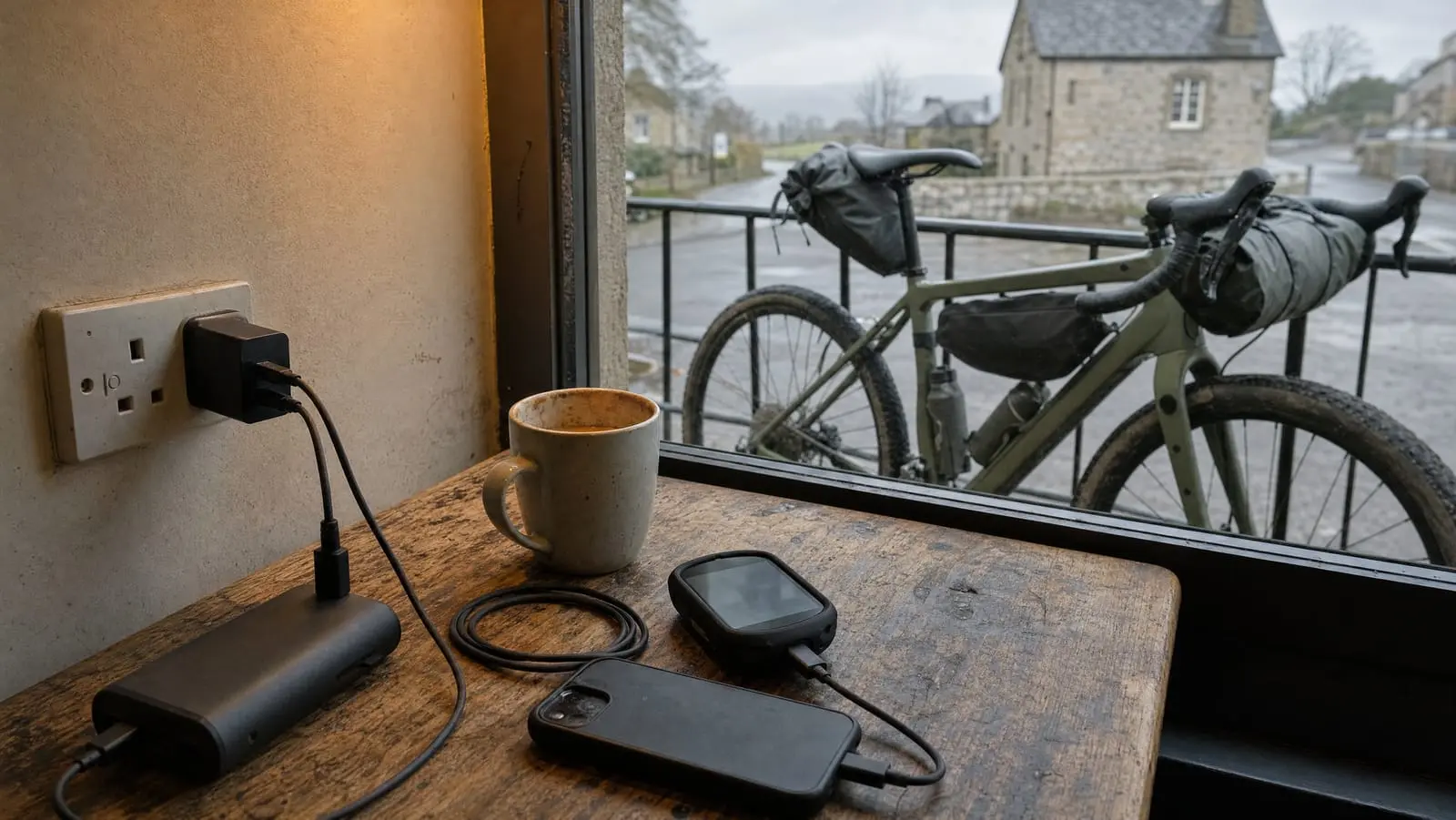
Cafes, public libraries, laundromats, campground shower and laundry blocks, grocery stores with seating, visitor centres, transit stations, hostels and bike shops. On a populated route you are rarely more than a day or two from one of them. The skill is not finding sockets. It is recognising them, and arriving able to use the forty minutes you actually get.
A rider with a dynamo makes power while pedalling. A rider without one buys it in short, scheduled bursts, and the system lives or dies on how much a single stop can swallow. Bank size, cable choice and charge order in bikepacking power and charging are all downstream of that constraint.
Charging on Route: Where the Sockets Actually Are
Sockets follow seated customers. Anywhere a business expects you to stay half an hour has power near the chairs; anywhere it expects you to keep moving does not. That one rule predicts most of the map.
| Place | Why it works | How reliable |
|---|---|---|
| Cafe or small-town diner | Seated customers, long dwell time, staff used to laptops | Good, if you buy something |
| Public library | Free, sheltered, staffed, usually quiet | Good, but policies vary and some limit charging time |
| Laundromat | You are there for an hour anyway, and sockets are plentiful | Good, though many are unattended |
| Campground shower or laundry block | Shaver and cleaner sockets near the sinks | A coin flip. Some are shaver-only or switched off |
| Grocery store with seating | Deli counters and in-store cafes often have outlets | Variable. Plenty have seating and no power |
| Visitor centre, park or trailhead building | Built for people waiting around | Good when open, which off-season may be rarely |
| Transit station | Waiting rooms and platforms increasingly have USB points | Variable, and USB-A points are often slow |
| Hotel, hostel or host | Every socket you want, overnight | The best charge of the trip. Plan around it |
| Bike shop | Sympathetic staff, and you may be buying a tyre | Ask. Never assume |
One honest warning about the outdoor ones. Exterior sockets on pavilions, restrooms and picnic shelters are often switched off at a panel inside the building, or removed entirely, and nothing about the faceplate tells you which. Treat any socket outside as a bonus, not a plan.
Libraries deserve their reputation, but they are not a free-for-all. One US public library's Electrical Devices and Outlet Usage Policy, approved by its board of trustees in January 2025, states that "Library outlets are primarily intended for library use" with "some limited use by the public" allowed, that charging time may be limited to ensure fair access, and that unattended items may be unplugged by staff and held at the nearest service desk for seven days. It also requires chargers to carry certification from a recognised testing laboratory such as UL, ETL or CSA, and prohibits charging transportation devices including e-bikes.
The Etiquette, Which Almost Nobody Writes Down
This is our judgment rather than published rule, but it decides whether the next bikepacker through town gets a socket at all.
Buy something. A coffee and a pastry is the rent on a 40-minute charge, and it is cheap rent. Ask first, even where the socket is obviously public. A staff member who said yes will defend you later; one who found out when they tripped over your cable will not.
Do not monopolise the one outlet by the door. Most cafes have one socket that everybody wants. Taking it for an hour with a single phone is worse behaviour than taking it for an hour with a four-port charger that a stranger can share.
Do not leave gear unattended. Beyond theft, policies anticipate it: the library policy above lets staff unplug anything left alone, and the University of Central Florida Libraries' outlets policy states that patrons "may not unplug any library equipment" and that cords "may not be draped across aisles, exit pathways."
Arriving Ready: the Top-Up Rhythm
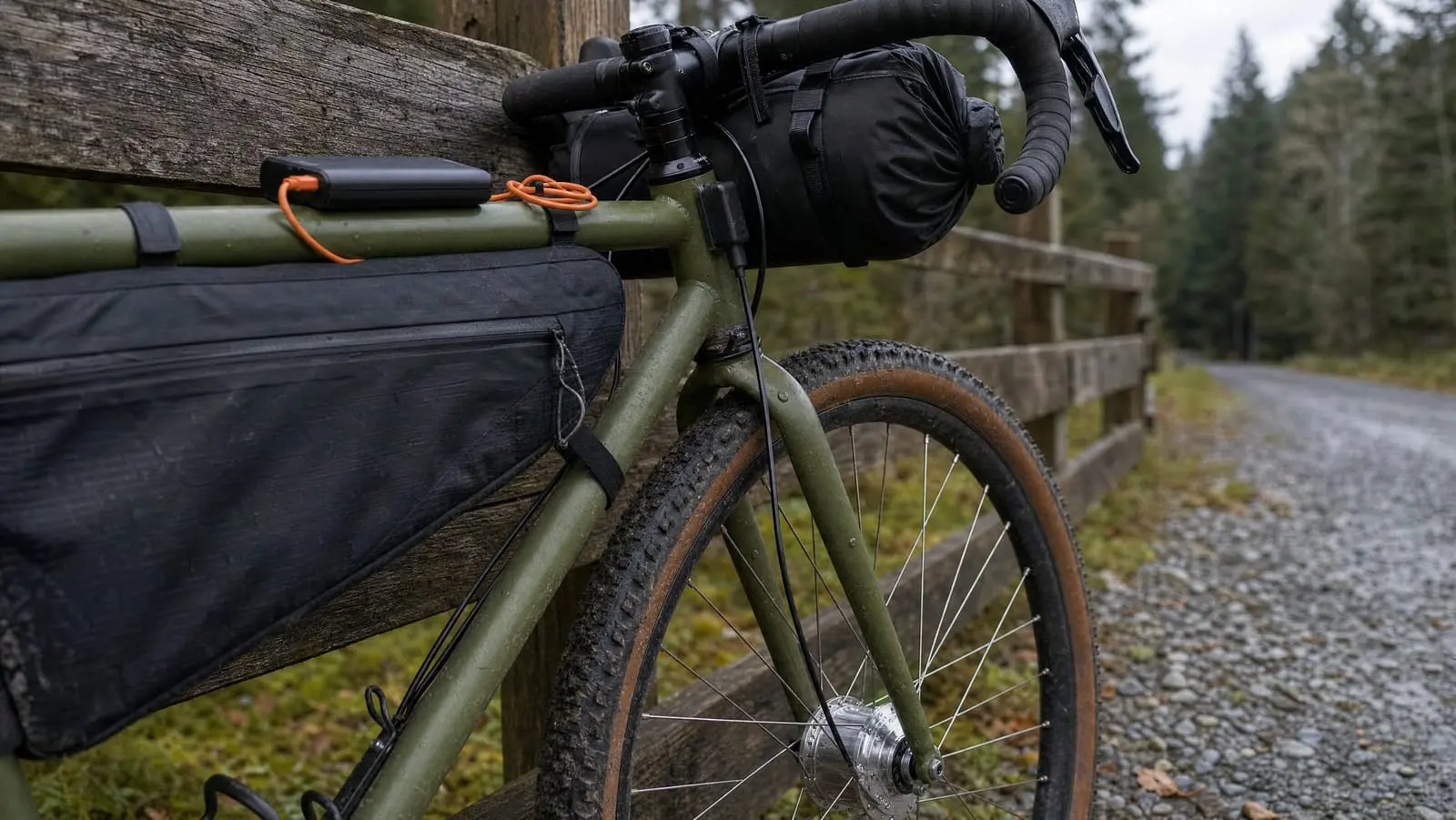
The rhythm that works is simple and almost nobody does it by default. The wall charges the power bank. The power bank charges everything else, later, while you ride.
The bank is the only item in your kit with the patience for a long, slow charge and the capacity to hold a whole day's budget. Your phone can be topped up in a tailwind. Your bank cannot be topped up from anything but a socket.
Arriving ready means the cables live in one pouch you can find without unpacking, the bank sits at the top of the bag rather than the bottom of a dry sack, and you know before you sit down which devices are low. Ninety seconds of digging is ninety seconds of charge.
When time is short, charge in the order that matters: the safety device first, then navigation, then the phone, then the luxuries. A satellite messenger is the one item where a flat battery changes the character of the trip rather than the comfort of it, so it gets the port before the headphones do.
The wall charges the bank. The bank charges everything else, later, from a jersey pocket.
Speed Is the Real Constraint
A cafe stop is 40 minutes, not four hours, and that changes which hardware matters. Work the arithmetic with the inputs visible.
A 10,000 mAh bank holds roughly 37 Wh at a nominal 3.7 V. At 20 W input, 40 minutes delivers 20 multiplied by two-thirds of an hour, so about 13 Wh before any conversion loss, or around a third of that bank. The same 40 minutes from a 5 W brick is about 3 Wh, which is under a tenth. The charger, not the stop, is what you are short of.
Published charge times line up with that. Anker's guide to charging a 10,000 mAh bank gives 6 to 10 hours from a 5 V 1 A (5 W) charger, 4 to 6 hours at 5 V 2 A, and 2.5 to 3.5 hours from an 18 W or faster USB-C PD or Quick Charge source. Note that the same page elsewhere says "around 3 to 4 hours" for an 18 W or 20 W charger, so treat these as ranges rather than specifications. Our arithmetic agrees with the shape of them: 37 Wh at 18 W is a touch over two hours in theory, and real-world losses push it towards three.
Three hours is more than you get. So the useful question is not "how long to full" but "how many watt-hours can I recover in the stop I was making anyway", which is the same currency we use in how much battery you actually need. If your budget runs near 18 Wh a day, two 40-minute stops at 20 W roughly cover it. The same two stops at 5 W come to under 7 Wh, about a third of it.
The Charger and the Cable
This is where a modest purchase buys real time. USB Power Delivery negotiates fixed voltages of 5 V, 9 V, 15 V and 20 V, and the USB Promoter Group's own announcement of PD revision 3.1 in May 2021 notes that before that update PD "was limited to 100W via a solution based on 20V using USB Type-C cables rated at 5A." Revision 3.1 added 28 V, 36 V and 48 V to reach 240 W, which is a laptop story. For us the whole game lives between 20 W and 65 W.
A gallium nitride multi-port charger in that band is small enough to forget about and lets one socket serve a bank, a phone and a head unit at once. The tradeoff is that total output is shared, not multiplied. j5create publishes a combination table for its 65 W three-port GaN charger showing that with all three ports occupied, the first USB-C port provides up to 45 W while the second USB-C port and the USB-A port share 5 V at 3.6 A. Retailer listings for other 65 W models show similar two-port splits, often 45 W plus 18 W or 45 W plus 20 W. Buy on the combination table, not the headline number.
The cable can undo all of it. The USB-IF's 5 A requirement for 100 W is the formal end of the scale, and explainers from cable vendors put the practical line lower: a 3 A cable at 20 V tops out around 60 W, and cables rated above that are supposed to carry an e-marker chip declaring it. The chain runs at the speed of its slowest declared link, so a 65 W charger, a thin unmarked cable from a petrol station and a fast bank will charge at the cable's pace. We would carry one known-good short cable per device plus one long one for awkward sockets, and treat the cheap replacement bought mid-trip as a temporary fix.
When There Is Genuinely Nothing
Some stretches have no answer. Four days between services, a shoulder-season route where the visitor centre and the campground laundry are both shut, a region where the grid itself browns out at night. There, no charging habit saves you and the fix is rationing, not hardware.
Rationing means doing less with the devices you have. Downloaded maps instead of live navigation is the biggest single lever, which is why offline maps when you have no signal is a power article as much as a navigation one. Longer tracking intervals on the messenger, the head unit's backlight off, aeroplane mode between checks. We have a separate piece on device power management on tour coming in this series; the short version is that behaviour beats capacity on almost every trip.
Crossing borders changes the plug and sometimes the voltage. Reolink's plug-type reference lists most of Europe at about 230 V on Type C, E and F plugs, the UK at 230 V on Type G, Japan at 100 V, and North America at 120 V on the Type A and B plugs Japan shares. Most USB chargers are rated for 100 to 240 V, so a plug adapter is normally enough, but that rating is printed on the charger and is worth reading rather than assuming. Cold shortens everything too, so a winter route needs a bigger margin than the same distance in June.
If you find yourself planning three trips in a row around socket scarcity, the honest conclusion is that you have outgrown the stop-based system. That is the moment for choosing between a dynamo hub and a power bank rather than buying a fourth cable.
Planning Charge Points Before You Go
Mark power the way you mark water. The resupply stops are already pinned when you build the route; add a note to each saying what socket you expect and how long you can sit there. Our resupply guide covers the town-stop planning this attaches to, and the two jobs overlap almost perfectly. A town day is a charge day.
Check opening hours against the shoulder season, not the summer listing. Note a second option in each town, because the one cafe with sockets is shut on Mondays somewhere. And give yourself one deliberate long charge every few days, usually a hostel or motel night, where the bank goes to full rather than to adequate.
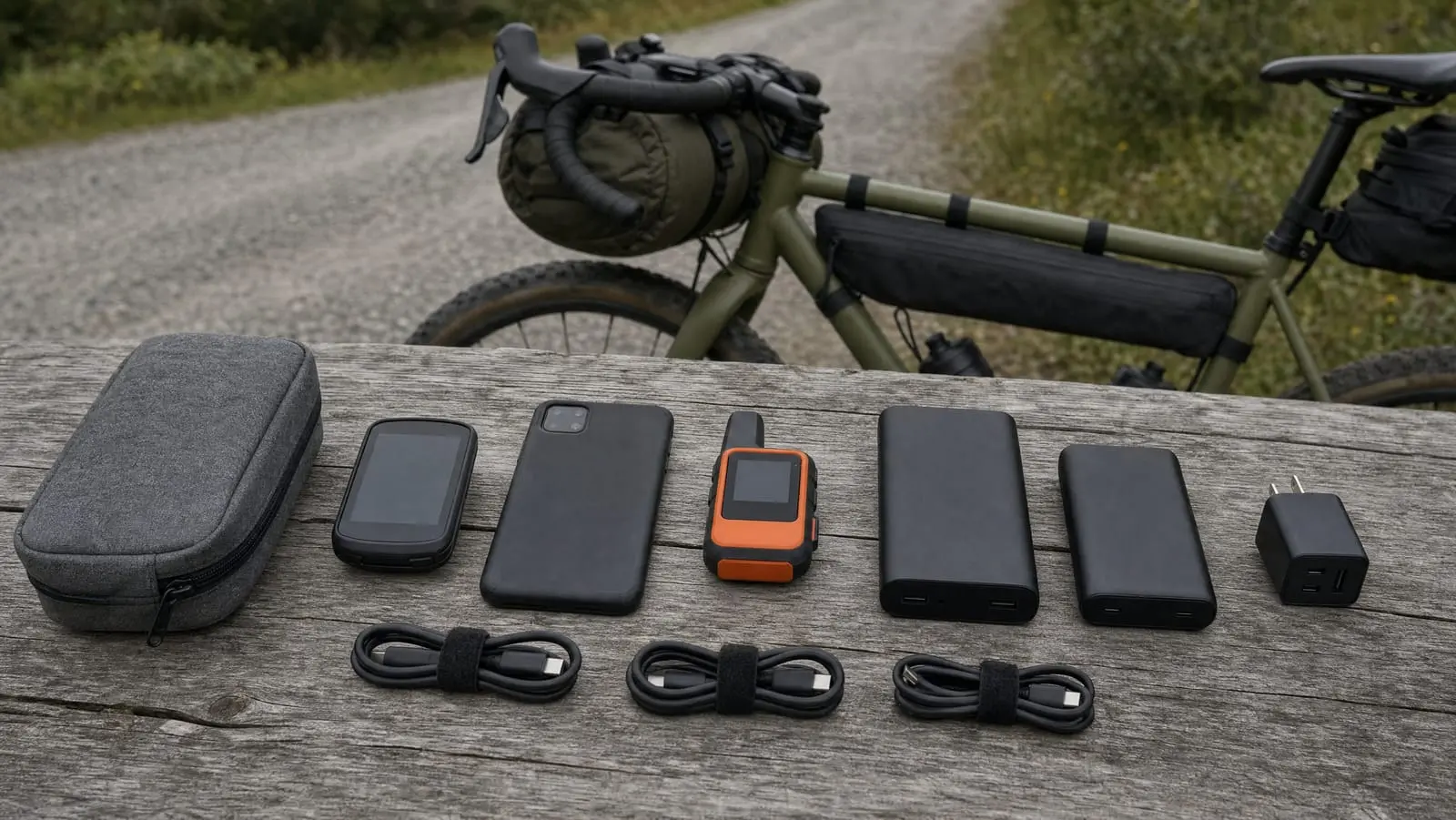
Then write the charging kit into your packing list as one pouch with a known weight: charger, adapters, one cable per device, one spare. Treating it as a single item is what stops it quietly growing into four chargers and a tangle.
What We Would Do
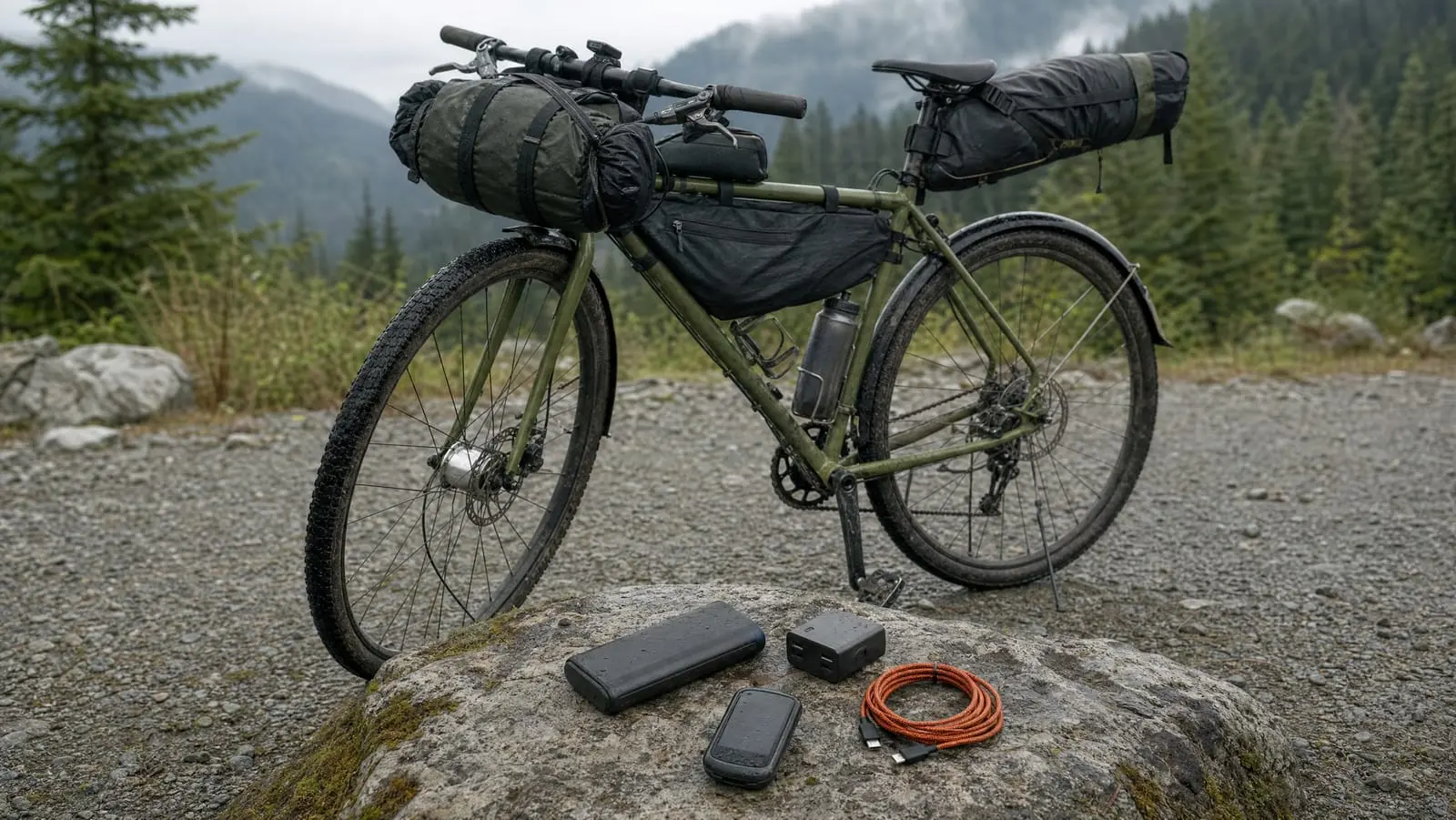
On a route through populated country we would carry a mid-size bank, a 30 W to 65 W GaN multi-port charger, a short extension and good cables, then stop thinking about power. The system is a rhythm, not a trick: the bank drinks from the wall while you eat, the devices drink from the bank while you ride, and the next town is a day or two away.
The failure mode is not running out of sockets. It is arriving at a good one with a 5 W brick, a tangled bag and 25 minutes, and leaving with nothing meaningful gained. Fix the charger, fix the pouch, and the sockets take care of themselves.
For how this fits with power budgeting, dynamo systems and the rest of the kit, start from our bikepacking power and charging guide.