Dynamo Hub vs Power Bank: Which Bikepacking Charging System Suits Your Trip
20+ years testing gear in Colorado backcountry
Dynamo Hub vs Power Bank for Bikepacking: The Short Answer
Ride long days, for many days, away from sockets, and the dynamo hub wins. Ride short days or short trips, and the power bank wins. The crossover sits at roughly six to seven hours of riding a day and about a week between mains outlets. Below those numbers a dynamo cannot earn back its weight, cost or drag.
That is the whole decision, and it is not about money. It is about how many hours a day you actually turn the cranks. A dynamo is a generator with a fixed cost per hour of riding and effectively infinite range. A power bank is a fuel tank with zero drag and a hard bottom. Everything else in your bikepacking power and charging setup follows from which of those two things your route needs.
The uncomfortable version: a dynamo bought for a weekend trip is almost always the wrong purchase, and a dynamo bought for a month-long remote route is almost always the right one. Riders arrive asking which is better. Below a certain daily mileage the honest answer is that a dynamo cannot cover its own charging overhead, and above a certain trip length a power bank big enough to do the job weighs more than the hub.
What Each System Actually Is, and What Each One Costs
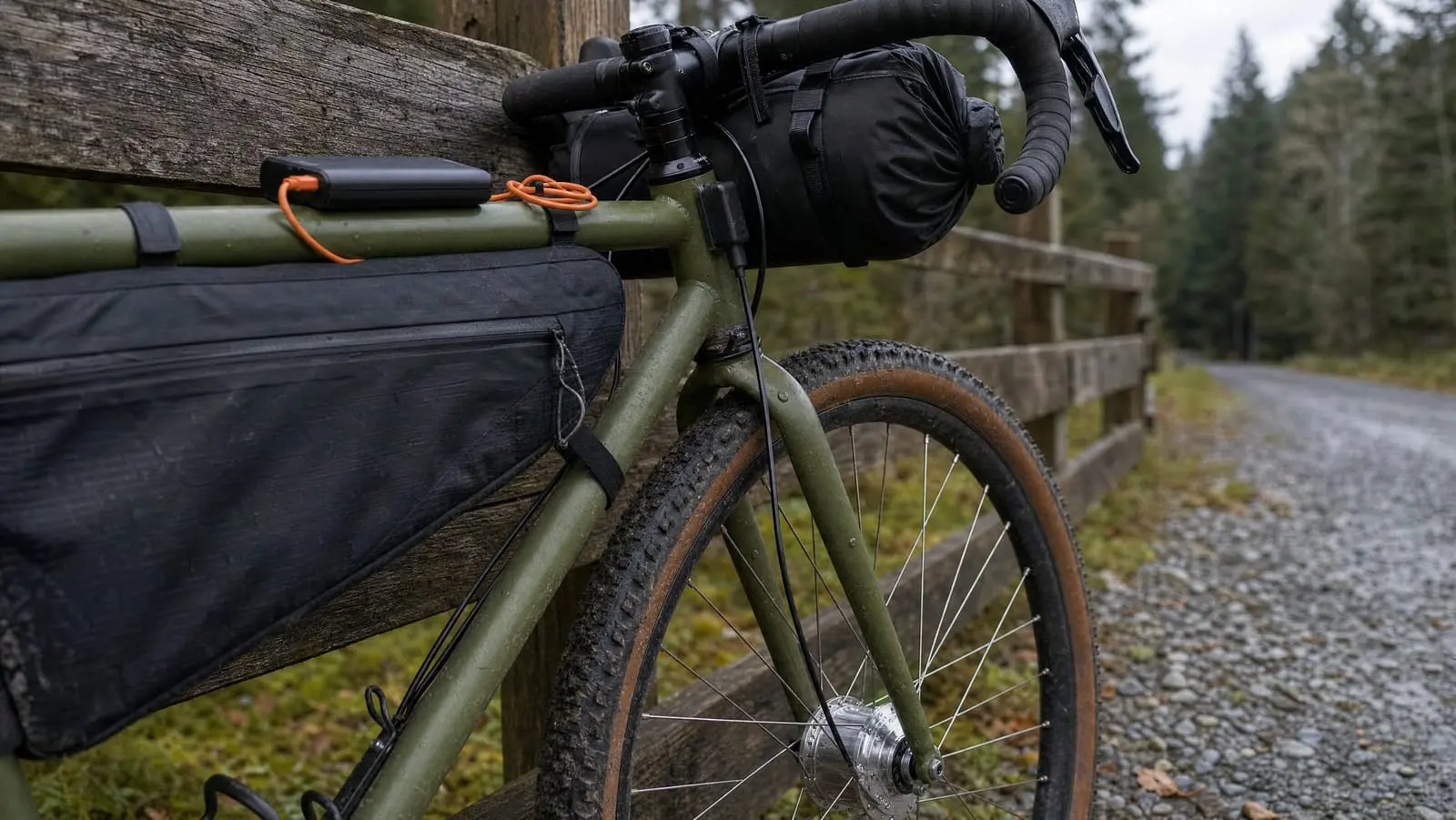
A hub dynamo is a small alternator built into your front hub. Most modern hubs are regulated to about 3 W at 6 V, with some reaching 6 W at 12 V, according to Wikipedia's hub dynamo entry. On its own it produces wild AC, so a dynamo-to-USB regulator converts and smooths it into something a device will accept.
Its costs are three, and only one is obvious. First, capital: hub, regulator, and usually a cache battery. Second, a wheel rebuild or a new front wheel, because the hub is the wheel. Third, drag — a real, permanent tax on every hour you ride.
That drag has been measured. CyclingAbout's lab test, which spins a dynamo wheel against a motor on a steel plate and subtracts a non-dynamo baseline, found drag with lights and chargers off running from 1.4 W to 1.9 W for a SON 28 across 10 to 30 km/h, against 1.9 W to 5.2 W for an SP PD-8 and 1.4 W to 4.5 W for a Shimano UR700, with the figures accurate to within about 1 W (CyclingAbout). Switch a bright light on and the load climbs steeply — the same rig reported 14.5 W at 15 km/h for a UR700 driving a Busch+Müller IQ-X.
A power bank is a sealed lithium cell with a converter on the front. Its costs are simpler: carried weight, a hard capacity limit, and the logistics of finding a socket. Its great virtue is that it adds exactly zero drag. Nothing it does slows you down.
A dynamo charges you by the hour. A power bank charges you once, in grams.
The Dynamo Case: Output at Realistic Touring Speeds
Dynamo output is a function of wheel speed, and the numbers at touring speed are smaller than most riders expect. CyclingAbout's rig measured a Shimano UR700 at its maximum power point producing 1.5 W at 5 km/h, 2.6 W at 10 km/h, 4.2 W at 15 km/h, 6.0 W at 20 km/h, 7.7 W at 25 km/h and 9.1 W at 30 km/h.
That is the theoretical ceiling. Through an actual charger you get less. The same test put a Forumslader V6 on that hub and measured 2.0 W at 10 km/h, 2.8 W at 15 km/h and 4.7 W at 20 km/h. The honest planning figure for a loaded bike at a genuine 15 km/h is therefore under 3 W, nowhere near the 9 W you see on a fast descent.
Output also plateaus. Hubs are regulated, so once you are above their rated speed you are not harvesting proportionally more. Retailer listings for the SON 28 state it reaches rated output at about 16 km/h in a 700c wheel, against about 19 km/h for the lighter SONdelux (SJS Cycles). The practical consequence is that a dynamo rewards duration, not speed. Eight slow hours beats two fast ones.
What the dynamo genuinely buys you is range that does not run out and lights that never die. On a route where resupply is food and water only, that is worth real weight. We will cover the hub choice itself in the best dynamo hubs for bikepacking, and the regulator choice in the best dynamo USB chargers, because the charger matters at least as much as the hub — the measured gap between pairings is the difference between charging a phone at 13 km/h and needing 18 km/h.
The Power Bank Case: Usable Capacity Is Not Rated Capacity
For most trips, the power bank is the correct answer, and it is not close. The tradeoff is that you are carrying every watt-hour you will use, and when it is gone it is gone.
Start by distrusting the number on the case. Anker's own support page works it through: a 10 Ah cell at 3.7 V is 37 Wh, which at 5 V is 7.4 Ah, and after conversion losses at "typically around 82 percent efficiency" the effective capacity a device can use is about 6,068 mAh (Anker). Converting that back to energy with Wh = mAh / 1000 x V gives 6.068 Ah at 5 V, or about 30 Wh of usable energy from a 10,000 mAh bank — roughly 60 percent of the headline 10,000 mAh.
Now weigh it. Retailer listings put Anker's PowerCore II 10000, a 37 Wh bank, at 195 g (Galaxus). Against 30 Wh usable, that is about 6.4 g per usable watt-hour. That single number is the one to carry around in your head, because it converts any power budget directly into grams.
The power bank also wins on every failure mode that matters. It works at 0 km/h, while you sleep, in a tent, on a bus. It has no spokes to true and nothing to short out in the rain. If you are choosing the bank itself, we go through capacities and ports in our guide to picking a portable charger for your phone and GPS.
The Crossover: Show the Sums
Pick a daily draw. We will use 20 Wh a day as a worked example — a phone topped up, a head unit kept alive, and a light or two. Your real figure may be half or double that, and getting it right is the whole exercise, so start with how much battery you actually need and substitute your own number into the sums below. Head units vary enormously in appetite; our round-up of cycling computers for bikepacking is a reasonable place to see the spread.
Break-even in riding hours. At the measured 2.8 W a Forumslader V6 delivered from a UR700 at 15 km/h, covering 20 Wh takes 20 / 2.8, about 7.1 hours of riding a day. Push to 20 km/h and the measured 4.7 W cuts that to about 4.3 hours. Drop to 10 km/h and the measured 2.0 W pushes it out to 10 hours. A three-hour evening ride at 15 km/h yields about 8.4 Wh — under half a day's budget. This is why a dynamo on a weekend trip is a net loss.
Break-even in grams. At 6.4 g per usable watt-hour, 20 Wh a day costs you about 128 g of power bank per day. Schmidt lists the SON 28 hub itself at about 440 g, so on hub mass against bank mass the batteries overtake the hub at roughly 440 / 128, about 3.4 days. Be honest about that figure, though: the dynamo system also needs a regulator and a cache battery, and you only pay the difference between the dynamo hub and the plain front hub it replaces. Add those back and the real mass crossover lands closer to a week of genuine off-grid riding.
| Trip | Energy needed at 20 Wh/day | Power banks, approx. | Our call |
|---|---|---|---|
| Weekend, 2 days | 40 Wh | ~260 g | Power bank, no argument |
| One week, a socket mid-trip | ~60-80 Wh carried | ~400-500 g | Power bank |
| One week, no sockets at all | 140 Wh | ~900 g | Dynamo if you ride 6+ hours daily |
| One month off-grid | 600 Wh | ~3.8 kg | Dynamo |
| Remote and open-ended | unbounded | impossible | Dynamo, only answer |
The bottom row is the real case for a dynamo. It is not that the hub is lighter on a given trip — it is that a dynamo's capacity does not have a bottom, so a route with no known end does not have a battery calculation at all.
When the Answer Flips Regardless of the Maths
Cold. Battery capacity falls in the cold while a generator does not care.
Very slow or technical riding. Dynamo output tracks wheel speed, and CyclingAbout's test found the 2.5 W smartphone charging threshold requires about 13 km/h with a UR700 and an Igaro D1, rising to about 17 to 18 km/h with other hub and charger pairings. A route averaging 9 km/h on chunky doubletrack may spend most of the day below the threshold entirely.
Hike-a-bike. Pushing generates nothing. A route with hours of carrying per day is a power bank route no matter how many days it lasts.
Electrically hungry setups. If you are running a bright dynamo light and charging, you are splitting a very small budget. For most riders, a rechargeable light plus a bank is simpler than a dynamo trying to do both, and our overnight bike light round-up treats that choice directly.
The device that must not go flat. If a satellite messenger is your emergency plan, it gets its own reserve. Neither system changes that.
Not wanting to rebuild a wheel. This is a legitimate reason, not a failure of nerve. A dynamo means a wheel build or a new front wheel, plus a connector that has to survive weather and vibration. Some riders simply do not want another system to maintain, and that preference is worth more than a few grams.
What We Would Do
Weekends and sub-week trips with any socket access. A power bank, every time. At about 6.4 g per usable watt-hour, two or three days of autonomy costs a few hundred grams. The tradeoff is that you are rationing from day one, and on a long cold weekend you may ration harder than you expected.
One to two weeks, mostly rural, occasional cafes. Still a power bank — one larger bank, charged at every opportunity. The tradeoff is route dependence: your charging plan is now a list of places that have to exist and be open.
One month or longer off-grid, 6 or more riding hours a day. The dynamo, decisively. At 20 Wh a day, a month of carried battery is roughly 3.8 kg, and no hub weighs that. The tradeoff is 1.4 W to 1.9 W of permanent drag on a good hub, plus the capital cost and a wheel build — and you still carry a cache battery.
Open-ended or expedition routes. The dynamo, and it is not really a comparison. The tradeoff is complexity in a place where a failed connector is genuinely inconvenient, so carry a small bank as backup regardless.
Short, slow, technical riding or heavy hike-a-bike. A power bank, even on long trips. The dynamo simply will not spin fast enough to pay.
The useful reframe is that these are not competitors. A dynamo is a slow trickle that never stops; a bank is a fast reserve that does. Most riders who end up with a hub still carry a bank, which tells you what each thing is actually for. For the full system — budgets, device draw, cables and chargers — see our complete guide to bikepacking power and charging.