Bikepacking Power and Charging: The Complete Guide to Staying Charged Off-Grid
20+ years testing gear in Colorado backcountry
Your Bikepacking Power and Charging Setup Starts With Three Numbers
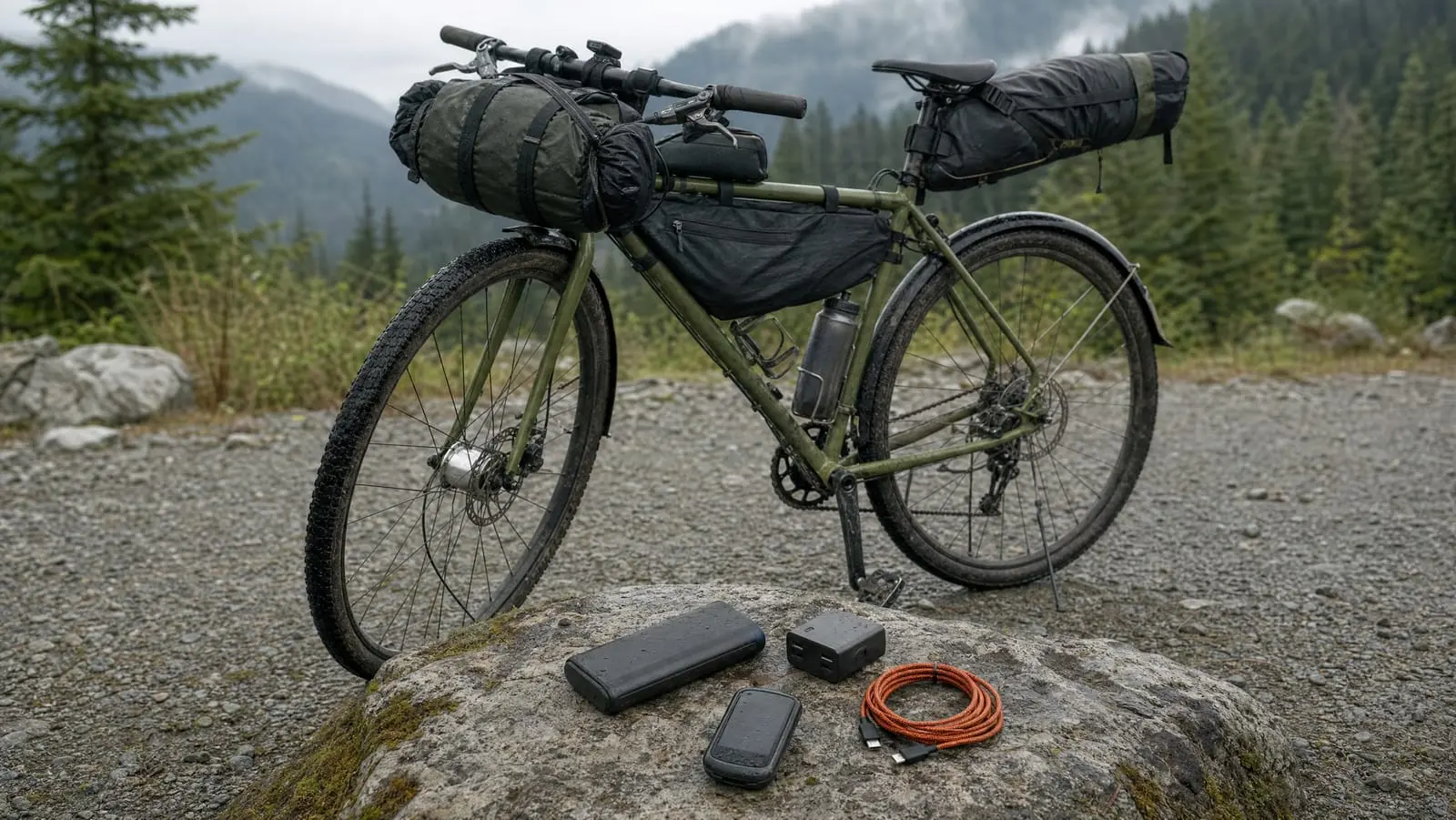
A bikepacking power and charging setup is arithmetic before it is hardware. Work out how many watt-hours your devices burn per day, how many hours a day you actually ride, and how many days you will go without a wall socket. Those three numbers decide whether you need a bigger battery, a dynamo hub, or nothing new at all.
Two failure modes show up again and again. The first is a dead GPS on day three, wired to a power bank that was never big enough to cover the gap — capacity bought by feel instead of by number. The second is a dynamo wheel built for a tour whose daily mileage was too low to charge anything useful, which is an expensive way to add drag to a bike.
Both are budgeting errors, not product errors. No purchase fixes either one. Get the three numbers first and the hardware choice is close to automatic.
Dynamo Hub or Power Bank: The First Decision
The honest framing of dynamo hub versus power bank is not which one is better. It is which one matches your riding pattern. A dynamo makes power while the wheel turns, so it rewards long days at moderate speed. A power bank holds a fixed lump of energy, so it rewards short trips, slow trips, and trips that pass a resupply town every few days.
Start from the rating. A standard hub is 6 V and 3 W, which CyclingAbout describes as 0.5 A of AC, becoming closer to 5 V at 0.5 A once a regulator has made it usable. Even if you held that output for six hours you would harvest something on the order of 15 to 18 Wh — and in practice less, because conversion is lossy. CyclingAbout puts the efficiency of a high-quality dynamo hub at around 50 to 60 percent at low power — riding at 10 to 20 km/h — increasing to 70 to 80 percent at 30 km/h. The charger then takes its own cut: in CyclingAbout's varying-speed test the best unit in the group, the Forumslader V5, retained about 66 percent of the power created.
Against that, a 10,000 mAh power bank carries about 37 Wh of cell energy, which is the conversion Anker itself publishes for a pack that size at a nominal 3.7 V. On a three-day trip, the battery wins on weight, cost and the number of things that can break. On a three-week trip it loses somewhere around day four, and keeps losing.
A dynamo is a subscription to small amounts of electricity. A power bank is a lump sum.
The drag question matters less than forum arguments suggest, but it is real. CyclingAbout's drag test measured the Schmidt SON 28 at 1.4 to 1.9 W of resistance from 10 to 30 km/h with the light and USB charger switched off, the lowest of the four hubs it ran, against a general no-load range across hubs of 1 to 5 W depending on speed and model. Switch a light on and the gap widens: above 20 km/h with a Busch und Müller IQ-X running, CyclingAbout measured the SON 28 at 3 to 4 W less drag than the Shutter Precision PD-8 and the Shimano DH-UR700. DT Swiss's own technology page says the added resistance of its dynamo hub remains below 1 W up to 30 km/h with the lights off, and that at 15 km/h delivering a standard 6 V, 3 W output, 4.2 W of your rolling power is used to run the lights.
We read that as a straightforward trade: a few watts of your legs in exchange for electricity you do not have to carry. If you only ride weekends, that trade never pays off, and our existing guide to picking a portable charger for your phone and GPS is the cheaper answer.
Working Out Your Power Budget
To work out your bikepacking power budget, list every device, find its battery energy in watt-hours, then estimate the fraction of that battery you will actually spend per day. The conversion is Wh = mAh / 1000 × V, so a 1,250 mAh cell at 3.6 V is 1250 divided by 1000, times 3.6, which is 4.5 Wh.
Real published numbers, where makers publish them:
- Satellite messenger. Garmin's inReach Mini 2 owner's manual lists a rechargeable, built-in 1,250 mAh lithium-ion battery, and quotes endurance in days rather than watt-hours. At a nominal 3.6 V that cell works out at about 4.5 Wh, our conversion rather than Garmin's — a rounding error next to a phone, which is exactly why there is no excuse for letting one go flat. Our roundup of satellite messengers for bikepacking covers which ones sip and which ones do not.
- Phone. Apple's EU energy label gives the iPhone 17 Pro as 4,252 mAh, a figure MacRumors reads as the eSIM-only variant, and Macworld, reporting a leak of Chinese regulatory filings, lists that same 4,252 mAh cell at 16.558 Wh. So a phone is worth nearly four satellite messengers, and navigating from it all day is the single most expensive line in most budgets. See what that costs in practice in our look at bikepacking navigation apps.
- Head unit. Most makers publish run time rather than cell capacity. Wahoo's own tech specs for the ELEMNT BOLT 3 give battery life as up to 20 hours and no cell capacity at all. Garmin does the same thing with the Edge 1050: the published numbers are run times — up to 20 hours in demanding use and up to 60 hours in battery-saver mode — with no cell capacity given, so that one has to be budgeted in hours rather than watt-hours. Compare claimed run times across the field in our cycling computer roundup and our guide to dedicated GPS units.
- Light. Rechargeable lights rarely publish capacity either. Budget from claimed runtime in the mode you will really use, not the lowest setting on the box, and read our notes on lights for overnight bikepacking first.
Now build the day. Suppose you spend 60 percent of a 16.5 Wh phone on navigation and photos, which is about 10 Wh. Add a head-unit top-up, call it 5 Wh. Add a couple of watt-hours for the messenger and 6 Wh for a light on a dark morning. That is roughly 23 Wh a day. Five days off-grid is about 115 Wh of delivered energy — and because a power bank does not deliver its sticker, a single 10,000 mAh brick is not in the conversation.
Finding Power on Route
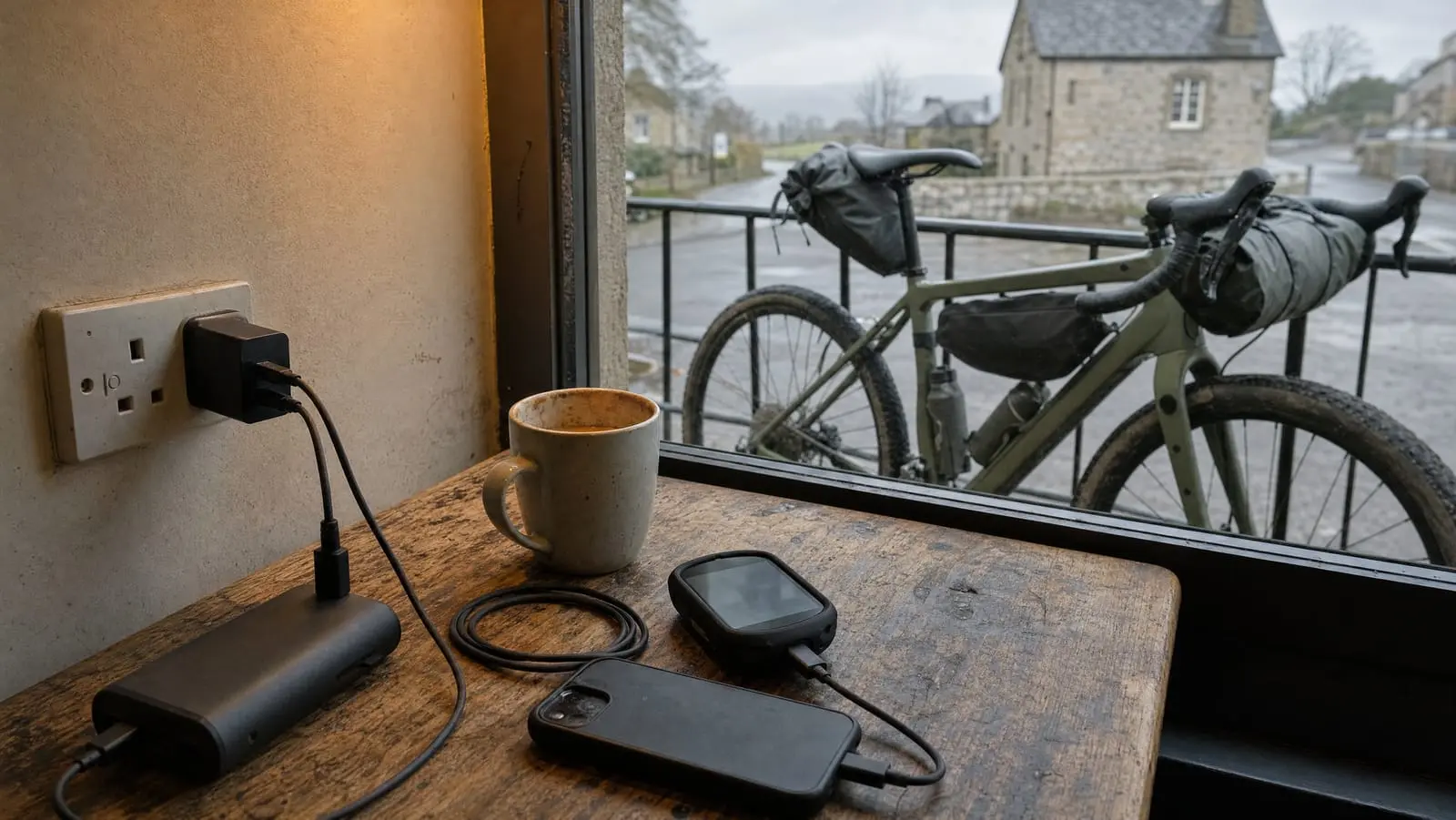
There is nothing clever about charging your devices on route — it is a logistics problem more than a gear problem. The sockets exist — cafés, libraries, laundromats, campground amenity blocks, visitor centres, bus stations, hosts. What decides whether you use them well is how fast your kit can swallow energy during a stop you were going to make anyway.
An hour in a café is a real resource. A multi-port USB-C brick that can charge a phone, a head unit and a power bank at once turns a lunch stop into most of a day's budget. A single-port 5 W charger turns the same hour into a phone that is 40 percent full and a power bank that is untouched.
So plan the route around sockets, not around sunshine. On a gravel tour through populated country, we would carry a modest power bank and a good wall charger and never think about a dynamo. On a route where resupply is four days apart, the stop-based strategy stops working and generation starts to make sense.
Keep a reserve that you never spend on navigation. The case for it is not convenience, it is the scenario in our guide to emergency communication with no cell signal — the day when the only thing that matters is that one device still has charge.
Cables, Bricks and the Charging Kit Itself
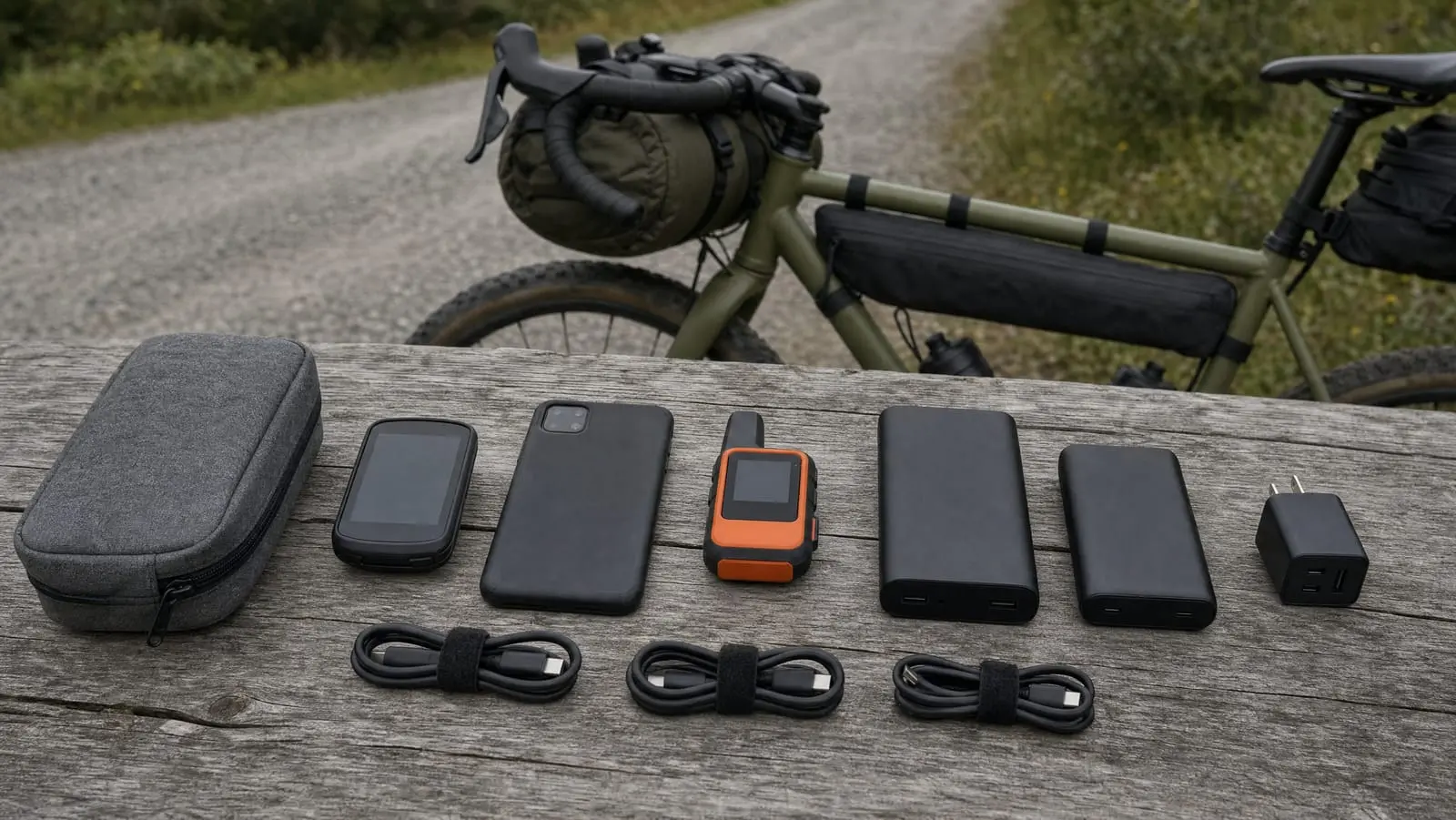
What makes a bikepacking charging kit worth carrying is that it is small, boring and redundant in exactly one place. Ours would be a multi-port USB-C wall charger, one short cable per device, one long cable for awkward sockets, and a spare of whichever cable type most of your devices use.
Cables are the failure point. They flex, they get rained on, they live in a frame bag with grit, and the connector that dies is always the one you need. A spare cable weighs a few grams and is the cheapest redundancy in the entire system.
Keep charging gear in one pouch, and keep that pouch dry. Micro-USB and USB-C ports both corrode happily, and a phone that will not take a charge because its port is damp is indistinguishable, at 9 pm in a tent, from a phone with a dead battery.
Installing and Wiring a Dynamo System
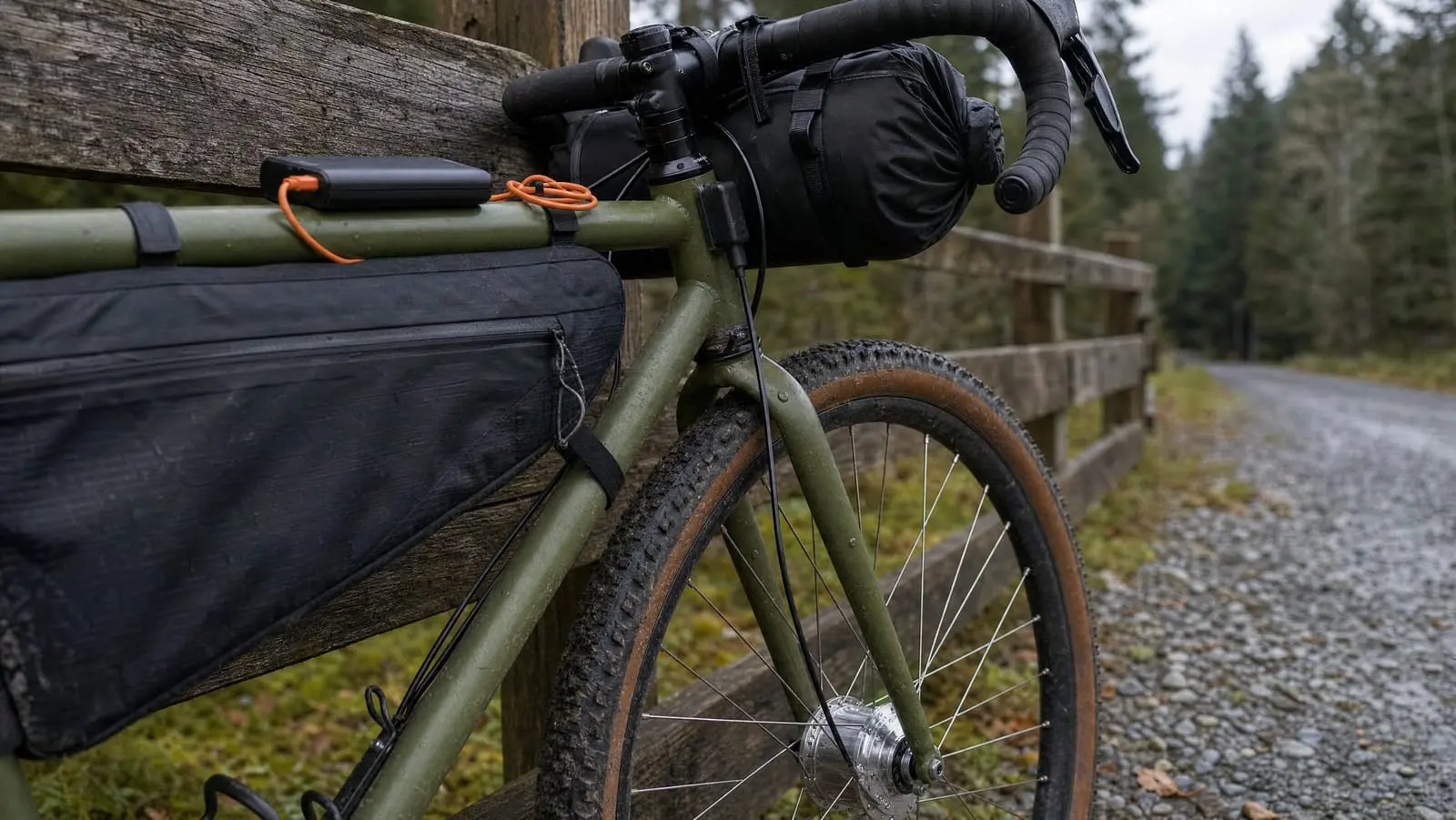
There are two jobs in installing and wiring a dynamo hub. The first is a wheel build, because the hub has to be laced into a front wheel with the right spoke count and length. The second is wiring, which is where most home installs go wrong.
Plan the axle standard before anything else. Thru-axle and quick-release versions of the same hub are not interchangeable, and it is worth noting that CyclingAbout's own drag test — the one that used real lights and chargers rather than the resistors of the earlier Fahrrad Zukunft test — states that it used quick-release hubs only, so thru-axle figures may differ.
Then plan the cable run. The wire leaves the hub at the axle, so it needs enough slack to let the fork move and the wheel come out, routed along the fork leg and secured often enough that it cannot flap into the spokes or the rotor. Strain relief at both ends matters more than neatness. Riders tend to report connector faults rather than hub faults.
Mount the regulator where you can see it and reach it: a stem bag, a top-tube bag, or a bracket on the bars. You will want to unplug it, and you will want to know whether its indicator is lit. Keep the connection weather-protected without sealing it so tightly that you cannot service it on the roadside.
Dynamo USB Chargers and Regulators
The hub only makes wild alternating current. The regulator is what turns it into something a phone will accept, and it is the component that decides how much of your pedalling actually reaches a battery. Comparisons of the best dynamo USB chargers come back to the same point: they differ enormously at low speed and converge at high speed.
CyclingAbout's compilation of Fahrrad Zukunft measurements is the clearest data we have seen. At 15 km/h, the Cinq Plug5 Plus returned 3.5 W, the Forumslader V5 and Lumi-Con P5 about 3 W, and the Sinewave and Busch und Müller E-Werk about 1.75 W — those last two from Igaro's conversions rather than the Fahrrad Zukunft bench, which CyclingAbout says track the lab figures within about 10 percent for the Sinewave. At 20 km/h the spread narrows to roughly 2.75 to 4.75 W, and by 25 km/h the Forumslader V5 reached 6.5 W. Most chargers manage about 1 W at 7 to 10 km/h, and the best hit 2 W at 11 to 13 km/h.
Those low-speed numbers are the whole story, because CyclingAbout notes that below roughly 2 W a dynamo charger cannot provide power to most devices. That is why a dynamo needs a cache battery rather than a direct connection. The battery accepts whatever trickle arrives, including at traffic lights and on climbs, then delivers a clean, steady current to your device. Several chargers build the buffer in — CyclingAbout lists the Cinq Plug5 Plus at 1,100 mAh and the Forumslader V5 at three 700 mAh cells.
Making the Battery You Have Last Longer
Good device power management on tour is the highest-return part of this whole system, because saved watt-hours weigh nothing. A rider who halves consumption has done more than a rider who doubled capacity, and paid less.
The big levers, roughly in order of effect:
- Kill the radios. Airplane mode with location still on is the standard trick. A phone hunting for a tower it cannot find is the most expensive idle state there is.
- Navigate offline. Downloaded maps avoid both the data and the search. Our guide to offline maps with no signal is as much a power article as a navigation one.
- Turn the screen down and off. Brightness and screen-on time dominate phone draw. A head unit with the backlight off and a sensible auto-sleep timeout costs a fraction of a phone doing the same job.
- Reduce sampling. Lower-frequency GPS logging and less frequent live tracking both cut draw, at the cost of track detail.
- Use the right light mode. Running a 1,000-lumen setting on a quiet gravel road burns a budget you will want at 2 am. Our notes on night riding safety gear make the case that runtime is a safety number, not a convenience one.
Cold is the factor riders underestimate. Lithium cells deliver less of their capacity when they are cold, so a battery that covered three days in September will not cover three days at minus 5 °C — plan for it using our cold weather bikepacking guide, and sleep with your power bank and phone inside the bag rather than in the frame bag.
Solar: When It Earns Its Weight
There is a marketing problem at the heart of solar charging for bikepacking — the rated wattage is measured in conditions you will never ride in. PVEducation gives the standard test conditions behind that number as 1,000 W per square metre of sunlight, a cell temperature of 25 °C and an Airmass 1.5 spectrum, and notes that in the field the module will likely be at a higher temperature, so the actual power will be lower. We are not going to put a percentage on what you will really get, because nobody credible publishes one for a panel bungeed to a seat pack.
A panel strapped to the top of a bag is close to the worst case. It is horizontal rather than aimed at the sun, and it is partly shaded by you. Shade is brutal: PVEducation's worked example for a series-connected module has shading one cell by half pulling the output power of the whole module down to half, and completely shading one cell taking the module to zero. Heat hurts too — PVEducation puts a module's operating temperature at 45 °C under the nominal conditions used for NOCT, 20 degrees above the temperature it was rated at.
So we would not buy solar to cover a daily deficit on a riding tour. Where it earns its weight is a narrower case: long trips with low daily mileage, where a dynamo barely spins and you have hours of camp time to lay a panel out properly in the open. Desert routes, long-layover expeditions, and anything where you are stationary in strong sun for half the day.
If that is not your trip, the honest ranking is wall sockets first, dynamo second, solar third.
Choosing a Dynamo Hub
Shortlists of the best dynamo hubs for bikepacking are short, and that is a good sign — this is mature hardware. Schmidt SON, Shimano and Shutter Precision cover most of the market, and the choice comes down to drag, weight, serviceability and axle standard rather than output, because output is standardised at 6 V and 3 W.
Drag is where the money goes. In CyclingAbout's drag test, the Schmidt SON 28 was the lowest-drag unit with the light and USB charger switched off, at 1.4 to 1.9 W from 10 to 30 km/h, against a general no-load range across hubs of 1 to 5 W. Over a 100 km day that difference is small but not nothing, and it is permanent — the hub is in the wheel whether you are charging or not.
The tradeoffs are straightforward. The premium hubs cost substantially more and are heavier than a non-dynamo front hub by a noticeable margin; the budget hubs cost less, weigh less in some cases, and give up some efficiency and some long-term bearing serviceability. We would pay for the low-drag option on a bike that will tour for years, and take the cheaper hub on a bike that will do one long trip.
Two practical filters before you buy. Confirm the axle standard and rotor interface match your fork, and confirm you can get bearings or a service kit in your part of the world. A hub you cannot rebuild is a wheel you will rebuild.
Flying With Batteries and Power Banks
Of everything here, flying with power banks and bike batteries is the part most likely to be out of date by the time you read it, because the rules moved during 2026. Check your carrier's current page before you pack. What follows is accurate as of October 2026.
The watt-hour bands are the stable part. The FAA's PackSafe guidance puts spare lithium batteries, including power banks and portable chargers, in carry-on baggage only — never in checked bags — and says that if a carry-on is gate-checked, the spares must come out and stay with you in the cabin. Batteries of 0 to 100 Wh are allowed with no quantity limit when they are for personal use, though for power banks specifically the ICAO cap below now sits on top of that. The 101 to 160 Wh band needs approval from the airline and is capped at two spare batteries per person. Above 160 Wh is not permitted in passenger baggage at all. The FAA's own arithmetic for working out which band you are in is volts times amp-hours.
What changed in 2026 is the layer above those bands. ICAO added Addendum No. 1 to its Technical Instructions, applicable from 27 March 2026. Its wording is short. Power banks must be carried as carry-on baggage; they must not be recharged while on board the aircraft; they should not be used to recharge a portable electronic device while on board; and no more than two power banks may be carried per person. Note that the first two are requirements and the third is a recommendation. That two-bank cap sits alongside the separate spare-battery limit rather than inside it — IATA's guidance to operators describes the addendum as separating power banks out from spare batteries. The UK Civil Aviation Authority states the same rules for passengers. Airlines may be stricter, and several got there first.
As reported by ABC News, Virgin Australia from 1 December 2025 and Qantas, QantasLink and Jetstar from 15 December 2025 barred passengers from using or charging a power bank on board, with the Qantas Group rules explicitly covering in-seat USB and power outlets. Both carriers allow two power banks per passenger; Qantas sets a 160 Wh ceiling per bank, while Virgin allows up to 100 Wh outright and 100 to 160 Wh with prior approval. Lufthansa Group's own notice to customers says that from 15 January 2026 power banks may neither be used nor charged on board its airlines, and aviation trade press reports the same in-flight use ban at Korean Air and the other Hanjin Group carriers from 26 January 2026. Korean Air also requires power banks to be kept out of the overhead bin.
How to Choose, and When Not to Bother
Run the three numbers, then pick the cheapest thing that covers them.
One to three nights, towns on route. Carry a power bank and a good multi-port wall charger. Nothing else. This is most trips most people take, and a dynamo here is a purchase in search of a problem.
Four to seven nights, thin resupply. Size the power bank from your measured daily draw plus a day, remembering that the sticker mAh is cell capacity and Anker puts conversion efficiency at roughly 80 to 90 percent for a good unit. A 20,000 mAh pack is about 74 Wh of cells, and at 85 percent — the middle of Anker's range — that is about 63 Wh at the output. That last step is our arithmetic, not Anker's; Anker's own worked example runs a 10,000 mAh pack at 37 Wh of cells and 30 to 35 Wh usable. Budget on the 63, not the 74.
Long trips, consistent daily distance. This is dynamo country. If you ride six or more hours a day at speeds comfortably above 13 km/h, generation beats carriage, and a charger with an integrated buffer removes most of the annoyance.
Low mileage, high sun, lots of camp time. Solar, as a supplement, with a power bank doing the actual storage.
The case for carrying nothing but a big power bank is stronger than the internet suggests. It has no drag, no wiring, no wheel build, no connector to corrode, and it works at 4 km/h up a hike-a-bike. For a weekend or a week, that is the right answer, and the money saved buys a better sleep system. Wherever your charging kit lands, write it into our bikepacking packing list as a single pouch with a known weight, so that next trip you are editing a system rather than guessing again.
Explore the full series
- Dynamo Hub vs Power Bank: Which Bikepacking Charging System Suits Your Trip — Generate power as you ride or carry it in a battery: the honest break-even point between the two.
- How Much Battery Do You Actually Need? Bikepacking Power Budgeting — The watt-hour maths that turns a guess about battery capacity into a number you can pack.
- Charging Without a Dynamo: Finding Power on Route — Cafes, libraries, campground outlets and the top-up rhythm that keeps a no-dynamo setup alive.