Flying With Bikepacking Gear: TSA Rules for Stoves, Fuel, Batteries, and CO2
20+ years testing gear in Colorado backcountry
Flying With Bikepacking Gear: The TSA Rules in Three Sentences
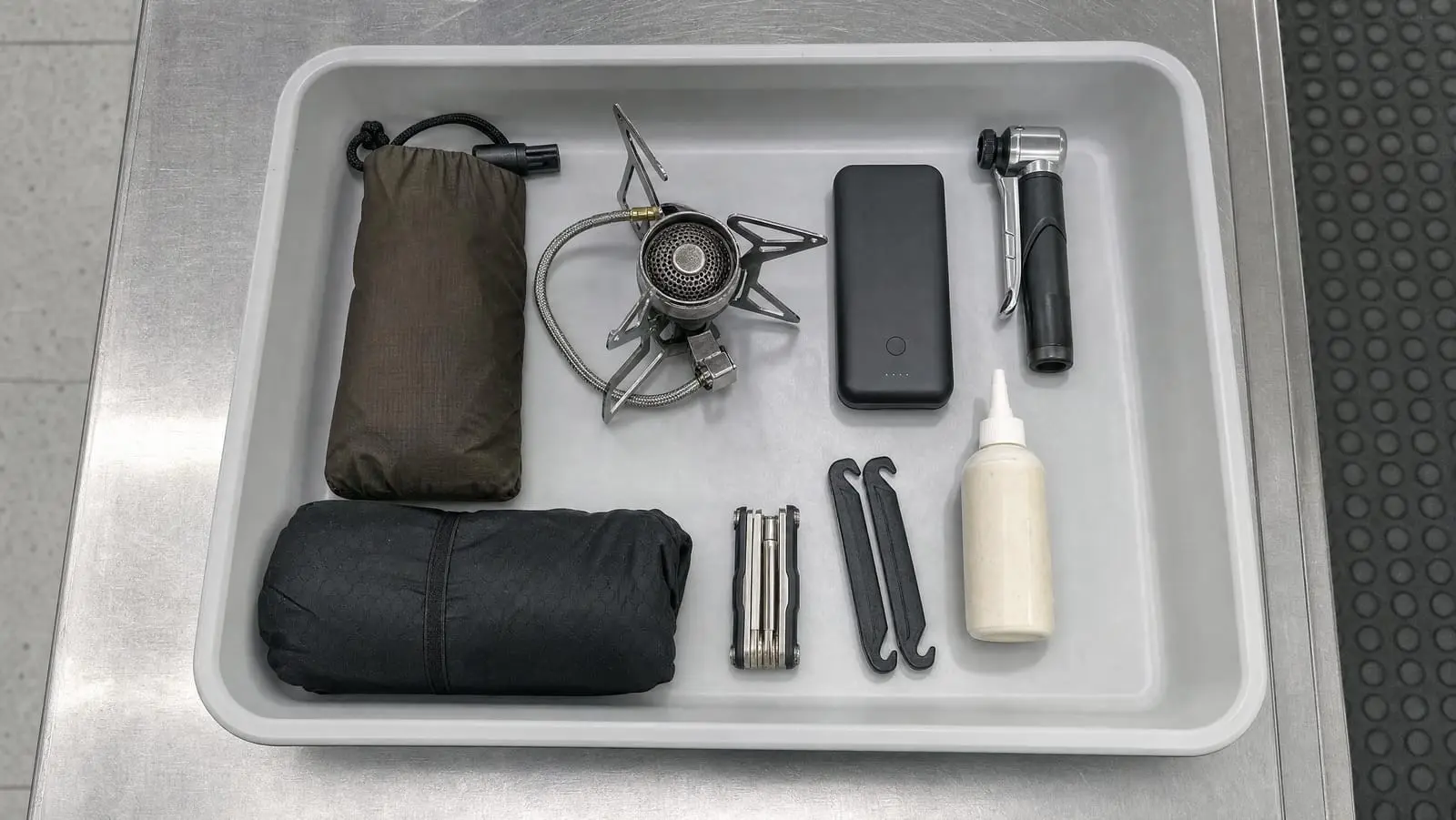
Three rules cover almost everything in a loaded bikepacking kit. Fuel never flies — not in your carry-on, not in your checked bag, in any quantity. Compressed gas flies only if it is provably empty. Lithium batteries ride in the cabin, never in the hold.
Learn those three and you can reason your way through the rest of the checkpoint. Get one wrong and you lose a stove, a power bank, or forty minutes at bag drop.
Everything below is sourced to the FAA's PackSafe pages, the TSA's item pages, or a carrier's published policy, current as of August 2026. Rules move — verify yours the week you fly. For the rest of the logistics, start with our bike travel guide.
One caveat runs through every TSA item page: the final decision rests with the officer in front of you (tsa.gov). Technically correct is not the same as through.
Can You Fly With a Camping Stove? Yes — the Fuel Is the Problem
The stove is legal. The fuel is not, and neither is the smell of fuel.
According to the FAA's PackSafe guidance on fuels, all forms of camp stove fuel are forbidden in both carry-on and checked baggage, and that prohibition extends to containers and equipment holding residual fuel. The TSA allows stoves in either bag only if they are empty of all fuel and cleaned so that no fuel vapors or residue remain (tsa.gov).
"Empty" is not the standard. "Empty and odorless" is, and an officer's nose is a legitimate instrument.
Canister stoves are the easy case
An isobutane screw-top stove has no tank of its own. The burner head is brass and steel, so it packs with no drama, and the canister — the actual hazmat — stays home. You are only ever solving a sourcing problem on arrival, never a purging problem at the airport.
Threaded canisters are typically easy to find in cities across North America, Europe and Japan, but in our experience availability thins fast outside them, so confirm one shop near your start. Our guide to bikepacking stoves and cooking systems covers which burners earn their space.
Liquid-fuel stoves are the hard case
A white-gas stove has a bottle, pump, fuel line and jet, and every one has been wet with naphtha. Purging is possible — burn it dry, run the pump empty, wash the bottle, then leave both uncapped in open air for a day or more. Even then you are asking an officer to disagree with their own nose, and the FAA's outdoor equipment page notes some airlines will not accept used camping equipment that has had fuel in it, regardless of how well it has been purged. If you own both, fly the canister stove.
Alcohol and solid fuel
An alcohol burner is the least objectionable stove here: the fuel evaporates without oily residue, and the burner is a piece of metal. Solid fuel tablets are still fuel — the FAA's fuels page names compressed canisters, liquid fuels and solid fuel tabs together as camp stove fuels forbidden in both carry-on and checked baggage (FAA PackSafe).
Lithium Battery Rules for Flights: Do the Watt-Hour Math
Batteries are where the airline cares more than the checkpoint does. Per the FAA's PackSafe page on lithium batteries, spare — meaning uninstalled — lithium ion and lithium metal batteries, including power banks and battery charging cases, must travel in carry-on baggage only. They are prohibited in checked bags, full stop. A battery installed in a device can go either way. A spare cannot.
Converting mAh to watt-hours
Power banks are sold in milliamp-hours. Aviation runs on watt-hours. The conversion is arithmetic:
Wh = mAh × V ÷ 1000
Use the cell's nominal voltage — usually 3.6 V or 3.7 V for lithium-ion — not the 5 V or 20 V printed next to the USB port (UGREEN). A 20,000 mAh pack at 3.7 V works out to 74 Wh (Anker), comfortably legal. A 27,000 mAh pack lands right on the line.
The three tiers
From the FAA's lithium battery guidance, which states that 0 to 100 Wh is allowed, 101 to 160 Wh requires air carrier approval, and anything exceeding 160 Wh is forbidden (PackSafe, FAA passenger resources):
- Up to 100 Wh — carry-on, no approval needed, reasonable quantities for personal use.
- 101 to 160 Wh — carry-on with airline approval, no more than two spares per passenger.
- Above 160 Wh — forbidden in passenger baggage entirely.
The FAA also requires terminals be protected against short circuit, by the manufacturer's packaging or by taping terminals and bagging each battery separately — and if your carry-on is taken at the gate or planeside, every spare battery and power bank comes out of that bag and stays with you in the cabin. American Airlines says the same in its own policy: lithium batteries must be carried in carry-on bags only, and spare batteries must be individually protected (aa.com).
If it powers something, it flies with you. If it is a spare, it flies with you and it flies taped.
Dynamo hubs are easy. E-bike batteries are not.
A dynamo hub is a generator, so it raises no hazmat question. A dynamo cache battery does, and plays by the rules above.
E-bikes are where this falls apart. BikeRadar notes many airlines ban e-bikes outright while others accept the bike only with the battery removed and left behind, and gives the arithmetic: a Specialized Turbo Levo SL battery is 320 Wh, a Brompton Electric battery 300 Wh (BikeRadar). Both sit far above the 160 Wh ceiling, and no paperwork fixes that. Realistically you rent at the destination or ship the battery as regulated dangerous goods.
Carriers are getting stricter, fast
Southwest became the first US carrier to restrict power banks in May 2025, and as of April 20, 2026 limits passengers to one power bank, requires it to stay in plain sight rather than an overhead bin, and bars using in-seat power to recharge the bank (Paddle Your Own Kanoo). That wave followed a January 2025 fire aboard an Air Busan A321, which investigators concluded was most likely started by a power bank inside an overhead bin as the aircraft prepared for departure (ABC News).
For a rider running a GPS, headlamp, messenger and phone, one bank is a real constraint — our guide to choosing a portable charger for your phone and GPS works through the capacity math.
CO2 Cartridges on a Plane: Empty, or Not at All
The TSA's CO2 cartridge page states that apart from personal medical oxygen, only an empty compressed gas cylinder may be carried, and it must be clearly visible to the officer that the cylinder is empty (tsa.gov). A 16-gram threaded bike cartridge is an opaque sealed steel slug. Nobody can see inside it, so the exception does not apply to you — not in carry-on, not in checked.
One allowance trips people up because it sounds like it covers inflators. The FAA permits a life jacket or similar self-inflating safety vest holding up to two small nonflammable gas cartridges, plus two spare cartridges per device — and even that requires airline approval (FAA PackSafe). That is written around safety devices, not tire inflators. Do not stretch it.
Tools and Sharps: What Rides in the Cabin
Per the TSA's multi-tools page, a multi-tool with a knife of any blade length is prohibited in carry-on and must be checked, while one with scissors shorter than 4 inches may go in carry-on. The TSA's separate tools page adds that tools 7 inches or shorter may be allowed in carry-on while anything longer must be checked — that never overrides the blade ban — and the multi-tools page says sharp objects in checked bags should be sheathed or securely wrapped to protect baggage handlers and inspectors.
For a bikepacking kit, that shakes out as:
- Bladeless multi-tool, chain tool, tire levers, short wrenches — usually fine in carry-on, though checking them costs you nothing.
- Multi-tool with a knife, any folding knife, scissors over 4 inches — checked, wrapped.
- Torque wrench, cassette lockring tool, long hex keys — checked once they measure over 7 inches.
Simplest is to put every tool in the bike box, which is going in the hold anyway. See how to pack a bike for flying for what belongs in the case, and the bike travel tool kit for the reassembly-day list.
Liquids: Sealant, Chain Lube, Sunscreen and Aerosols
Two rule sets apply here, and confusing them is how people lose things.
In carry-on, the TSA's 3-1-1 rule caps each container at 3.4 ounces (100 ml), all of it in one quart-sized bag, one bag per passenger (tsa.gov). A standard bottle of tubeless sealant exceeds that, so it gets decanted or it does not fly in the cabin.
In checked baggage, the FAA's medicinal and toiletry allowance applies: no more than 2 kg (70 oz) or 2 L (68 fl oz) per person, with no single container over 0.5 kg (18 oz) or 500 ml (17 fl oz) (FAA PackSafe). Sunscreen, sanitizer and aerosol deodorant count against that pool.
The catch is flammability. The FAA's aerosols page is explicit that flammable aerosols which do not qualify as a medicinal or toiletry article are forbidden in both carry-on and checked baggage (FAA PackSafe). Aerosol chain lube, degreaser and aerosol sealant are the likeliest to land on the wrong side of that line. Read the can — if it says flammable and you do not put it on your body, assume it stays home.
Our advice is to fly with none of it. Top up before you box the bike — see tubeless tire maintenance — and carry a plug kit, not a bottle.
Flying With Bear Spray: The Rule People Get Wrong Most Often
Bear spray is banned from both bags. Not just the cabin — both.
The TSA lists bear spray as prohibited in carry-on and in checked bags (tsa.gov). The reason is size and formulation. The FAA's sprays and repellents guidance permits one self-defense spray per passenger in checked baggage only, capped at 118 ml (4 fl oz), with no more than 2 percent by mass of CS or CN tear gas and a positive means of preventing accidental discharge — a recessed button alone does not count. A typical bear spray canister is well past 4 ounces, which is why that allowance does not rescue it.
So buy bear spray where you are riding and leave it there. Outfitters across bear country sell it, and some airports and hostels run donation bins. Plan that purchase into day one the way you plan fuel. Our wildlife safety guide for bikepackers covers how much it changes your risk profile.
One more distinction from the same FAA page: repellent sprayed on skin or clothing falls inside the toiletry exception, while insecticides sprayed into the air or at insects do not. Your DEET bottle is fine. Wasp killer is not.
Non-US Flights, Codeshares and Connections
Everything above is the United States. Leave it and two things change.
First, the operating carrier's rules apply, and they can be stricter than the regulator's floor. IATA's 2026 guidance for passengers travelling with lithium batteries keeps the familiar shape — spares in carry-on only, airline approval and a two-spare cap in the 100 to 160 Wh band — but on power banks it is tighter than the US floor: a maximum of two power banks, none over 100 Wh, no recharging a power bank from aircraft power, and no stowing one in an overhead locker. It also states that airlines may impose more stringent conditions of their own (IATA). So a 130 Wh power bank an FAA-only reading would let you carry with approval is simply not accepted on an IATA-aligned carrier.
Second, the US self-defense spray allowance does not travel. The same FAA page notes that international aviation regulations (ICAO/IATA) prohibit self-defense sprays in both carry-on and checked baggage (FAA PackSafe), so on a non-US itinerary pepper spray stays home too.
On a multi-leg trip the strictest carrier governs your packing, and screening happens again at each international transfer — an item that cleared in Denver can still be pulled in Frankfurt. Screenshot the policy page for the leg you expect to be questioned on. Checked-bag allowances shift between carriers too; we cover the money side in airline bike fees and policies.
The Night-Before Checklist
Run this at home, not at the curb. It takes about fifteen minutes.
- Empty every pocket of every cabin bag — the forgotten multi-tool, a stray cartridge, a lighter.
- Smell the stove. Any fuel odor and it is not flying. Decide now, not at the checkpoint.
- Read the watt-hour rating on every battery. Under 100 Wh, cabin. Over 100 Wh, call the airline. Over 160 Wh, it stays.
- Tape the terminals on spares and bag them individually, as the FAA requires.
- Move every blade into the bike box or checked bag, wrapped.
- Pull all CO2 out of every bag, including the seat pack you have not opened since spring.
- Decant or drop the liquids — under 3.4 oz for the cabin, or buy on arrival.
- Check the operating carrier's dangerous goods page for each leg, not the marketing carrier's.
- Write the buy-on-arrival list: fuel, cartridges, lube, sealant, bear spray, plus one shop near your start.
What This Actually Costs You
Almost nothing, if you plan for it. A fuel canister, a couple of cartridges and a bottle of sealant are a day-one errand. The expensive version is finding out at the checkpoint.
The rules that will not bend: fuel and residue never fly, CO2 flies only if visibly empty, spare lithium batteries fly in the cabin or not at all, blades go in the hold, and bear spray does not board. The rest is a judgment call by an officer trying to move a line — a good argument for boring bags.
Sort the hazmat first, then the box, then the fees. The rest of that sequence is in our full guide to traveling with your bike.