The Best Panniers for Bikepacking: Off-Road Ready Picks
20+ years testing gear in Colorado backcountry
The Best Panniers for Bikepacking, Answered First
The best panniers for bikepacking are the ones whose hooks lock rather than rest, because off-road it is vibration, not rain, that we would expect to end a pannier first. Our overall pick is the Ortlieb Back-Roller Plus at $195.00 as of September 2026. The budget pick is the MOSISO 20L Bike Panniers, 2 Pack at $44.21 as of September 2026. We earn a commission on purchases made through the links below, at no extra cost to you.
Everything below follows from one uncomfortable fact: almost every pannier on the market was drawn for pavement — commuting, groceries, credit-card touring on sealed roads. Those bags answer the question "is it waterproof?" A loaded bikepacking rig asks something else — will the mounting hardware still be attached after six hours of washboard?
Mounting and closure are what separate a pannier that works off-road from one that ends up as litter beside a forest road, and they are the two things most roundups skip in favour of litres and colourways. If the rack question is unsettled, start with bikepacking racks and panniers; this guide assumes a rack is already going on the bike.
Do You Want Panniers at All?
Be honest about the route before you spend anything. Panniers are the wrong default for technical singletrack: they widen the bike, they catch brush and rut edges, and they hang weight outboard where it argues with every direction change. If your route is chunky singletrack, buy soft bags instead and stop reading this. Our complete bikepacking bag and storage guide covers that system properly.
They earn their keep on the other trip: long, loaded, mostly gravel and dirt road, where volume and fast access beat agility. Resupply is four days out, you are carrying a stove, water and a winter sleeping bag, and you want lunch in hand ten seconds after stopping.
Numbers make the volume case clear. Bikepacking.com's side-by-side of a traditional four-pannier touring kit against a standard bikepacking kit puts the touring setup at 102 litres of capacity for 11 lb of bags and racks, against 42.7 litres for 3.9 lb of soft bags. Roughly 7 lb of dead weight buys roughly two and a half times the space. On a two-night gravel loop that is a bad trade; on a three-week route with cold nights and long food carries it is obviously a good one.
So it is a route decision, not a gear decision. Panniers also carry an older tradition with them — the one we pull apart in bikepacking versus bike touring. A dedicated comparison of bikepacking bags versus panniers is coming as a separate piece.
Panniers are not a worse way to carry gear. They are a different bet: more volume and faster access, paid for in width, weight and hardware you have to watch.
What Actually Matters Off-Road
Here is our ranking of what to care about, which is close to the inverse of how most listings are written. Mounting first, closure second, volume third, fabric fourth.
Pannier mounting hardware and anti-sway come first
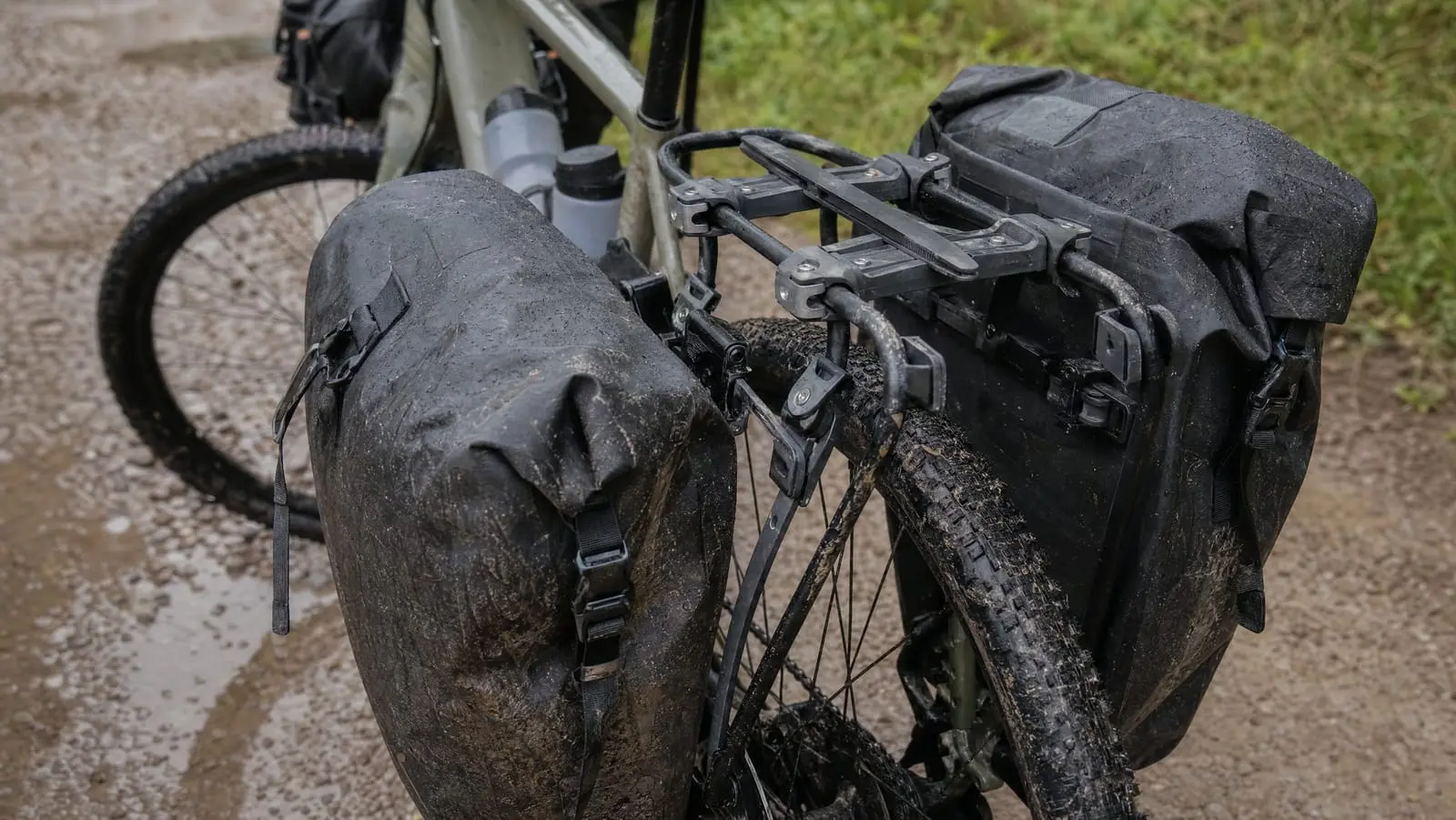
A pannier attaches with two upper hooks over the rack's top rail plus some lower anchor that stops the bag swinging. On pavement almost anything works. Off-road, the difference between a hook that rests on the rail and a hook that closes around it is the difference between a system and a hope.
CyclingAbout's off-road pannier index is blunt about how hook systems fail: "They can rattle on the trail. They can unhook and drop a pannier. They are susceptible to damage." That is an argument for hooks with a positive latch and a lower anchor that is actually loaded rather than dangling.
This is why a 3-point connection matters once the surface goes rough. Two upper hooks control lift; a third lower point controls sway. Without it the bag rotates around the rail on every impact, working the hooks and the rack bolts at once. Ibera lists a 3-point interlock specifically to reduce side swing — the most off-road-relevant claim in this lineup.
Check hook sizing before you buy — it is the most common compatibility miss. North St. Bags sells its panniers in three hook sizes, 3/8 inch (9 mm), 1/2 inch (12 mm) and 3/4 inch (16 mm), and notes that the most common top rail on a road bike rack is around 9 mm. Heavy-duty and e-bike racks use fatter tube. Measure your rail, then read the bag's fit range.
Holster style panniers sidestep the argument entirely — the holster stays on the rack and a dry bag drops into it — and CyclingAbout points riders who want both security and fast removal that way. None of our five picks is a holster system.
Closure: roll-top versus flap
A roll-top closes by folding the bag's throat over itself and clamping it: slower, slightly less usable volume, much harder to flood, because there is no zipper at the top waiting for water to run into it.
A flap closes fast. You can get a jacket out one-handed at a junction without unclipping anything, which is why touring riders keep buying them. But a flap sheds water the way a roof shingle does — fine when rain falls down, less convincing when it comes sideways for two hours while road spray arrives from below.
Our rule: if the trip is long enough that a wet sleeping bag would end it, take a roll-top. For two nights in settled weather, a flap is a fair trade.
"Waterproof panniers" are a spectrum, not a category
Three genuinely different products share the same word on Amazon: a sealed bag that keeps water out on its own, a water-resistant bag that handles rain for a while, and a bag plus a rain cover — which is a water-resistant bag with an admission attached. The listings blur all three, so read what each maker actually claims. Ibera lists these panniers as waterproof and also includes an all-weather rain cover for each bag — that combination points to shower resistance plus a cover, not a sealed bag. Thule states an IPX4 rating for the Shield. That number has a specific meaning: IPX4 testing sprays water at the enclosure from all possible angles for ten minutes, and a device certified to IPX4 "is not considered waterproof". It is splash and rain resistance. It is not submersion, and it is not a dry bag.
We will not tell you how any of these bags perform in a four-hour downpour, because we have not ridden them. We will say that fabric sits downstream of closure — see bikepacking bag materials and durability — and that abrasion matters most where the bag rubs the rack and where it hits the ground when the bike falls over, which it will.
Volume per side, and why symmetry beats total
A 30-litre pair is really two 15-litre bags that have to be packed against each other, not one 30-litre space. Total capacity is the number on the listing; symmetry is the number that decides how the bike rides.
What matters less than the marketing suggests
Colour. External stretch pockets — excellent for a wet jacket, a liability for anything you would miss. Laptop sleeves belong on a commuter bag, and shoulder straps are nice in a hostel and irrelevant on the bike. None of it should outrank a locking hook.
The Five Bags We Would Buy
Five picks, in the order we would consider them. We have not ridden, loaded or weighed any of these: every specification below is the maker's, and our contribution is judgement about which trip each suits.
Ortlieb Back-Roller Plus — the touring benchmark
Ortlieb Back-Roller Plus
The default answer for long, loaded, remote riding, and the bag other panniers get compared against. The listing describes robust, waterproof Cordura fabric, 3M Scotchlite reflectors and an integrated inside pocket, at a stated 20 litres.
- Robust, waterproof Cordura fabric per the listing
- 3M Scotchlite reflectors
- Integrated inside pocket
- 20 litres stated capacity
The tradeoff is money plus a piece of homework. At $195.00 as of September 2026 it is by far the most expensive option here, more than four times the MOSISO. And the listing is ambiguous about quantity: the title reads "Bag" in the singular at 20 litres for one colourway, so confirm quantity and colour before buying — the price only makes sense once you know what arrives in the box.
Thule Shield Bike Pannier Bag, 13L — for genuinely wet riding
Thule Shield Bike Pannier Bag, 13L
A pair of 13-litre bags that attach to and release from 8-16 mm rack tube without adapters, which covers most rear racks including chunkier ones. Three interior pockets keep small items from migrating to the bottom.
- Includes two 13L bags
- Fits 8-16 mm racks without adapters
- IPX4 splash and rain rating
- Light loops and reflective panels
Two honest limits at $169.95 as of September 2026. IPX4 is splash and rain resistance, not submersion, so do not read it as a dry bag. And 13 litres a side is small for multi-day loads — 26 litres total is a credible weekend, not a week with cooking kit. The wide 8-16 mm fit range removes the adapter lottery, which is the quiet reason to choose these. Stock was down to three units when we pulled this data, so availability may have changed.
Ibera Panniers Bike Bags 30L (Pair) — the value pick
Ibera Panniers Bike Bags 30L (Pair)
The only pair here whose listing claims a 3-point interlock connection to reduce side swing, which is the single most useful mounting feature for rough surfaces. A clip-on quick-release system means no straps to thread at every stop.
- 3-point interlock reduces side swing
- Quick release clip-on, no straps required
- Rain cover included for each pannier
- Top zippered pocket plus two inside pockets
Read the water claim carefully at $149.99 as of September 2026. Ibera lists these as waterproof and ships a rain cover for each bag, and shipping a cover is a maker telling you what the fabric alone will not do. The 19.8 lb figure is Ibera's stated capacity for the pair as listed, not something we measured.
The real catch is lock-in: the quick-release is optimised for Ibera's own PakRak Carrier Plus+, and the listing also says it fits most carriers. Both statements can be true without being the same promise, so confirm fit against the rack you own.
MOSISO 20L Bike Panniers, 2 Pack — the budget pair
MOSISO 20L Bike Panniers, 2 Pack
Two 20-litre bags for less than a quarter of what the Ortlieb costs, with a flap closure that opens fast at a roadside and what MOSISO lists as a waterproof polyester shell. The cheapest credible way to find out whether you actually like riding loaded.
- 2-pack with 20L main compartment each
- Waterproof polyester material
- Two metal hooks plus quick-release buckle
- Flap closure for fast access
The tradeoff, plainly: two metal hooks and a flap is the least secure mounting arrangement in this lineup, and no rain cover is listed. Fine on gravel and pavement, and the first thing we would expect to rattle loose on a long rough descent — which is why the hook check below is not optional with these. Buy them for a first loaded trip near phone signal, not for a remote route where a dropped bag is a real problem. At $44.21 as of September 2026, the difference is better spent on a rack that does not flex.
ROCKBROS 15L Bike Rear Rack Bag — the rack-top alternative
ROCKBROS 15L Bike Rear Rack Bag
Not a pannier. This is a trunk bag that sits on top of the rack with fold-out side pockets for extra capacity, for riders who want more volume without widening the bike at hub height. Foam padding in the base and sides holds its shape when it is half empty.
- 15L maximum with removable divider board
- Fold-out side pockets expand capacity
- Rain cover and carrying strap included
- Strap mounting fits most racks, fat and e-bikes included
At $35.69 as of September 2026 this is the honest answer for a rider doing overnighters on mixed surfaces who wants one obvious place for the bulky things and nothing brushing trailside vegetation. The fold-out pockets let you run small most of the time and larger on resupply day.
Two costs. It straps and buckles on rather than hooking, so removal means undoing webbing instead of lifting a bag off a rail. And it carries its load high, right above the rack platform — the opposite of what you want. Keep it light and dense items low elsewhere.
What Bike Panniers for Touring Buy You: Volume, and How to Split It
Total capacity is the least interesting number on the listing. What matters is how the load divides, left against right and front against rear, because a bike carries balanced weight far better than it carries a lot of weight.
Start with left and right. CyclingAbout's packing guide puts it simply: "Ideally both your left and right sides of your bike will be equally weighted", and it is equally direct about height — "Pack your weight low in your panniers. That is, heavier items at the bottom of the bags wherever possible." No scale required. Lift both loaded bags, one in each hand, and move things until they feel the same. An asymmetric load makes the bike pull toward the heavy side, and you spend the day correcting without noticing.
Inside each bag: dense and heavy at the bottom and toward the wheel, light and bulky on top. Water, fuel and tools low; a puffy jacket anywhere. Same mechanics we work through in how to pack bikepacking bags for weight distribution.
Front against rear is where riders overload the back of the bike. Alpkit's touring load guide suggests roughly 60 percent of the load over the rear and 40 percent over the front with four panniers; other guides reverse those figures, so treat it as a starting point. The principle is what matters — a rear-only setup puts everything behind the saddle and makes the front end vague on loose climbs. If you are packing a rear pair to bursting, read up on front racks for bikepacking instead of buying bigger rear bags. A guide to the best rear racks for bikepacking is coming in this series too.
Then be honest about what fills the space, because panniers get chosen for volume and then filled because the volume exists. Sleep system, shelter and cooking kit drive most of the bulk — see bikepacking camp gear, sleep systems and cooking — and if a 30-litre pair is not enough, the kit list is the problem.
Making Panniers Survive the Route
Panniers fail at their fasteners. That is where attention goes.
Check the hooks and rack bolts at every resupply. Both upper hooks, the lower anchor, every bolt holding the rack to the frame. This is the same habit as your pre-trip bike inspection checklist, repeated on the road instead of once at home.
Carry spare hardware. CyclingAbout's off-road pannier guide, writing about Ortlieb's hook-mounted bags, notes they are known to rattle and sometimes drop their bolts on corrugated roads, and recommends carrying spare bolts of the same size as your water bottle bolts, plus washers and nuts. The alternative is improvising a rack mount with a hose clamp.
Put medium-strength threadlocker on the rack bolts. Park Tool describes its blue medium-strength compound as something that "adds security and longevity to any threaded application while still allowing for future removal" — exactly the profile you want on a fastener you may need to service at a trailhead. Leave anything you adjust by hand dry.
Give every hook a backup. A toe strap or a length of accessory cord over the bag and through the rack turns an unhooked pannier into a dragging pannier — annoying rather than destructive. We would do this on the MOSISO as a matter of course.
Do not overfill a flap bag. A flap stretched taut over a bulging load has no tension left to hold itself shut, and an overstuffed bag levers its own hooks away from the rail.
The Verdict
Ortlieb Back-Roller Plus if the route is long, loaded and remote — confirm the quantity on the listing first. Ibera 30L pair if you want a genuine quick-release with a 3-point interlock and can live with Ibera's preference for its own rack. Thule Shield pair if the forecast is the problem and 13 litres a side is enough. MOSISO pair if this is a first loaded trip. ROCKBROS rack bag if what you wanted was one place for the bulky things without widening the bike.
And if your route is singletrack, buy soft bags. That is not a failure of panniers; it is a different question asked of the same bike.
The rack under the bags, the front-versus-rear split and the case for going rackless are covered in our complete guide to bikepacking racks and panniers. Start there if you are still building the system rather than choosing bags for a rack you own.