Travel-Friendly Bikepacking Bikes: Couplers, Folders, and Packable Frames
20+ years testing gear in Colorado backcountry
Travel Bikepacking Bike, Couplers, or Folding: Which One You Actually Need
There are three honest answers. Put couplers in a full-size frame, buy a purpose-built folding bike, or buy no travel bike at all and put the money into a good case and a repeatable packing routine. For most bikepackers the third option is correct, because the arithmetic behind the first two changed and most of the internet has not caught up.
This article contains affiliate links. We may earn a commission if you make a purchase through our links, at no extra cost to you.
The old case for a couplered frame was financial: pay four figures to make your bike split in half, dodge a $150-each-way bike surcharge, break even in a handful of round trips. That surcharge has largely disappeared on US carriers, so the payback math no longer works — worth reading alongside our guide to how to travel with a bike. What survives is better: a bike that packs small enough to be treated as luggage goes places a bike box cannot. Access, not savings.
The Arithmetic That Justified Couplers Has Broken
The old math
Checking a bike used to mean a bicycle-specific surcharge on top of the bag fee. BIKEPACKING.com's report on United dropping its bicycle fees notes those charges historically ran $150 to $200, and that American and Delta had dropped theirs before United followed, in a change reported on October 5, 2021, treating a properly packed bike as standard luggage.
Run the old numbers. At $150 each way, a round trip cost $300. A Ritchey Break-Away steel frameset with its travel case is listed by Incycle Bicycles at $1,599 as of August 2026 — more than five round trips to break even, and you still build it up yourself. Retrofits sit in the same range: the UK specialist Kinetics lists S&S coupling installation on a solo steel frame at £675 including the spanner and cable splitters, or £795 with a repaint — before a case, freight, or US labor rates.
Now delete the $300 a round trip. The payback period is not long. It is undefined.
The math that still works
Delta's baggage policy sets the standard checked bag at 62 linear inches and 50 pounds. Boxed bikes ride under a separate, more generous sporting-equipment allowance — Delta accepts a bicycle up to 115 linear inches at standard checked-bag fees, which is why a bike box flies at all, and which does nothing for you once you are off the plane.
A bike that fits inside 62 linear inches is a suitcase. According to S&S Machine, the coupling was designed around a 26 x 26 x 10 inch case that "travels as regular airline luggage" — 62 linear inches exactly, which is not a coincidence.
Buy a travel bike for access and reliability, not for a payback calculation that stopped working five years ago.
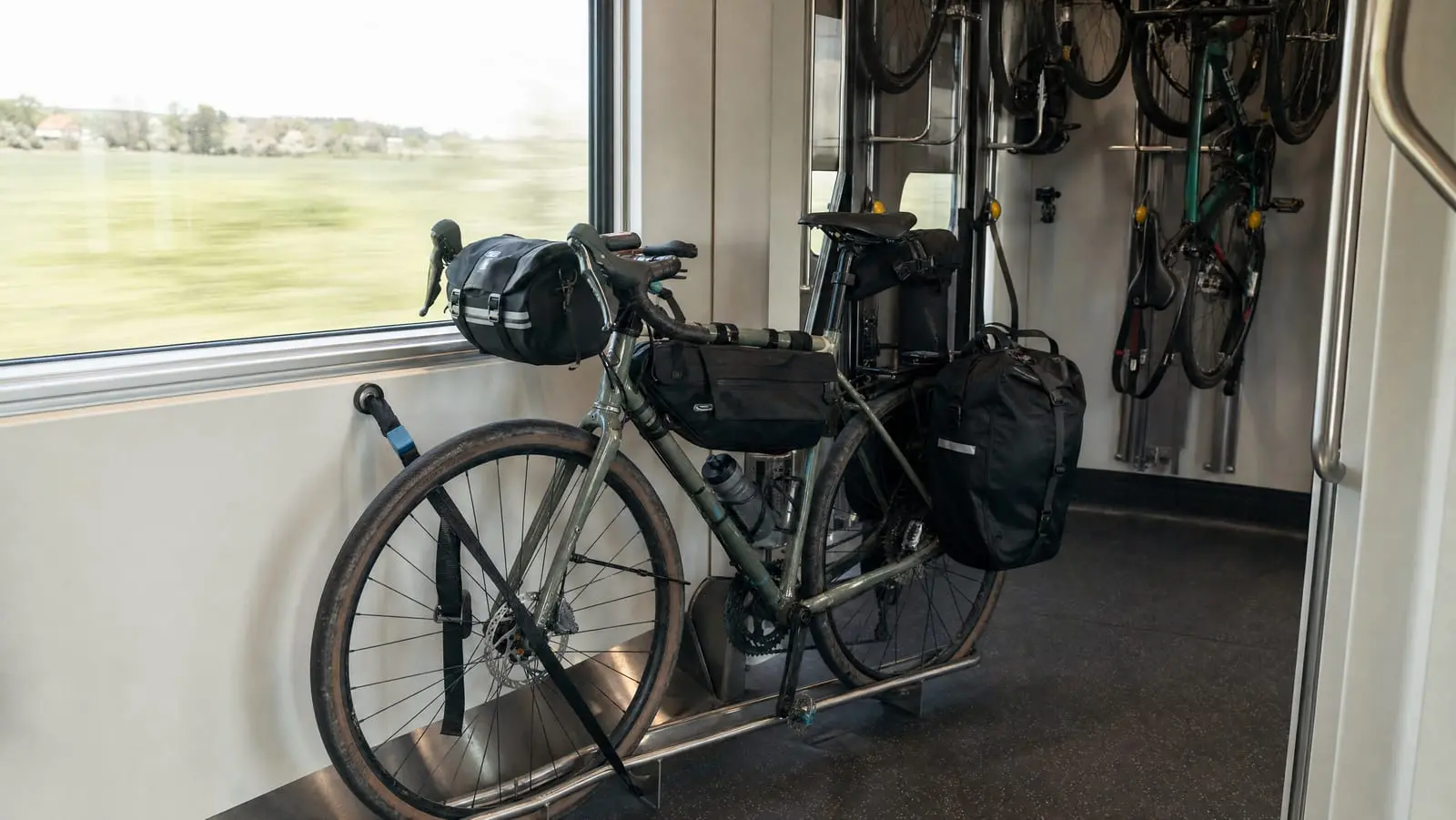
The access argument gets concrete fast. Amtrak allows a true folding bicycle under 34 x 15 x 48 inches onboard all trains in lieu of a piece of carry-on baggage — no bike car, no box. Meanwhile Greyhound classifies bicycles as bulky items that must be packed in "wood, canvas or other substantial containers," with a fee attached. A folded bike in a bag is luggage. A bike box is freight.
One softer benefit we believe in but have not measured: a suitcase-shaped container gets handled like a suitcase, because baggage systems are built for that shape. For the fee side, our airline bike fees and policies breakdown has the carrier-by-carrier numbers.
S&S Couplers and the Ritchey Break-Away, Explained
Neither is an Amazon purchase. Both come from framebuilders and bike shops.
What a coupler is
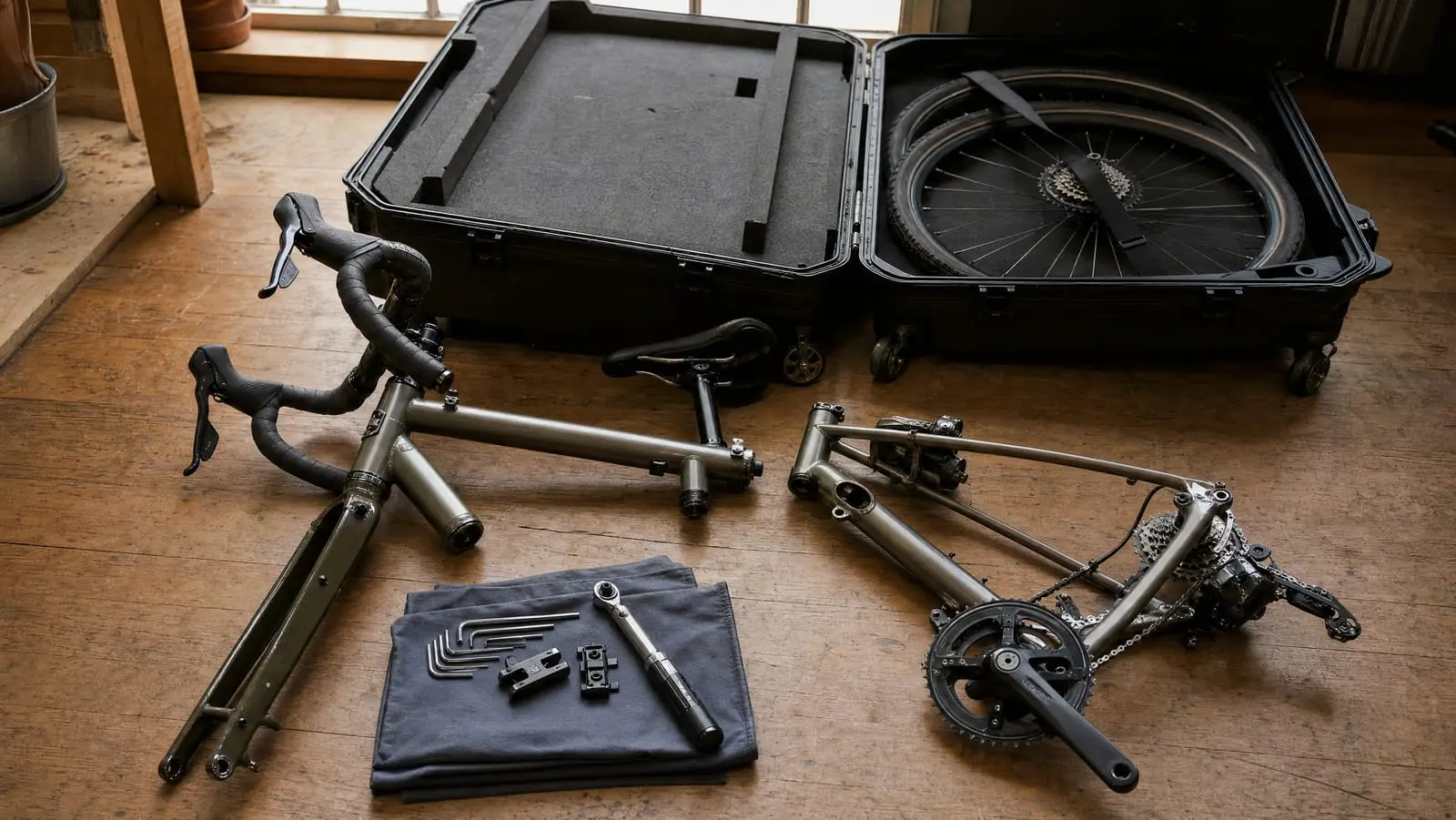
S&S Machine describes its Bicycle Torque Coupling as "a precision lug that is installed in a bicycle frame" so the frame can separate and pack down. Two of them, top tube and down tube, let a full-size frame come apart into halves that nest in a flat case. S&S states the couplings add only 8 ounces total to a typical road bike — far less than most riders assume.
The Ritchey Break-Away uses a different joint: a downtube clamp plus a seat tube junction. Ritchey's Outback Steel Break-Away ships with the travel case, hinge clamp, and brake and derailleur cable connectors, and lists that case at 8.5 in W x 26.5 in H x 31 in L with wheels — 66 linear inches, a little over a standard bag envelope but suitcase-shaped and only 8.5 inches deep.
What the retrofit involves
This is frame surgery, not a bolt-on. Kinetics is blunt: paint comes off for roughly three to four inches on either side of each coupling, and the frame will need to be repainted. The job includes cable splitters, because the housing now comes apart where the frame does.
Material limits are hard limits. S&S Machine states plainly that aluminum frames cannot be retrofitted, and Kinetics restricts its own service further: steel only, round top and down tubes, explicitly not titanium. Shops differ, so ask before shipping a frame anywhere.
Questions to ask a builder
- Have you done this tubeset before, and will the butting allow it without replacing a tube?
- Does the quote include cable splitters, the spanner, and paint?
- What is the turnaround, and who pays freight if the frame proves unsuitable?
- In my frame size, does the rear triangle fit the case with the wheels in?
The Best Folding Bike for Touring Is Two Different Categories
"Folding bike" covers a $250 product and a $3,100 product. Pretending they belong on one list is how riders end up disappointed on day two.
Tier one: the travel-grade folder
Dealer purchases, engineered as folders rather than bikes that happen to hinge. People genuinely tour on these.
Brompton lists the C Line Explore's folded size at 25.3 in H x 23 in W x 10.6 in D — under 59 linear inches, inside a standard checked-bag envelope and well inside Amtrak's carry-on folder limit. Brompton's US site showed it at $1,560, down from $1,950, as of August 2026.
Tern lists the Link D8 at $999 as of August 2026, 26.7 lb, folding to 15 x 31.1 x 28.3 inches, with a maximum gross vehicle weight of 264.6 lb and a maximum rider weight of 231.5 lb. Bike Friday goes furthest toward bikepacking: its All-Packa is a 20-inch-wheel bikepacking bike that Bike Friday says disassembles into a standard airline-checkable suitcase measuring 31 x 21 x 12 inches, with custom builds starting at $3,100 as of August 2026. Birdy sits in similar territory.
The tier-one tradeoff is money and parts: $1,000 to $3,000-plus, and proprietary hinges, odd stem hardware, and 349 or 406 tires are not in a small-town shop's drawer.
Tier two: the $250 to $500 folder
A genuinely different machine, and it deserves a fair hearing rather than a sneer.
What it can do: flat-to-rolling pavement and smooth gravel with a light load, short trips, city-to-city hops, the "fly in, ride three days, fly out" shape.
What it cannot do: washboard, chunky gravel, 40-pound loads, or long days in comfort. Small wheels transmit more of the road, gear ranges are narrow, and the steel models are heavy enough that lifting the folded bike onto a train rack is an event. If your budget stops here, read our budget bikepacking setup under $500 guide first.
ZiZZO Via 20-inch Folding Bike
ZiZZO Via 20-inch Folding Bike (Aluminum, Shimano 7-Speed)
The aluminum frame separates this from the rest of the sub-$500 shelf, and ZiZZO lists it at 26.5 lb with a Shimano 7-speed drivetrain, folding to 31 x 27 x 12.5 inches. No rack or cargo mount appears in ZiZZO's feature list, so your load lives on the bars, in a seat pack, or on your back.
- Aluminum frame, not high-tensile steel
- Listed weight 26.5 lb
- Shimano 7-speed with grip shifter
- Folds to 31 x 27 x 12.5 in
Price may vary
We would take this one if the route is paved, days are 30 to 50 miles, and the load is a bar roll plus a seat pack. The aluminum frame earns its premium over the steel Ferro purely because you will be lifting this onto trains. Do not buy it expecting to hang panniers.
ZiZZO Ferro 20-inch Folding Bike
ZiZZO Ferro 20-inch Folding Bike (Steel, 7-Speed)
The high-tensile steel version of the same idea, at $249.99 as of August 2026, down from a $299.99 list price. ZiZZO specifies 2-inch multi-terrain tires and V-style brakes — the widest rubber here, and the reason it handles a rough shoulder better than you would expect. It is also the heaviest option at a listed 29 lb.
- Lowest price in this group
- 2-inch multi-terrain tires
- High-tensile steel, listed 29 lb
- Folds to 31 x 27 in
Price may vary
Buy this to find out whether folder travel suits you before committing real money. You feel all 29 listed pounds lifting it over a train vestibule step, so treat it as a $250 experiment, not a long-term bike.
Dahon Dream D6
Dahon Dream D6 Folding Bike (20-inch, 6-Speed)
Dahon effectively invented this category, and the Dream D6 is its entry-level Hi-Ten steel model with a 6-speed derailleur and V-brakes. Dahon lists a claimed 25.7 lb, a folded size of 31.5 x 13.6 x 26.18 in, a fit range of 4 ft 9 in to 6 ft 2 in, and a maximum rider weight of 230 lb — and markets it for leisure riding and commuting, not touring.
- Published 230 lb maximum rider weight
- Claimed weight 25.7 lb
- Only six gears
- Folded 31.5 x 26.18 x 13.6 in
Price may vary
That 230-pound rider limit is the most useful number on this page: a 200-pound rider carrying 30 pounds of gear is already at the ceiling. We would buy the Dream D6 for the brand's parts network rather than its six gears, and only for a rider well under the limit.
Schwinn Loop
Schwinn Loop Folding Bike (20-inch, 7-Speed)
The only bike here with an integrated rear carrier rack, which changes what you can carry. It uses an aluminum folding frame, a 7-speed twist shifter, and linear-pull brakes front and rear, and Schwinn lists a fit range of 4 ft 4 in to 6 ft 4 in. A nylon storage bag is included, and Schwinn positions it for commuting and casual vacation rides.
- Integrated rear carrier rack
- Nylon storage bag included
- Aluminum folding frame
- Fits riders 4 ft 4 in to 6 ft 4 in
Price may vary
If you need to carry more than a frame bag's worth of kit, the rack decides it. Schwinn's feature list does not state a rack load limit, so keep panniers light and keep it off sustained washboard.
Carry Bags for a Packable Travel Bike
A folded bike still needs a container. A soft bag will not survive a baggage belt the way a hard case will, but it keeps grease off everything else, makes the bike acceptable to conductors and drivers, and gives an awkward object a shoulder strap. Check dimensions first: both bags below exceed 62 linear inches measured outside, so neither turns a folder into a standard suitcase.
Rhinowalk Travel Bag, 20 to 26 inch Folders
Rhinowalk Folding Bike Travel Bag (fits 20-26 inch folders)
The larger of Rhinowalk's two bags at 38.6 x 15.7 x 31.5 in, which Rhinowalk states suits folding bikes from 10-inch to 26-inch wheels. It is high-intensity nylon that Rhinowalk describes as waterproof, with reinforced webbing and a shoulder strap. The detail that matters point-to-point: it packs into a small pouch that straps to a handlebar, pannier, rack, or backpack.
- Fits 10-inch through 26-inch folders per Rhinowalk
- 38.6 x 15.7 x 31.5 in outside
- Packs into a strap-on storage pouch
- Unfolds flat as a ground sheet
Price may vary
For under $40 this solves the container problem adequately and solves the storage problem a hard case creates. We would buy it for train and bus travel without hesitation. We would not check a bike in it and expect the wheels to arrive true — on a flight it supplements padding, it does not replace it.
Rhinowalk Travel Bag, 16 inch and Small 20 inch Folders
Rhinowalk Folding Bike Travel Bag (fits 16-inch and small 20-inch folders)
The smaller sibling at 31.5 x 11.8 x 25.6 in, which Rhinowalk states fits 16-inch folders and small 20-inch folders — and Rhinowalk explicitly advises measuring your folded bike before ordering. It is high-intensity polyester described as water-resistant rather than waterproof, with reinforced sewing and quick-release buckle straps that let the empty bag ride on the bike.
- Sized for 16-inch and small 20-inch folders
- 31.5 x 11.8 x 25.6 in outside
- Quick-release straps carry the empty bag
- Polyester, water-resistant
Price may vary
This is the Brompton-sized bag, and the size warning is the whole review: a 20-inch folder that packs to 31 x 27 inches will not fit a 31.5 x 25.6-inch bag. Measure first, then choose between this and the larger one.
The Case for Not Buying a Travel Bike at All
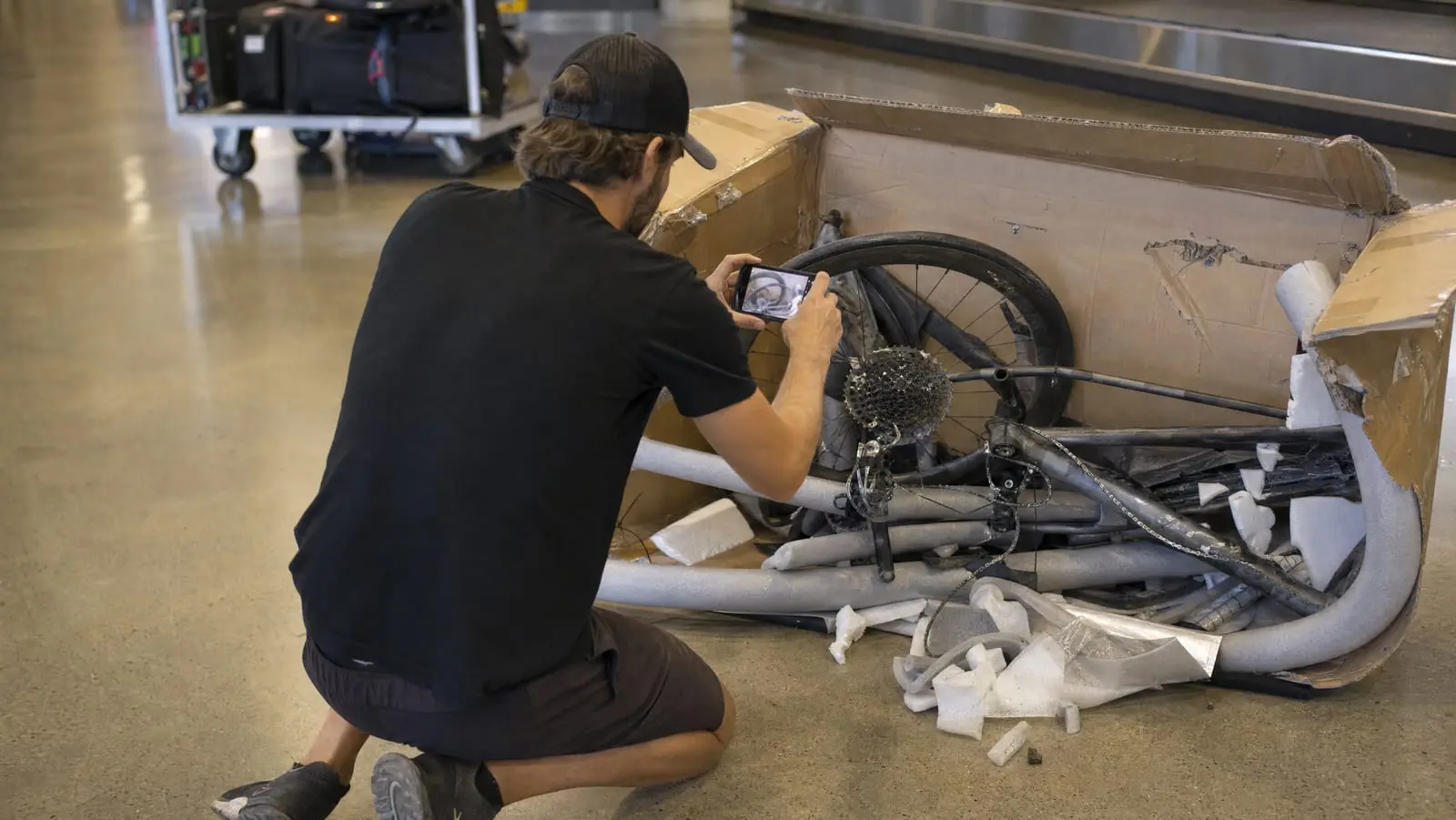
Most readers should keep the bike they already ride well and buy a container and a routine instead. A good case plus a practiced pack costs a fraction of a retrofit, and it applies to the bike that already fits you, already has your gearing, and already has your mounts.
Our comparison of best bike travel cases and bags covers hard shell versus soft bag and the part nobody plans for: where the empty container lives while you ride. And how to pack a bike for flying is the routine itself — genuinely an hour-plus job the first few times before it gets quicker.
So what is the couplered bike's real edge? Three things, narrower than the marketing suggests.
- The container is suitcase-sized, which is what makes trains, taxis, and hotel rooms work.
- You skip the oversize conversation at check-in, at the rental counter, and with the shuttle driver.
- Reassembly is faster — couplings and cable splitters instead of a fork, a bar, and a hanger every time.
Against that: four figures, weeks without your frame, a repaint, and material restrictions. Fly once or twice a year and none of it is worth $1,599. Fly six times a year with trains at both ends and it earns its keep every trip.
What Makes Any Bike Easier to Travel With
Most of what makes packing miserable has nothing to do with whether the frame comes apart.
- External cable routing. Internal routing is fine until a cable disappears into the down tube in a hotel parking lot.
- A threaded bottom bracket. Not to service on the road, but because a creaking threaded shell can be fixed with tools any shop owns.
- Mechanical disc or rim brakes. Hydraulics are better brakes and worse travel companions. Keep them if you like, but keep the discipline: pad spacers in every time a wheel comes out.
- Racks that come off in under a minute. A rack needing three hex sizes and a bolt you will drop is one you will fight at 5 a.m.
- Standard tire sizes. 700c and 29-inch rubber exists everywhere. Odd sizes strand you in the towns where you need a tire.
- No proprietary parts. A proprietary seatpost, hanger, or axle is trip-ending when it breaks two time zones from a dealer.
Our guide to the bike travel tool kit and reassembly covers the kit itself. If you are still choosing a bike, best bikepacking bikes for every budget is the place to start — travel-friendliness is a tiebreaker, not a first criterion.
What We Would Actually Do, by Trip Shape
One flight a year. Buy a case and learn the routine. One annual trip cannot justify a $1,599 frameset, and your normal bike will always ride better than a compromise.
Four or more flights a year, same bike every time. The real coupler case — saved reassembly time and avoided oversize hassle compound. Get the tubeset assessed first, budget for the repaint, expect four figures.
Mostly trains and buses. Buy a travel-grade folder. Amtrak's carry-on allowance for a true folding bike under 34 x 15 x 48 inches beats negotiating a bike box, and a bagged folder is simply luggage to a bus driver.
Mostly international, or one big trip. Consider not bringing a bike. Our comparison of renting a bike abroad versus flying your own lays out when the rental is the smarter purchase — for a single two-week trip in a country with a real rental scene, it usually is.
The Bottom Line
The couplered travel bike was engineered to beat a fee that mostly no longer exists. That does not make it a bad bike — it makes it a bike to buy for a different reason. Buy it because 62 linear inches unlocks trains, taxis, and hotel elevators, and buy a travel-grade folder for the same reason, one tier down in price and ride quality.
If you fly once a year with the gravel bike you already love, buy a case, practice the pack twice in your garage, and put the other $1,500 into airfare. That is the honest answer, and the one we would follow ourselves. When you are ready to plan the logistics end to end, start with our complete bike travel guide.