Best Bike Travel Cases and Bags for Bikepacking: Hard Shell vs Soft Compared
20+ years testing gear in Colorado backcountry
Which Bike Travel Case Should a Bikepacker Actually Buy?
For most riders, the best bike travel case for bikepacking is a soft bag, not a hard shell. Hard cases protect better and they are the right call for a round trip. But a bikepacker usually flies into one airport and rides away from it, and a rigid box weighing 18 pounds empty has to sit somewhere for the next two weeks.
This article contains affiliate links. We may earn a commission if you make a purchase through our links, at no extra cost to you.
The Question Nobody Asks Until They Land
Every bike case review measures protection. Almost none of them measure the thing that decides the purchase for a bikepacker: where the empty case lives while you ride.
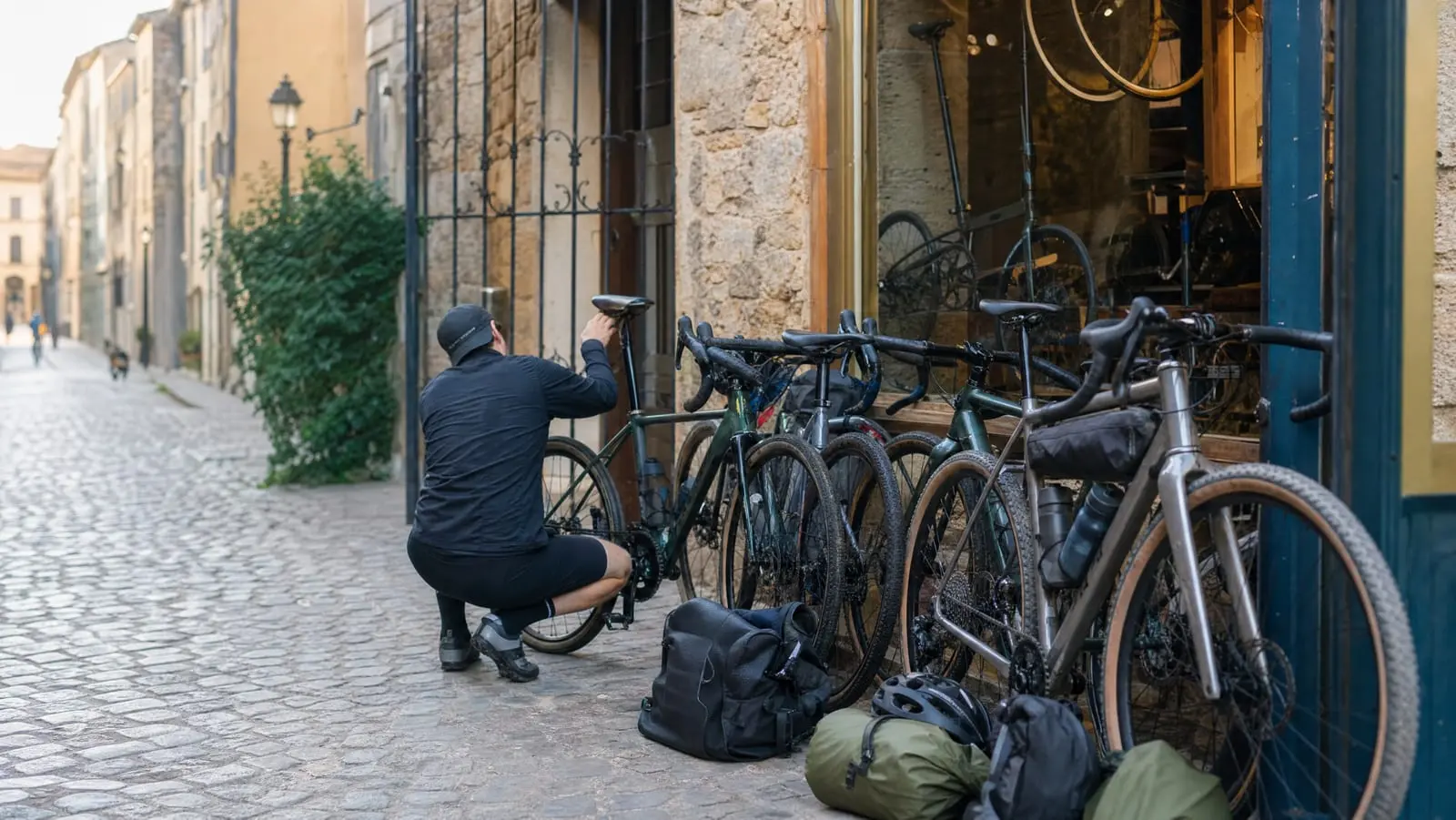
This is the fork in the road for anyone traveling with your bike. A road racer flies to a race, races, and flies home from the same terminal. The case sits in a hotel luggage room for four days. A bikepacker flies to Missoula, rides to Banff, and flies home from Calgary. That case is now 500 miles from where you left it.
The Adventure Cycling Association puts the problem plainly in its guide to shipping and flying with a bike: travel cases are "great if you're beginning and ending your tour in the same location; otherwise, getting the case to the ride's end can be problematic." That is the whole tension in one sentence.
Your realistic options at the far end are:
- Pay a bike shop to hold it. Common, and entirely dependent on that shop having spare floor space in high season. Call and confirm before you fly, not after.
- Ship it forward. Adventure Cycling notes that a shop can box and ship your bike to a shop at your destination and repeat the process in reverse on a point-to-point tour. Reliable, and the most expensive option by a wide margin.
- Store it at your first night's lodging. Works if you booked a real hotel. Does not work if night one is a campground.
- Throw it away. Free, guilt-free, and completely rational — if the container was a free cardboard box.
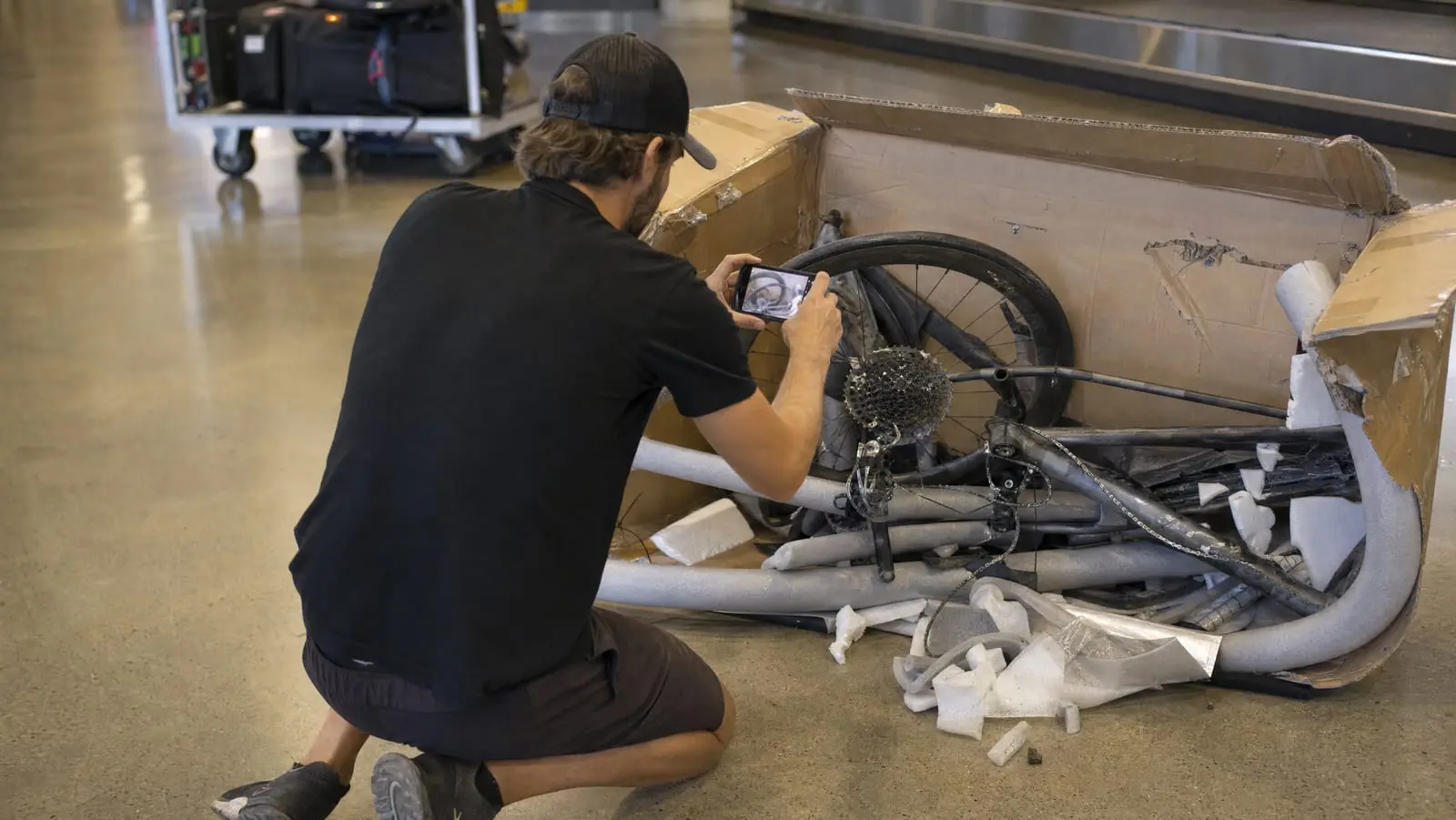
That last line is why the honest answer for a lot of bikepacking trips is not a $500 case at all. Once you accept that the container may be disposable, a cardboard box plus real wheel protection starts to look less like a compromise and more like the correct engineering choice.
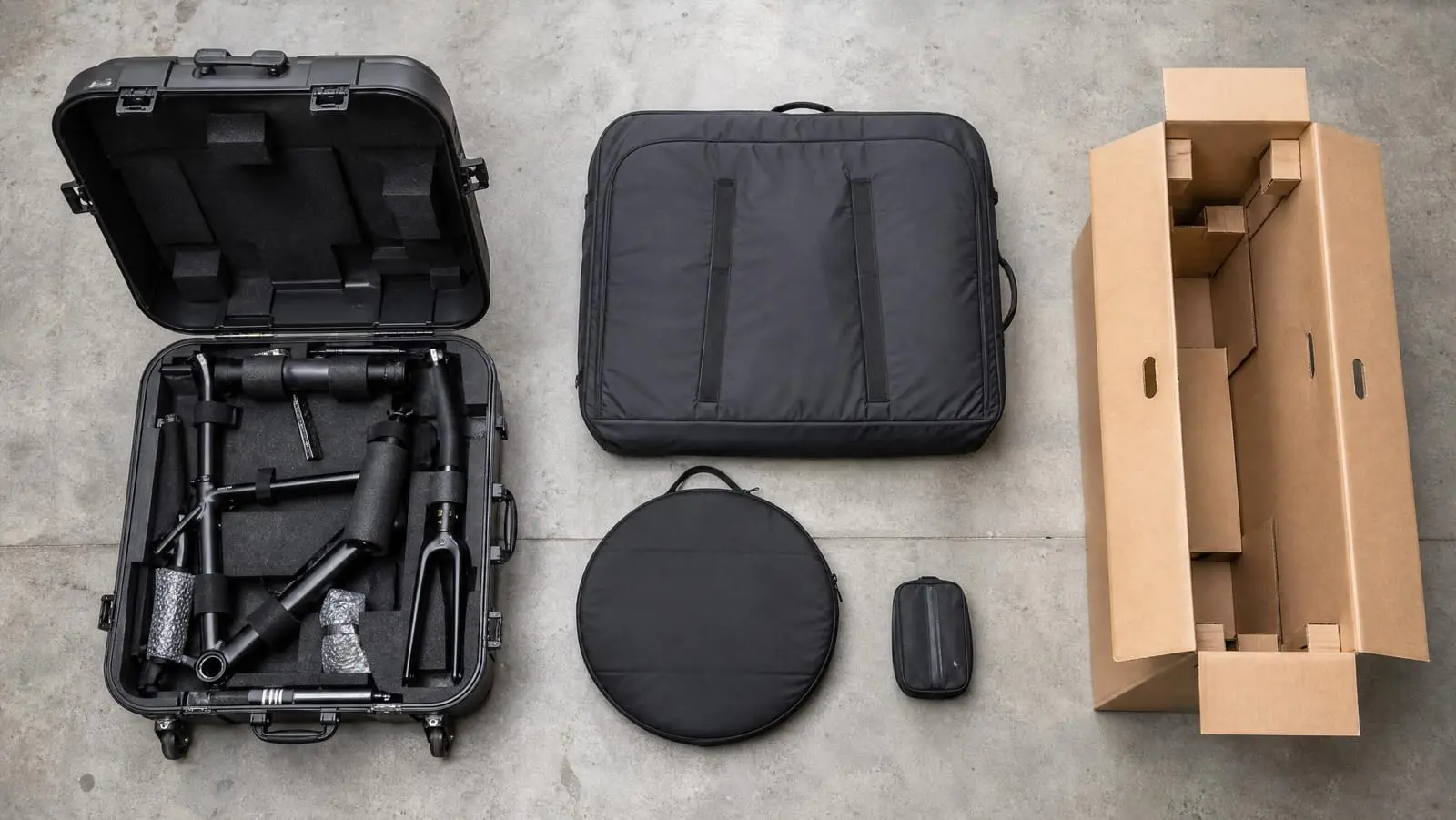
Hard Shell vs Soft Bag vs Cardboard Box
Three containers, four things that matter. Here is how they actually compare.
| Hard shell case | Soft bag | Cardboard box | |
|---|---|---|---|
| Crush protection | Best | Good with internal structure | Poor |
| Empty weight | 18.3 lb for the CyclingDeal case, per the maker | Rarely published — weigh it yourself | Roughly 4–5 lb for a light shop box, over 10 lb for a sturdy one |
| Storage at home | Bad — it is a coffin in your garage | Good — folds or collapses | None needed |
| Storage at destination | Bad | Manageable | Free to discard |
| Cost | $400+ | $40–$600 | Free to $100 |
Protection: rigid shells win, and it is not close
A hard shell spreads a point load. If your bike ends up at the bottom of a pile with the corner of a Pelican case pressing into it, only a rigid wall stops that force from reaching your top tube. Fabric, no matter how many deniers it claims, does not resist lateral crushing on its own — the structure in a good soft bag comes from internal frames, fork mounts, and wheel dividers, not the shell.
There is a paperwork angle too. Delta's sporting equipment policy states that a liability release form is required for a checked bicycle unless the bicycle is in a hard shell case. In other words, the airline itself treats a hard shell as the standard of care. If you fly with a soft bag or a box, you are signing away most of your claim before the bike leaves the counter.
Weight: do the 50-pound arithmetic before you buy
This is where hard cases hurt bikepackers, and the math is not subtle.
Delta's baggage rules set the standard checked bag at 50 pounds and 62 linear inches, and its sporting equipment page adds that bicycles are accepted up to 115 linear inches, with excess weight charges above 50 pounds and outright refusal at 100 pounds or more (all as of August 2026). So 50 pounds is your working budget.
According to CyclingDeal, its hard travel case weighs 8.3 kg — 18.3 pounds empty. That is 37 percent of your allowance gone before the bike goes in. You have 31.7 pounds left. A loaded-touring or gravel rig with tubeless tires, a dynamo wheel, and a rack is frequently 26 to 30 pounds. Add pedals, a tool roll, and the foam you stuffed around the fork, and you are at the counter watching the scale read 52.
By contrast, a cardboard bike box is much lighter — but not weightless, and the range is wider than most riders assume. Shipping guides commonly budget around 4 to 5 pounds for the box itself, while Exploring Wild's guide to flying with a bicycle warns that "just the box alone can weigh over ten pounds" on a sturdy one. Call it 5 to 10 pounds and you still have 40 to 45 pounds left for bike and padding — 8 to 13 pounds more than the hard case leaves you. That gap is the difference between packing freely and repacking on the terminal floor.
Size: the numbers that get you refused
Linear inches are length plus width plus height. Run the sum yourself, because a case that "fits airline limits" in a product description may not fit your airline.
- CyclingDeal lists its case at 45 x 10 x 33 in — 88 linear inches, comfortably inside Delta's 115-inch bike ceiling.
- BikeFlights sells a heavy-duty reusable Bike Box Large at 64 x 14 x 32 in and 22 lb for $99.95 as of August 2026 — 110 linear inches, only five inches of margin, and note that it weighs far more than the thin shop box you get for free.
- CONFUTURY lists its soft bag at 55.11 x 31.29 x 10.82 in — 97 linear inches.
None of these fit inside a 62-inch standard bag limit, which is exactly why bikes are handled under a separate policy. Fees and thresholds vary a lot by carrier and change often, so check your specific airline against our breakdown of airline bike fees and policies before you buy a container sized to the wrong rulebook.
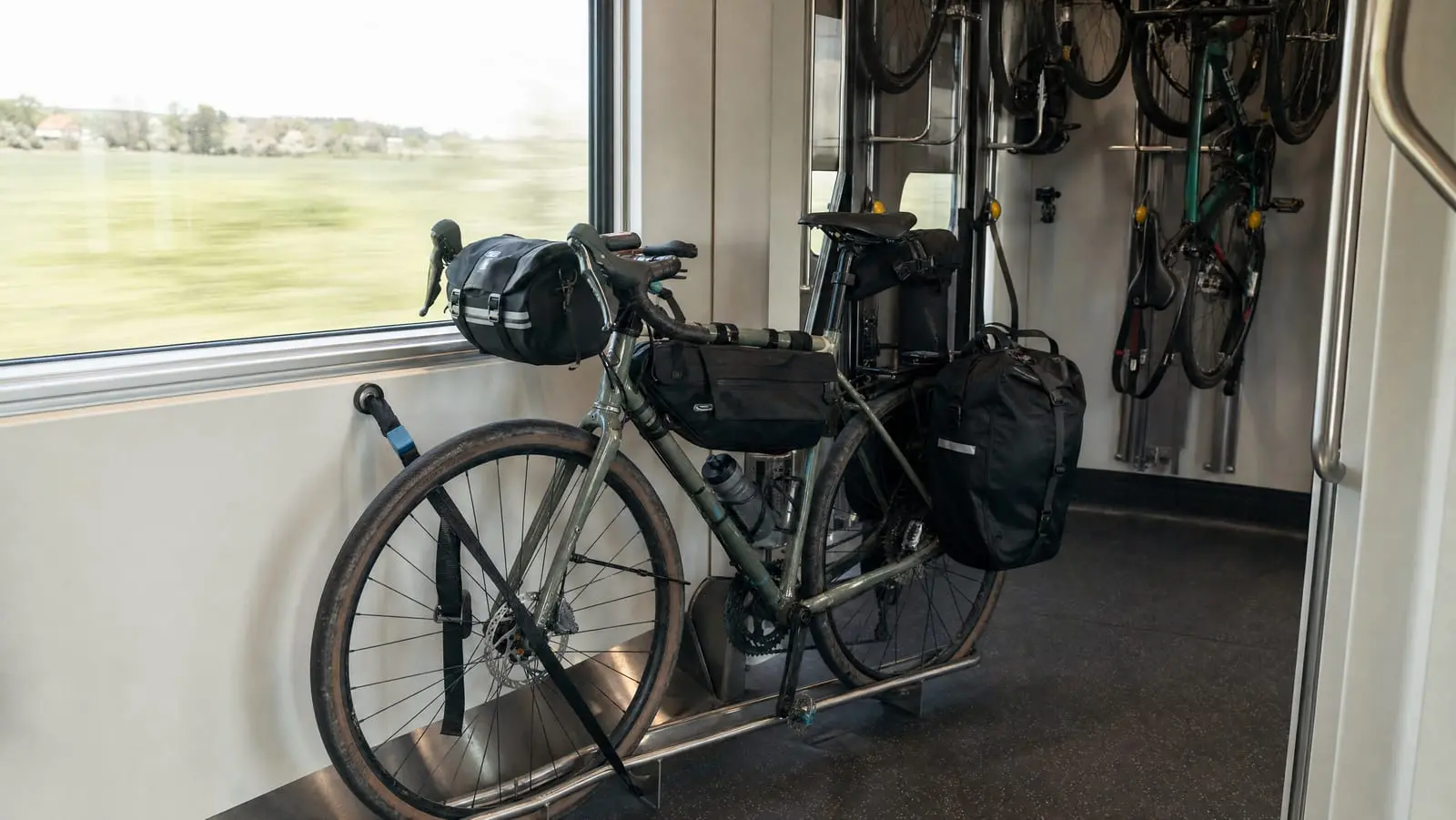
Trains are their own puzzle. Amtrak's special-items policy allows a checked bicycle in a container up to 50 lb and 70 x 41 x 8.5 in, sells bike boxes at most staffed stations for $15, and charges $10 to check a bike in a container in lieu of a piece of baggage (as of August 2026). Note the 8.5-inch depth: a 10-inch-thick hard case is over that limit. If your itinerary includes an Amtrak leg, a flat box may be the only thing that works.
The Six Cases and Bags We Would Consider
We have not destructively tested these, so every manufacturer claim below is attributed as a claim. Prices are as of August 2026 and move constantly.
EVOC Bike Bag (285L) — Best Soft Bag Overall
EVOC Bike Bag (285L)
The soft bag we would buy if we only bought one. EVOC lists a 285-liter capacity that takes cross-country, all-mountain, enduro, freeride, downhill, road or triathlon bikes up to a 126 cm wheelbase, with separate wheel compartments, a stabiliser bar intended to keep spokes and brake discs from bending, reinforced fork support with extra padding, and a bottom protection plate. The tradeoff is money and physics: it costs more than most hard cases and no fabric shell resists a crushing load the way a rigid one does. The listing we sourced does not publish an empty weight, so put it on a scale before you plan around a 50 lb allowance.
- Fits XC, enduro, downhill, road and triathlon bikes
- Separate wheel compartments with a stabiliser bar
- Reinforced fork support plus bottom protection plate
- Extra-wide chassis with replaceable wheels
- Maximum wheelbase 126 cm
Price may vary
The stabiliser bar and the bottom plate are the features that matter here — they are the internal structure doing the job the fabric cannot. Stock was thin when we checked in August 2026, which is normal for this bag in the summer travel season. If you fly point-to-point more than once a year, this is the pick.
VEVOR Bike Travel Case — Best Hard Case for the Money
VEVOR Bike Travel Case (EVA Hard Shell)
The cheapest route to a genuinely rigid shell that we would still trust. VEVOR lists an EVA hard shell with a top tube cover, fork protectors and side handle protectors, two wheel bags and a chain tool bag, rolling wheels, a cushioned handle, a quick-release buckle system and a TSA-approved lock. The tradeoff is fit and life at the far end: it is sold for 700C road bikes, so a wide-tire gravel or bikepacking rig with a long wheelbase may simply not go in, and a rigid case this size becomes a storage problem the moment you land.
- Rigid EVA shell with tube, fork and handle protectors
- Two wheel bags and a chain tool bag included
- TSA-approved lock and dual zippers
- Rolling wheels and cushioned handle
- Marketed for flights, trains and road trips
Price may vary
At $421.90 as of August 2026 this undercuts most name-brand hard cases by a few hundred dollars. Measure your wheelbase and your tire width against the 700C road-bike fit claim before you order, and assume you will remove wheels, bars, pedals and saddle every single time.
CyclingDeal Bike Travel Hard Case — Best Clamshell Hard Case
CyclingDeal Bike Travel Hard Case
The clamshell layout is the reason to pick this one: CyclingDeal describes a clamshell design that opens fully, which makes packing a bike far less like solving a puzzle in a suitcase. The company lists an EVA shell 1 cm thick with a hardness rating up to Hs 80, case dimensions of 115 x 25 x 84 cm (45 x 10 x 33 in), a weight of 8.3 kg (18.3 lb), two padded wheel bags, a TSA lock, 360-degree front wheels with rear rubber wheels, and a 2-year warranty. The tradeoffs are that 18.3 lb of empty weight and a hard compatibility limit: CyclingDeal states it is for 700C road bikes with QR or thru-axle wheels and is not compatible with MTBs or integrated seatposts.
- Clamshell design opens fully for easier packing
- 1 cm EVA shell, hardness rating up to Hs 80
- 45 x 10 x 33 in (88 linear inches), 18.3 lb empty
- Two padded wheel bags and a TSA lock
- 2-year warranty per the manufacturer
Price may vary
This is the case we used for the weight arithmetic above, and it is the honest illustration of the hard-case bargain: excellent protection, 18.3 pounds of your 50-pound allowance, and a bike list that excludes mountain bikes. If your bikepacking rig is a drop-bar gravel bike on 700C wheels, it works. If it is a hardtail, it does not.
LOOMA MOTION Bike Travel Bag — Most Protection Included in the Box
LOOMA MOTION Bike Travel Bag
Nobody includes more small parts protection. LOOMA MOTION says the bag ships with 2x brake lever protectors, 2x front fork, 2x handlebar, 2x disc brake pad insert tools, seat stay, down tube, top tube and gear protection, a seat cover, a TSA lock, 2x quick-release skewers, a derailleur protector and 4x adapter bases, inside a 1680D polyester shell with 8 mm EPE foam. Assembling that same set of guards piecemeal is both fiddly and expensive, so the bundle carries real value. The tradeoff is that 8 mm of foam is not a rigid shell, and the fit list covers road, triathlon and TT bikes rather than mountain or long-wheelbase adventure bikes.
- Full protector set: fork, bar, lever, tube and derailleur guards
- Disc brake pad insert tools included
- 1680D polyester shell with 8 mm EPE foam
- TSA lock and quick-release skewers included
- Rolling wheels and ergonomic handles
Price may vary
Buy this one if you would otherwise be assembling your own protection out of pipe insulation and zip ties. The derailleur protector and the disc pad inserts prevent the two most common transit failures we hear about. If you want to know what those denier numbers mean in practice, we broke it down in our guide to bag fabrics and durability ratings.
CONFUTURY 900D Bike Travel Bag — Best Budget Soft Bag
CONFUTURY 900D Bike Travel Bag
At under $40 this is not a protective case and we would not pretend otherwise — it is containment. CONFUTURY lists a 900D Oxford outer with a 210D lining and an SPF 85+ coating, three fixed buckles intended to stop the zipper bursting under rough handling, separate compartments for frame and wheels, reusable cable ties, a front fork holder, adjustable shoulder straps and a front pocket, measuring 55.11 x 31.29 x 10.82 in and fitting most 26-29 in MTBs, 700C road bikes and folding models. The tradeoff is obvious: there is no meaningful padding, so anything you do not wrap yourself is unprotected.
- 900D Oxford outer with 210D lining
- Separate frame and wheel compartments
- Three buckles to back up the zipper
- Shoulder straps for carrying through terminals
- Fits 26-29 in MTB, 700C road and folding bikes
Price may vary
Where this earns its money is as a shuttle bag: van transfers, ferries, hostel storage, a train leg where a cardboard box would disintegrate. For a flight, use it only if you are padding the frame yourself with foam, and expect to sign the airline's liability waiver. At $39.89 as of August 2026, it is cheap enough to treat as disposable at the end of a one-way trip.
Rhinowalk Bike Wheel Bag — Best Add-On for a Cardboard Box
Rhinowalk Bike Wheel Bag
The single highest-value thing you can add to a free cardboard box. Rhinowalk lists waterproof polyester with a reflective logo, a 26 in version at 73 cm diameter, 4.5 cm thick and 550 g, and a 29 in version at 80 cm diameter, 5 cm thick and 640 g, each holding one complete wheel. The tradeoff is scope: Rhinowalk sells these as wheel protection, not as a bike case, and one bag holds one wheel — you need two, and they do nothing for your frame.
- Padded, waterproof polyester with reflective logo
- 26 in version: 73 cm diameter, 550 g
- 29 in version: 80 cm diameter, 640 g
- One complete wheel per bag
- Adds roughly 1.2 lb per wheel to your packed weight
Price may vary
Two of these run about $44 as of August 2026 and weigh roughly 1.2 pounds each for the 26 in size. They are the difference between wheels that arrive true and wheels that arrive as tacos.
The Cardboard Box Strategy, Done Properly
For a one-way bikepacking trip, this is the setup we would actually run. A free box from a shop is not the cheap compromise it sounds like — it is a deliberate choice to spend your protection budget on the two components that get destroyed most often.
The build:
- Get the box early. Exploring Wild's flying guide suggests asking every bike shop in town; shops receive new bikes constantly and are usually happy to hand one over. Amtrak also sells bike boxes at most staffed stations for $15 as of August 2026 if you want a known quantity.
- Protect the wheels properly. Wheels take the worst of it because they sit flat against the box wall. A pair of padded wheel bags runs about $44 as of August 2026, which is cheap insurance against a wheel rebuild on day one of a trip.
- Guard the derailleur hanger. Remove the rear derailleur, wrap it, and tie it inside the rear triangle. This is the failure we hear about most.
- Fill every void. Your sleeping pad, tent, and clothing are free padding — and they are coming anyway. Pack your frame bag and seat pack full and wedge them into the gaps, which is a nice side effect of the way we already recommend organizing your bikepacking bags.
- Carry the rebuild tools in your hand luggage. A multi-tool with a torque function, pedal wrench capability, and a small torque key. Our bikepacking tool kit guide covers the exact set worth carrying.
If you go the hard case route instead, use a TSA-accepted lock. Travel Sentry, which administers the program, says officers can open and relock these locks with a secure master key, while a non-approved lock may be cut off entirely to inspect the contents. The VEVOR, CyclingDeal and LOOMA MOTION options above all include one. We cover the packing sequence itself in a separate piece on how to pack a bike for flying.
How to Choose, in Three Questions
1. Do you finish the trip where you started it? Yes: buy a hard case. The protection is real, the liability position is better, and storage is somebody else's problem for four days. No: buy a soft bag or use a box. Nothing about a rigid case survives contact with a point-to-point route.
2. What is left of 50 pounds after the container? Weigh your bike. Subtract it from 50. If the remainder is under 20 pounds, an 18.3-pound hard case is already over budget and you are shopping for a soft bag whether you like it or not.
3. How many times a year do you fly with the bike? Once: a $15 Amtrak box or a free shop box plus $44 of wheel bags is the correct answer, and it is not close. Three or more: a case amortizes fast, and the packing routine becomes muscle memory instead of an annual ordeal.
A fourth question worth asking before you buy anything: does your bike fit? Integrated seatposts, 29 x 2.6 in tires, and long wheelbases defeat cases built around 700C road bikes. If you are still choosing a rig, our roundup of bikepacking bikes at every budget is the place to start, and we have a piece on travel-friendly bikepacking bikes if a couplered or folding frame is on your mind.
What We Would Buy
If we were flying round trip to ride a loop, we would buy the CyclingDeal clamshell at $449.98 as of August 2026 and accept the 18.3 pounds, because a fully opening clamshell and a rigid shell make a real difference and Delta will not ask us to sign away our claim.
If we were flying one way — which describes most bikepacking — we would buy the EVOC 285L at $595.00 as of August 2026 if the trip mattered and we fly often, and otherwise we would take a free cardboard box, two Rhinowalk wheel bags at $21.99 each, and spend the difference on the trip.
The expensive mistake is not buying the wrong case. It is buying an excellent case for a route that ends 500 miles from where it started. Decide the route shape first, then the container.
For airline fees, train rules, shipping services, and the rest of the logistics, start with our bike travel guide. And whatever container you choose, keep your gear dry inside it — our picks for waterproof bags for your gear do double duty as padding on the way out and dry storage on the trail.