Renting a Bike Abroad vs Bringing Your Own: How to Decide
20+ years testing gear in Colorado backcountry
Renting a Bike Abroad vs Bringing Your Own: The Short Answer
Rent for trips under about a week on graded surfaces where the logistics are the whole problem. Bring your own for trips over two weeks, technical or remote routes, and any trip where you will be in the saddle more than roughly five hours a day. Between one and two weeks it is close enough that money should not decide it.
Most comparisons get this backwards. They line up a rental day rate against an airline bike fee, declare a winner by forty dollars, and stop. Forty dollars is noise. Eight hours a day on a bike whose reach is 20 mm long is a trip you remember for the wrong reasons, and no refund fixes it.
You still need the cost model, so it is below — but the rest of this piece is about the variable that actually decides the question. For the wider logistics, see our bike travel guide.
The Honest Cost Model for Bikepacking Bike Rental in Europe
Build a model, not a number. Rates swing by country and outfit, so plug in your own quotes.
The rental column
Five lines, not one:
- Day rate. A decent gravel or touring bike in Europe generally lands in a €35 to €75 band: Routes & Roads in Paris advertises gravel rental at 35 euros a day, RockVelo in Slovenia's Vipava Valley lists carbon gravel at €55 per day.
- The multi-day taper, the line that decides the crossover. Cycle Classic Tours in Copenhagen prices a gravel bike at €80 for two days, €190 for seven and €335 for fourteen — €40 a day at the short end, about €24 at two weeks. The curve flattens; it does not go to zero.
- Delivery and one-way drops. RockVelo charges €25 for delivery and pickup within the Vipava valley. Point-to-point drops cost more and are harder to find at all — a 2022 EuroVelo overview describes one-way bike rental as "still an emerging service" with large regional differences in what is on offer.
- The deposit. Cycling Rentals, which serves several European touring routes, asks €50 per bike and €100 per e-bike. Others hold far more. Not a cost, but a card limit you need free.
- Bags, if you do not bring your own. Cycle Classic Tours lists a rack and panniers at €30 and a handlebar bag at €30. Rented luggage is where rentals quietly get worse than your own kit.
The bring-your-own column
Also five lines. Round-trip bike fees are the obvious one, and we will not restate them — our airline bike fees and policies piece has the carrier-by-carrier numbers and the thresholds that trigger surcharges. The four people forget:
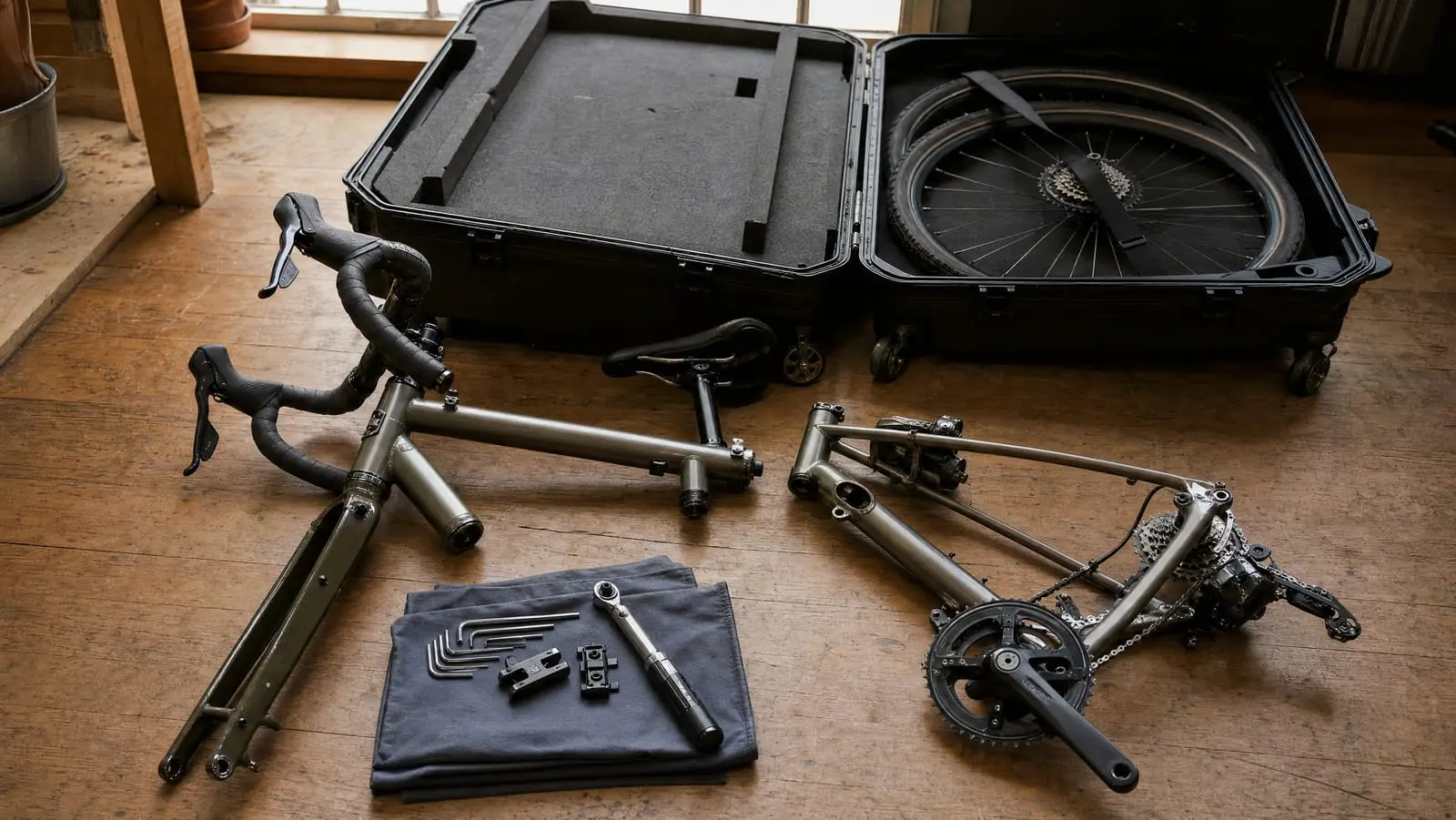
- The case, amortized over the trips you will honestly take in the next five years. If that number is two, the case is expensive. Our best bike travel cases roundup covers the tradeoffs.
- Ground transport at both ends. A packed case does not fit a standard taxi or a compact hire car. Budget a van transfer in each direction.
- Storing the empty case while you ride. Some hotels do it free, some charge, and lockers are usually too small. Sort it before you fly.
- Rebuild time and risk. An hour at each end, plus whatever a shop charges if the hanger arrived bent.
Where the lines cross
Rental usually wins under about a week. Bringing your own wins past two, because the airline fee is fixed while the rental keeps accruing even at the discounted rate. The middle is a genuine coin flip — which is why everything below matters more than the arithmetic.
The money is close enough to be a rounding error. The fit is not.
Fit: The Variable That Should Actually Decide It
A rental fleet is sized in three or four buckets. Your body is not. The question is not whether the rental fits — it is which dimensions you can drag into range at the counter, and which you are stuck with all trip.
What has to be right
Saddle height and setback. Height has real evidence behind it — the research literature converges on setting it so the knee reaches roughly a 25 to 35 degree flexion angle at the bottom of the stroke, for efficiency and for reduced knee injury risk. Setback matters nearly as much on a loaded bike and gets adjusted far less often.
Reach. Saddle to bars, set by frame size, stem and bar shape. This is the dimension that quietly ruins trips, because it is fine for ninety minutes and wrong by hour six.
Bar width, which changes shoulder angle and hand pressure — too wide is the common rental failure on gravel bikes. And crank length, rarely adjustable, occasionally decisive if you are short or have a knee history.
What you can fix at the counter in ten minutes
Saddle height, fore-aft and tilt, bar roll, lever position on drop bars, and spacers under the stem if the steerer was not cut short. Bring 4 mm and 5 mm hex keys, and do it in the shop where they can retorque anything you loosen.
What you cannot fix
Frame size, stack, standover, crank length, and in practice stem length, because most outfits will not swap one onto a bike sized for the next customer.
Send them with your booking request and ask which frame size they would put you on, and what the resulting reach and stack are. An outfit running real touring bikes answers with numbers. One that answers "we'll sort you out on the day" rents city bikes to tourists. If a rental cannot give you the model and frame size in advance, you have your decision.
The Hybrid That Works: Fly Your Contact Points
You do not have to choose the whole bike. A saddle, a set of pedals and your own grips or bar tape weigh a couple of pounds, fit in a carry-on, and close most of the comfort gap that makes rentals miserable. The saddle alone is worth it — the one component where "close enough" is least true, and a five-minute swap.
Bring your own bags too. Bikepacking luggage packs flat into a duffel, costs nothing extra inside your checked bag, and means you are not paying €30 for panniers you dislike. Our bag and storage guide covers what needs to come; for what the security line allows, see flying with bikepacking gear.
The compatibility checks to run first
Ask before you pack, because a saddle you cannot mount is dead weight:
- Seatpost diameter and clamp type — single-bolt, twin-bolt, or an integrated cradle that only takes the supplied rails. Carbon rails need a compatible clamp.
- Rack, cage and fender mounts — how many, and where. This decides whether your cages have anywhere to go.
- Frame triangle size — a full-frame bag cut for a 56 cm frame will not fit a 52 cm rental. A half-frame or top-tube bag travels better.
- Bar diameter and shape — 31.8 mm versus 35 mm clamp, flared drops versus flat, which changes what a harness can hold.
- Pedal thread and tool — 15 mm spanner or 8 mm hex, and whether they have one.
How to Vet a Rental Outfit From Another Continent
Email this list. The quality of the reply tells you more than the answers.
- Exact make, model and frame size you would put me on, plus model year and current condition.
- Tire size fitted, and the widest the frame takes.
- Rack, cage and bag mounts, with a photo of the actual bike, not the catalogue.
- What tools and spares come with it. RockVelo includes a spare tube, pump, multi-tool and helmet in the day rate; plenty of outfits include none of that.
- The failure procedure when something breaks 200 km away — who I call, and who pays for recovery.
- Deposit amount and how it is held: charged, or authorized against a card.
- What the damage policy actually covers, in writing.
- Whether you will fit a saddle I post ahead, or one I bring.
Read your own contract; terms vary enormously and nothing here is universal. As one worked example, Cycling Rentals' published terms make the renter liable for theft, damage or loss regardless of fault, sell optional cover that halves repair or replacement costs, cover structural items like frames, bottom brackets and hubs, and leave punctures, chains, spokes and any roadside recovery to the rider. Another outfit will draw those lines somewhere else entirely.
Where Hiring a Touring Bike Clearly Wins
- One-week fly-in, fly-out loops. Cheaper, and you skip four hours of packing and rebuilding.
- Countries with a real touring rental culture and a dense shop network, where a mechanical is a 20 km detour rather than a trip-ending wait for parts.
- Trips where the bike is not the only cargo — camera gear, or non-cycling family.
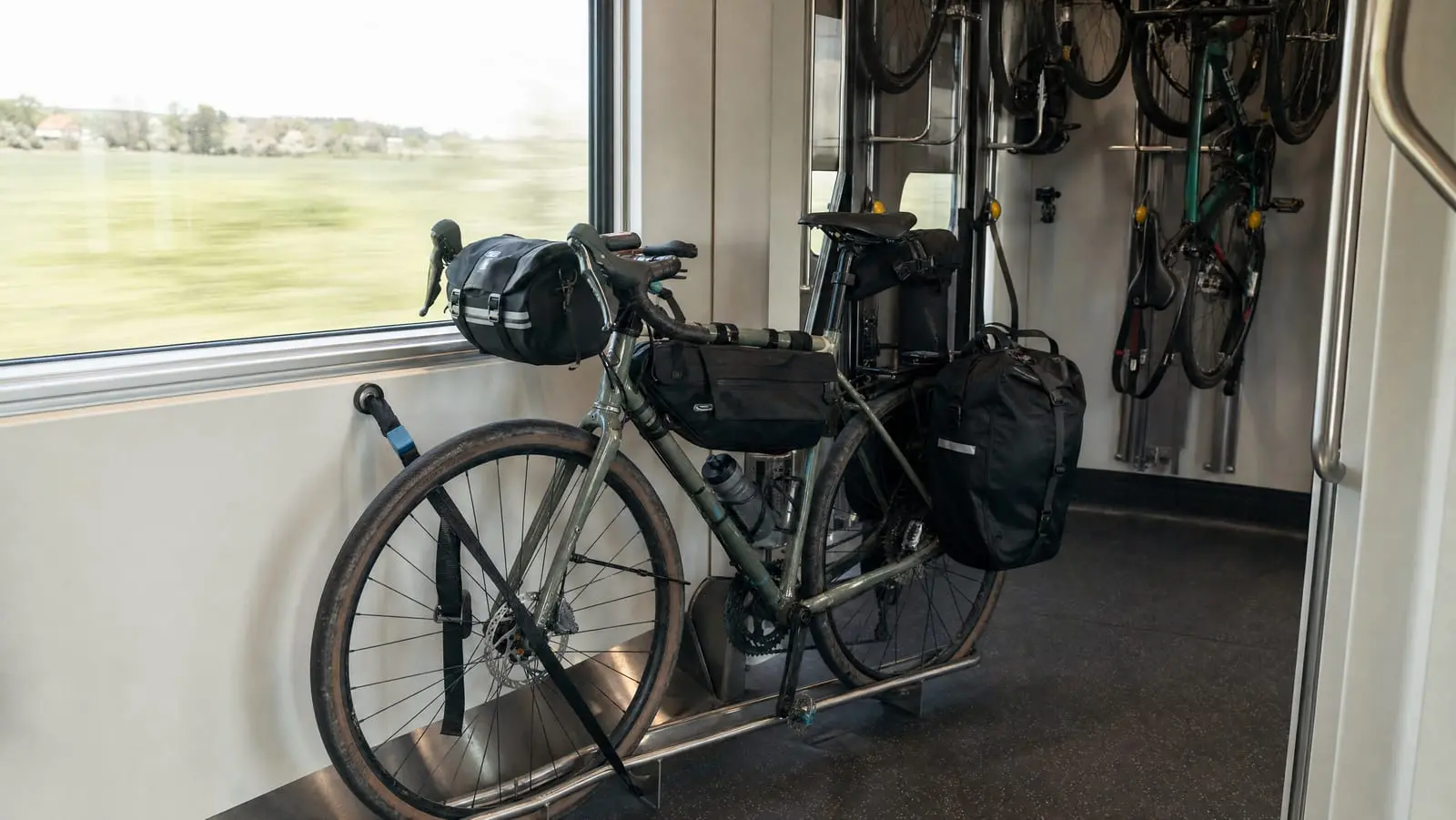
- Multi-modal trips where you would rather not shepherd a case between riding sections. Though taking a bike on a train in Europe is easier than Americans expect: Deutsche Bahn requires a bicycle ticket plus a space reservation on long-distance services, a bicycle ticket but no reservation on local trains, and carries folding bikes free as hand luggage.
- Any trip you would otherwise skip. A rental that gets you riding beats a perfect bike in the garage.
Where Bringing Your Own Bike Overseas Wins
- Trips over two weeks, where the discounted day rate still out-accrues a fixed round-trip fee.
- Technical or remote routes needing specific tire clearance, gearing or suspension — and where a fit compromise compounds over ten-hour days.
- Unusual body dimensions. If you ride a 46 cm frame with 165 mm cranks, or a 61 cm with a 130 mm stem, the fleet does not have your bike.
- Dialed setups. A cockpit and drivetrain you spent two seasons refining is not replicable by a rental.
- Expedition loads — four-plus bags and full water capacity, which most fleets are not built to carry.
- Anywhere the local fleet is city bikes and e-bikes rather than loaded tourers. Check first; do not assume.
If that is where you keep landing, the equipment can meet you halfway. Couplered and folding frames pack into smaller cases — our guide to travel-friendly bikepacking bikes covers who that is worth it for, and who should skip it.
One Caveat: E-Bikes and Cargo Bikes
Rented e-bikes are common in Europe and the default in some fleets. They change the trip's shape: range planning becomes charge planning, and your day ends where an outlet is. They also close off the bring-your-own option, because the FAA treats a lithium-ion device over 160 watt-hours as prohibited in both carry-on and checked baggage, and most e-bike batteries are well past that. If you want an e-bike abroad, you are renting one. That is its own article; we are naming it and moving on.
Making the Call
Run it in order. How many days are you riding? Under seven, rent. Over fourteen, bring yours. In between, ask two more questions: how many hours a day on the bike, and how far from a shop at the worst moment? Past five hours, or more than a day's ride from help, your own bike earns its airfare.
Whichever way you land, fly with your saddle, pedals and bags. It costs almost nothing, takes ten minutes at the far end, and is the difference between a rental that works and a rental you endure.
For the packing, paperwork and everything else involved in traveling with your bike overseas, start with our complete guide.