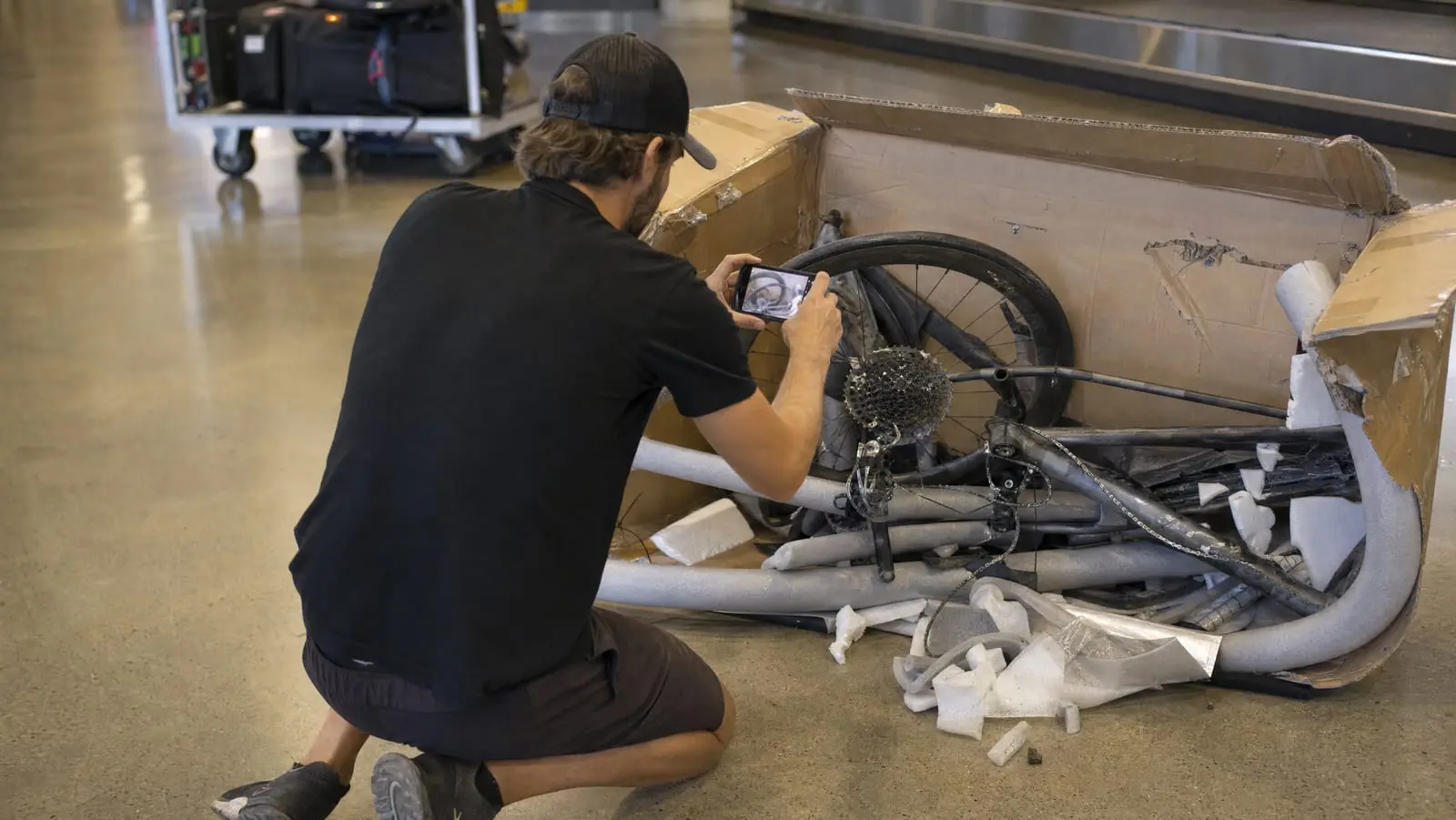
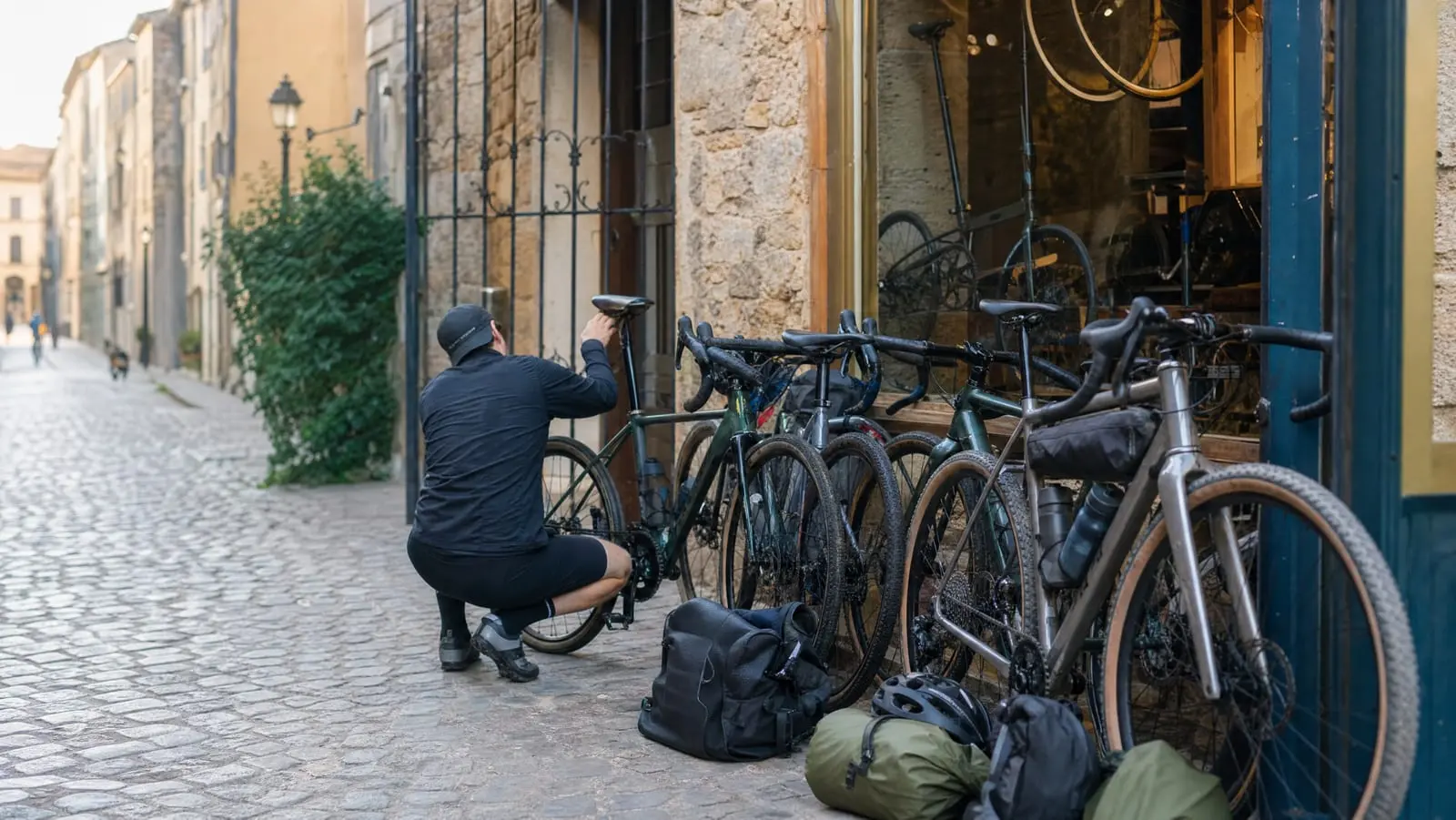
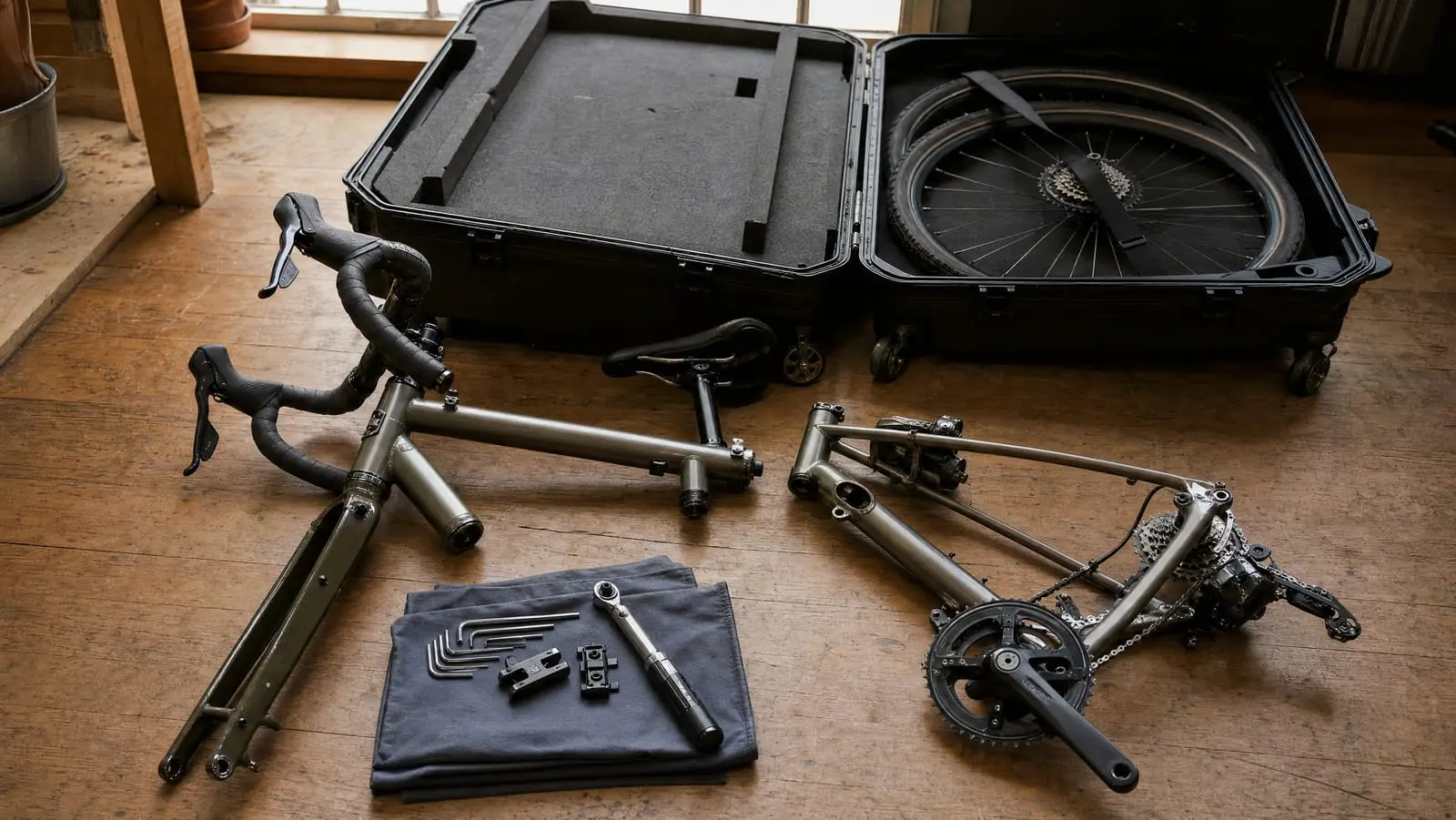
Taking a Bike on Trains, Buses, and Ferries: Amtrak and Beyond
20+ years testing gear in Colorado backcountry
Taking a Bike on a Train, Bus, or Ferry: The Three Service Models
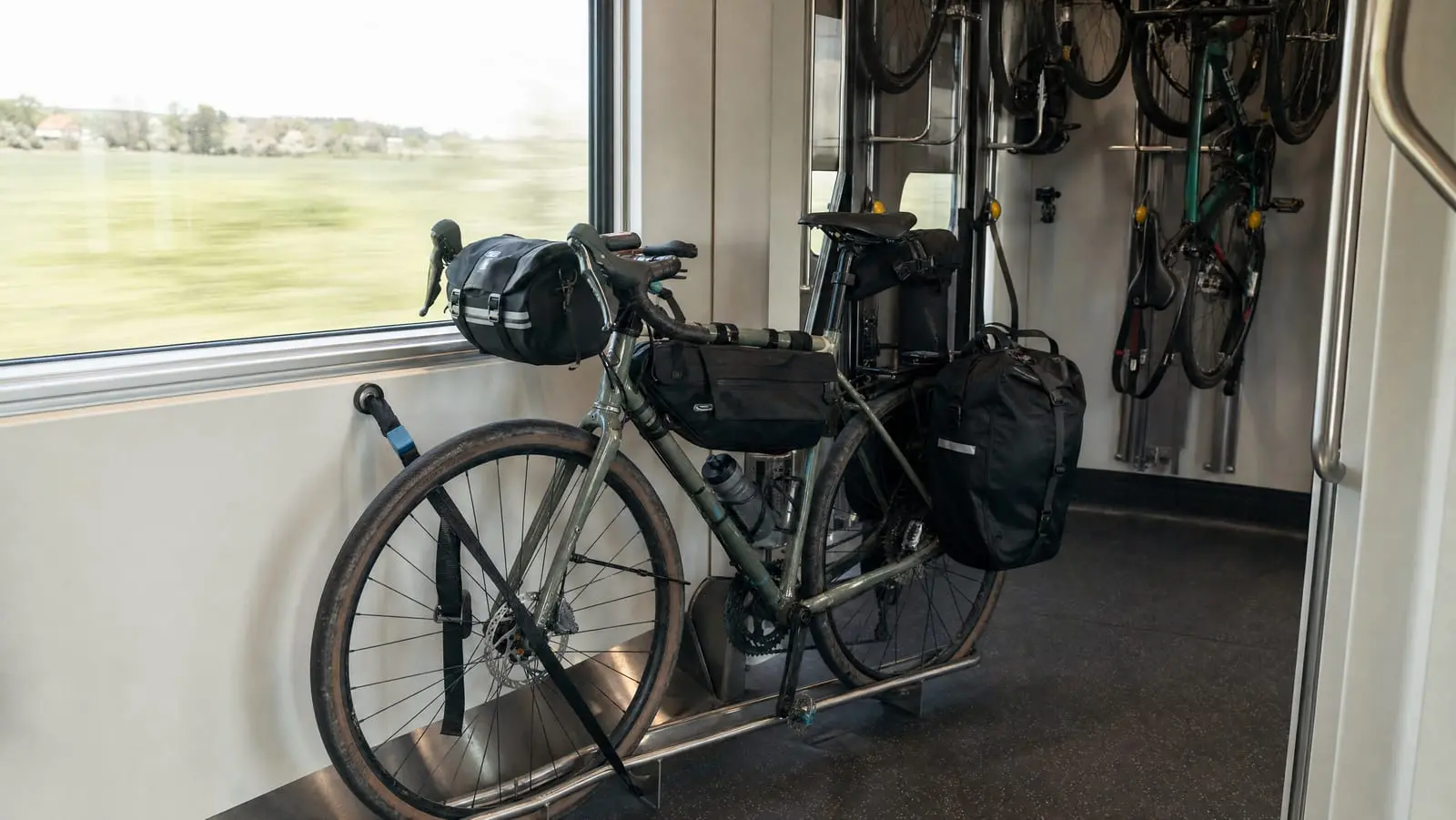
Taking a bike on a train, a bus, or a ferry comes down to three service models. Roll-on: the bike stays assembled in a reserved space. Checked or boxed: you take it apart and it rides as baggage. Rack-carried: a two- or three-bike rack on the nose of a transit bus. Which one you get is a property of the specific departure, not of the railroad or the bus company.
That distinction is the whole article. It is also why surface transport earns its planning burden: it is the only way of traveling with your bike that does not involve taking the bike apart. No box, no pedal wrench, no 45 minutes of reassembly in an airport parking garage with black hands. You push the bike aboard and ride away at the far end, sometimes with the bags still on it.
The catch is inventory. Bike spaces are a fixed, very small number per departure, they sell out, and a walk-up bike with no reservation is frequently refused.
Amtrak Bike Service: Roll-On, Trainside Checked, and Boxed
Amtrak runs all three models, and the practical gap between them is bigger than the gap in price. Carry-on (what riders call roll-on) means racks you load yourself. Trainside checked means, in Adventure Cycling's description, that "you check your bike onto the baggage car by handing it to an Amtrak staff person" — which also means walking to the baggage car at boarding and again at your stop. Boxed is the fallback where neither exists.
Amtrak's own page states that most routes charge a bicycle fee of $20 or less, that fees vary by route, and that the amount appears in the price summary when you reserve (Amtrak). Boxed travel is priced separately: Amtrak's special items page lists a bike checked in a bicycle container for $10 in lieu of a piece of baggage, boxes sold at most staffed locations for $15, and checked bikes capped at 50 lbs and 70 by 41 by 8.5 inches (Amtrak).
The spread between routes is wide enough that you should never assume:
- Amtrak Cascades publishes that "Ten bike racks are available on every Amtrak Cascades train," reservable at $5 each, with boxing as the alternative at $15 per box plus a $10 handling fee (amtrakcascades.com).
- Northeast Regional carry-on launched at $20 per bike with "up to two bikes per departure," front wheel off to fit the rack, per Amtrak's September 3, 2020 announcement.
- Piedmont and Carolinian in North Carolina: $0 per bike on the Piedmont, whose baggage cars hold five bike racks, and $0 between Charlotte and Raleigh on the Carolinian, rising to $20 for stops from Selma to New York (NC By Train).
The equipment rules also disqualify plenty of bikepacking rigs. Adventure Cycling summarizes them as standard two-wheel bikes with tires up to about two inches wide and e-bikes under 50 pounds, with no recumbents, tandems or trikes. A 2.6-inch plus-tire bike is a boxed bike on those trains.
Set those fees beside the numbers in our airline bike fees and policies piece: rail is cheaper and drops you and an intact bike downtown, but an overnight train is an overnight.
Two bike spaces on a Northeast Regional is not a policy problem. It is an inventory problem, and inventory sells out.
Commuter and Regional Rail: Cheap, Unreserved, Extremely Local
US commuter rail is the friendliest tier and the hardest to generalize about. Bikes are typically free, typically need no reservation, and are typically restricted at peak hours — and every one of those hedges is doing real work, because rules are set agency by agency.
The MBTA shows the shape. Its policy says "Up to four bikes and/or devices may be permitted per open coach on off-peak trains," warns that bikes "may be prohibited if coaches become too crowded," caps non-folding bikes on subway cars at two per car, and permits fully folded bikes any time (MBTA). That is a capacity limit, a peak restriction and conductor discretion, stacked.
So do not hunt for a national rule. Search the agency name plus "bikes on board" and read three things: the peak window, the per-coach limit, and whether that limit is a guarantee or a courtesy.
Bikes on Buses: The Awkward One
Buses break two different ways.
Intercity coaches: boxed, in the bay, at a price
On long-distance coaches the bike is cargo. FlixBus, whose parent company Flix also owns Greyhound in the US, says you can bring a bike "on most of our trips, but the availability of bike spots may differ by route and country," and that "e-bikes, tandems, and tricycles are not allowed" (FlixBus). Its bicycle carriage price list is set by country of departure: USD 23.5 to 47 in the US, EUR 12 to 24 in Germany, EUR 6 to 12 in France (FlixBus).
The line to internalize from that page: "Adding bikes at the bus is subject to higher fees and not guaranteed, since there is limited space for bikes on our buses." Turning up at the curb with a bike and hope is the most common way this goes wrong.
Since a coach means a boxed bike anyway, it competes against shipping your bike ahead, and against simply flying. Once you are disassembling, you have given up what made surface transport special.
Front-rack transit buses: free, fast, fussy about your setup
City buses are the opposite: no reservation, usually no fee, hard physical limits. King County Metro states that "every Metro standard bus can carry 3 bikes on its front rack," with a max weight of 55 lbs per bike including accessories, a max tire width of 3 inches, no tandems, recumbents, cargo bikes or three-wheelers, and the blunt instruction that "if the bike rack is full, please wait for the next bus" (King County Metro).
For a loaded rig the sleeper problem is not weight — it is the support arm that swings over the front tire. Community Transit spells it out: "Bikes with attachments over the front wheel that block the support arm cannot be accommodated. This may include baskets, handlebar packs" (Community Transit).
The drill: pull the handlebar roll and the bottles, lift the bike into the slot, swing the arm over the front tire, and remind the driver at your stop that you are exiting through the front door. Practice once at an empty stop, because doing it first with six people watching is how bikes get dropped.
Ferries With Bikes: Usually the Cheapest Leg of the Trip
Ferries are the reason to route a trip along a coastline: almost always roll-on, almost always cheap, and they rarely ask you to disassemble anything.
Washington State Ferries charges a bike passenger the ordinary walk-on fare plus a stowage surcharge of $1 to $4 depending on route, waived with a multi-ride or ORCA card except on the Anacortes, San Juan Islands and Sidney BC routes. WSF tells cyclists to "arrive 20 minutes prior to departure time to get priority loading" and notes that "bikes may be secured to eyebolts on the bulkhead or to railings" (WSDOT).
BC Ferries is simpler still: "Cyclists are required to pay only a passenger fare (Your bike is FREE)," with no booking required (BC Ferries).
Two things to actually do on a crossing. Lash the bike down properly — an unsecured loaded bike on a rolling car deck falls into whatever is beside it, and derailleur hangers do not survive that. Take the handlebar bag with you. BC Ferries states that "per Transport Canada safety regulations, passengers loaded on enclosed lower decks are required to leave their vehicle/bike during the sailing." You will be upstairs regardless, so your wallet, passport, phone and battery should be too — the cheapest theft prevention you will do all trip.
European Trains With Bikes: Inventory Is the Whole Game
Europe has the best bike-on-train network anywhere and the most ruthless booking system. High-speed services want a bagged bike or a scarce reserved space; regional trains are generous, cheap and frequent.
- Germany. Deutsche Bahn is explicit: "You always need a long-distance bicycle ticket and a bicycle space reservation on long-distance trains," bookable up to six months ahead, with a red bicycle symbol meaning spaces are gone. Local trains need no reservation, just a bike ticket, though rules differ by transport association and some restrict bikes at rush hour (DB).
- France. SNCF Connect allows a dismantled bike in a labelled carrying bag of "no more than 90 x 130 x 50 cm" in the luggage areas, and notes regional TER policy varies, with a mandatory €1 bike reservation in several regions during the May-to-September 2026 season (SNCF Connect).
- Italy. Trenitalia charges a €3.50 supplement for an assembled bike on regional trains, valid until 11:59 p.m. on the date shown, and the same €3.50 with mandatory booking on Intercity. On the Frecce high-speed trains an assembled bike is not an option: one bike travels free only if disassembled and bagged within 80 x 110 x 45 cm (Trenitalia).
- The Channel. Eurostar prices a bike as registered luggage at £45 each way booked more than 48 hours ahead, £60 inside 48 hours, accepts fully assembled bikes on London-Brussels, and requires a bagged or boxed bike on London-Paris (Eurostar).
The pattern holds everywhere: the faster the train, the likelier your bike has to come apart. If the plan is one high-speed leg then a week of riding, the honest alternative is to skip the transport problem — renting a bike abroad often costs less than the reservations, bag and shop time you were about to spend.
How to Actually Get the Bike Aboard
The reservation is the hard part. Loading is a five-minute skill nobody teaches you.
Arrive 20 to 30 minutes early. WSF asks for 20 minutes to earn priority ferry loading, and the same margin at a station buys time to find the right car.
Strip the bike before you lift it. Frame bag, seat pack and bottles come off on the platform, not in the doorway — hanging a fully loaded bike from a hook by its front wheel is how rims get tweaked. Our guide to packing bags and weight distribution is easier to apply when the bags come off as a set. Keep them with you, too: in a bike car or on a car deck, gear sits unattended for hours.
Learn the hook or the strap before you need it. Vertical hooks take the front wheel; horizontal racks want a strap through the frame. Tighten it, then shove the bike sideways to check.
Know your dwell time. Some stops last two minutes. Be unhooked, bags shouldered and standing at the door before the train slows — and if your bike is trainside-checked, the baggage car door is not the one you boarded through.
Where Surface Transport Wins Outright
Three trip shapes justify the hassle.
Point-to-point. Ride one direction, train back. It turns an out-and-back into a linear route with no shuttle and no second driver.
The bail-out. A derailleur explodes on day three, or the weather turns dangerous. A rail line or ferry route inside your corridor converts a trip-ending problem into a shorter trip. A flight cannot, because a boxed bike needs a shop and two hours you do not have.
Trailheads no airport serves. Ferry towns, mountain valleys and river-corridor towns with one daily train are exactly the places worth riding, and several of the best beginner routes in the US start within a few miles of a platform.
The tradeoff is real: surface transport is slower and fails harder, and a missed bike reservation on a one-train-a-day route costs a full day. We still take the train on any corridor that has one, because the trip where you never open a toolbox is a better trip.
The Bottom Line
Find out which of the three models your departure uses, reserve the bike space in the same transaction as your seat, and confirm the fee on the operator's own page rather than trusting any number here, including ours. Then show up early, strip the bags before you lift, and keep valuables on your body.
Do that and you get the version of bike travel that never starts with a cardboard box. For the full picture — including boxing, shipping and flying when the train will not work — see our complete bike travel guide.