Racks and Panniers on Full-Suspension and Small-Frame Bikes
20+ years testing gear in Colorado backcountry
The Short Answer for a Bikepacking Rack on a Full-Suspension Bike
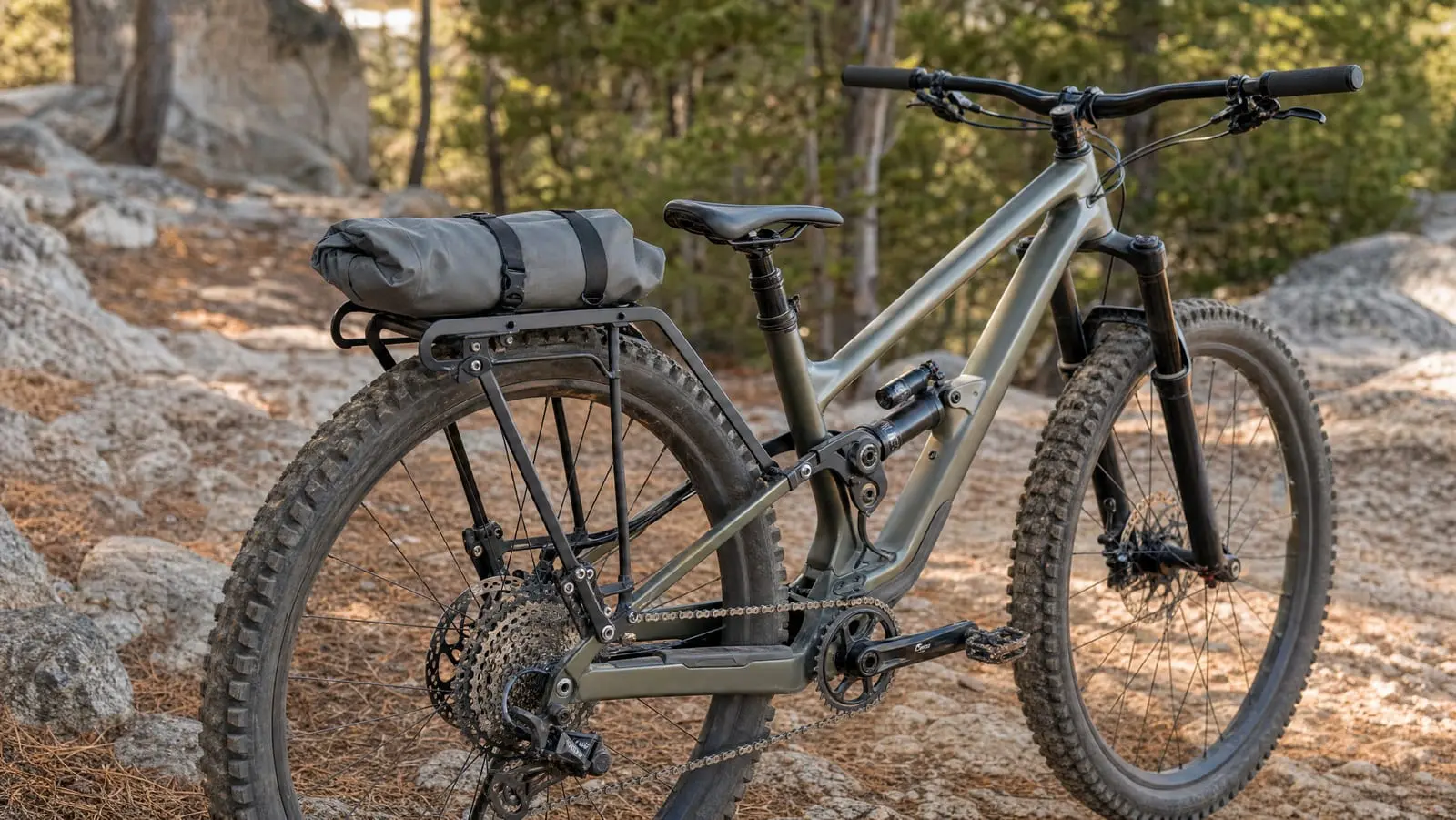
Use a rack that mounts to the rear axle and travels with the swingarm, or one that clamps only to the rear stays with no seatpost attachment at all. Rule out seatpost-clamp racks and any strut that bridges the moving rear triangle. On a small frame the fix is the same — volume on a deck above the tyre, not hanging off the saddle.
Riders arrive expecting to be told to buy a bigger seat pack. The honest answer is usually a deck. Of everything we have written about rack-based carry systems, this is the one case where a rack beats a soft bag outright, and the reason is the dropper post. A seat pack hangs off the saddle, so it descends with it; a deck sits above the tyre regardless of where the saddle went. BIKEPACKING.com's rear-rack gear index makes the same point, noting that racks are especially advantageous with a long-travel dropper because they leave the saddle area clear for the post to move fully, and suggesting a drybag strapped to the platform when a seat bag is too small.
Why the Soft-Bag Default Fails on Exactly This Bike
The standard bikepacking answer — three soft bags, no hardware — assumes three spaces this bike does not have. The main triangle is full of shock and linkage, which is why bikepacking bags versus panniers resolves differently here than on a rigid frame. The space behind the saddle is governed by a post that moves. And the rear triangle moves relative to the seatpost through the travel.
That last one is the mechanism people miss. A rack bolted between the seatpost and the moving rear triangle has to change length as the shock compresses, and it cannot, so it binds or it breaks. No clever bracket escapes this; the two ends of the span are not rigid with respect to each other by design. Either the whole rack rides on the swingarm, or the whole rack rides on the front triangle — not both.
The dropper is the other constraint, and it fails more quietly. A seat pack sized with the saddle at full height sits somewhere else entirely when the post is slammed on a descent. BIKEPACKING.com's dropper-post seat bag index puts numbers on it: dropper-specific packs typically want roughly 5 to 8 inches, 13 to 23 cm, between saddle and rear tyre, and packs of 5 to 9 litres suit lightweight setups without affecting dropper function, while anything much larger risks tyre clearance problems. The same index recommends a rear rack or mountless rack when you need more volume.
Read that honestly and the usual recommendation inverts: if 9 litres is the practical ceiling on a dropper bike, advice to size up your saddle bag is advice to buy something that will buzz the tyre on the first descent.
A seat pack descends with the saddle. A deck does not care where the saddle went.
The Mount Types That Work, Strongest First
Most full-suspension frames have no rack eyelets, so this is a load-path question before it is a product question — the ranking logic in mounting a rack without eyelets applies, with one rule layered on top: the load path must survive the travel.
Axle-mount racks that travel with the swingarm
A fit kit replaces the rear thru-axle with one carrying threaded bosses, and the rack bolts to those. The load enters the axle, passes into the dropouts and then the swingarm — the path that already carries your weight — and because the rack rides the moving part, nothing has to bind. Old Man Mountain's Elkhorn is the reference design; Old Man Mountain lists a 25 lb, 11.4 kg, rating, and a Radavist long-term review notes the racks can be installed on full-suspension bikes using Robert Axle Project thru-axle mounting, with a reminder to use Robert Axle Project's axle finder to pick the correct axle for your bike. One retailer's rear fit kit listing specifies 174 to 189 mm thru-axle lengths with an M12 by 1.0 thread.
Tailfin takes the same approach and is explicit about the suspension problem. Its fitting guidance describes small bushings at the connection points that, in Tailfin's words, "allow each part to pivot and work with your rear suspension system", and for full-suspension bikes it recommends its fixed CargoPack (18 litre) or SpeedPack (10 litre) over the Carbon Pannier Rack, on the grounds that the fixed system is stronger off-road and lighter because there are fewer components. When a maker tells you which of its own products to buy for your case, that is the most useful sentence on the page.
Failure mode: a mismatched or under-torqued axle, which is not a failure you ride out. Follow the axle maker's documentation exactly.
Stay-mounted strap racks, with no seatpost attachment
The second workable family braces off the seatstays on rubber-faced cradles held by tensioned straps and touches the post nowhere. Aeroe's FAQ is unusually direct about why that matters, stating that the Spider rear rack "fastens to the rear stays of a full suspension bike totally independent to the seat post" and calling it a good solution for dropper post and full-suspension use. Published capacity is a recommended total of 16 kg, 35 lb, spread across a maximum of 5 kg per cradle and 7 kg per Quick Mount Pod.
Two caveats worth more than the capacity figure. Bike-magazin's review of the same rack stresses that it must be positioned so the load never contacts the frame or seatpost even when the suspension is compressed — a clearance check in the stand is not the check that counts. And Tour-magazin's review found the load sits relatively high above the rear wheel, making the bike feel rear-heavy when fully loaded and costing it handling marks.
Failure mode: strap creep and cradle rotation rather than fracture. It loosens before it lets go, which is a virtue only if you check it.
Minimalist cargo-cage decks
The low-volume answer is a deck with 3-pack bosses instead of pannier rails. Adventure Cycling's 2026 gear-trend piece describes them plainly — "instead of pannier rails, these minimalist racks sport 3-pack mounts on their uprights" — and frames the result as the dropper fix: "strap on a couple 5-liter dry bags, plus another 8 to 10 liters on the deck, and you have nearly 20 liters of stable, dropper-post-friendly capacity." Roughly 20 litres is not a touring load, but it is about double what the dropper will allow a seat pack, which is why we would start here for an overnight. Our notes on the best rear racks for bikepacking separate these decks from conventional four-point racks.
The ones to rule out
Seatpost-clamp racks: incompatible with a dropper, and all the load goes through one clamp on a cantilever. Bolt-on struts bridging the travel path: covered above, and careful fitting does not fix geometry. Any clamp on a carbon stay the frame maker has not approved: no.
The Honest Capacity Ceiling
A full-suspension bike will not carry a four-pannier touring load, and it should not be asked to. A rack here is a capacity fix for a bike that had almost none — perhaps 9 litres of seat pack to perhaps 20 on a deck — not a route to touring weight.
The published figures make that point without help from us. Aeroe's recommended total is 16 kg for the entire rack, subdivided to 5 kg per cradle. The Elkhorn's listed rating is 25 lb, 11.4 kg, again for the rack rather than per side. A loaded four-pannier touring setup lives well above both, so the ceiling is not a matter of taste.
Two things to check before you load past halfway, neither of which the rack spec covers. The rear wheel was laced for rider weight and cornering loads, not a static mass hung behind the axle — engineering reasoning rather than a measured limit, but the reason we would not push a trail wheel to a rack's full rating. And brake and tyre clearance change through the travel, so check both at full compression, per Bike-magazin's warning.
If the trip genuinely needs touring volume, the honest answer is that this is the wrong bike for it. Take the hardtail, use a trailer, or move volume forward onto front racks and low-riders — the only remaining direction on a bike whose rear end is this constrained.
Re-Set Your Suspension With the Load On
Adding static weight behind the rear axle changes what your shock was set up to do. Sag is measured at rider weight; the bike now carries rider weight plus a deck load, so both the sag figure and the rebound speed that suited it describe a bike you no longer have.
Tailfin says this plainly in its own guidance, advising that the extra weight carried on the bike will affect your suspension so sag should be adjusted accordingly, and recommending a test ride on a familiar trail with the new setup to adjust shock pressure, rebound and compression if available. This is the step almost everyone skips, and it is the cheapest improvement available on a loaded bike.
We will not give you pressures or click counts: the right numbers depend on your shock, your frame's leverage curve and your load. Your shock manufacturer publishes a recommended sag range for your frame — use that, with the bike loaded as you intend to ride it.
Small Frames and Short Riders Have the Same Problem, Milder
A small frame does not move underneath you, but the geometry lands in the same place: the triangle is small, so the frame bag is small, and a short seat tube with a low saddle compresses the saddle-to-tyre gap before a dropper is even involved.
BIKEPACKING.com's guide for shorter riders is blunt about it, stating that "no matter what wheel size you run, small frames and shorter saddle heights equate to limited tire clearance," with one author noting that the more a seat pack is stuffed, the more likely she is to buzz the tyre. The guide reaches the conclusion this article is built on, saying "a rack and bag pairing can virtually eliminate the possibility of hearing the dreaded buzzing of seat bag on tire." The margins are tight: one 15 litre seat pack's listing specifies a minimum of 8 inches from the seat rails to the top of the rear tyre, which a short seat tube may simply not offer.
Heel strike is the other effect. The same guide observes that the smaller you go in frame size, the greater your chances are of clipping your heel on the bottle — and the same shrinking clearances are what we would expect to bite the moment you set panniers rearward on a short chainstay. Low standover on a loaded bike also changes how it feels to mount and dismount on a slope — a fit question, not a bag question; bike fit on a loaded bike covers the part no rack solves. The same reasoning applies to plenty of XS and shorter-reach frames, and it is geometry, not a separate product category.
So: a smaller seat pack plus a deck beats one oversized seat pack, every time, on a small frame. Two medium volumes in two load paths are more stable and far less likely to rub than one large volume on a lever.
What Actually Belongs on the Deck
Put the bulky light things up there — sleep kit, shelter, insulation — and keep the dense things low and central. The split matters more here than on a rigid bike. The deck sits high, as Tour-magazin's rear-heavy finding shows, so every dense item up there is a lever on a bike you want to throw around — and weight behind the axle is exactly what your new suspension setup is compensating for.
So this ends up a hybrid system rather than a rack system — the deck carries volume, the remaining soft bags carry mass. Combining racks with bikepacking bags is where that division of labour gets worked out, and our guide to weight distribution when packing covers which items belong where. Use the deck for the awkward shapes a seat pack compresses badly.
The Bottom Line
A full-suspension bike is not a bad bikepacking bike. It is a bike whose carrying spaces were spent on a shock and a dropper, and the hardware answer is narrower than the soft-bag answer most guides reach for. Mount to the axle so the load travels with the swingarm, or clamp only to the stays with nothing touching the post. Verify clearance compressed, not in the stand. Re-set sag loaded. And treat 20 litres as the win it is instead of chasing a load this bike was never going to carry.
For the full picture — mounting hardware, eyelet ratings, pannier choice and how rack systems compare across bike types — it is all in our complete guide to bikepacking racks and panniers.