The Best Rear Racks for Bikepacking: Load-Bearing Picks Compared
20+ years testing gear in Colorado backcountry
The Best Bikepacking Rear Rack, Answered First
The best bikepacking rear rack is the one whose capacity number was measured against a published standard, because every other figure on these listings is marketing. Our overall pick is the Topeak Explorer Disc Rack MTX 2.0 (Without Spring) at $67.32 as of October 2026. For a frame with no eyelets, the AEROE Spider at $169.00 as of October 2026. We earn a commission on purchases made through the links below, at no extra cost to you.
Now the uncomfortable part. Of the five racks here, exactly one tells you what its capacity number means. Topeak's own product page for the Explorer Disc MTX 2.0 states that it "supports loads up to 57 lb (26 kg)" and that it meets EN 14872 / ISO 11243. The cheapest rack here, the ZTZ at $32.99 as of October 2026, claims 110 to 165 lbs and names no standard at all. The rack that cites a test standard rates less than half of what the rack citing nothing claims, and that gap is the whole story of this category.
So we have organised this around load path and mount compatibility rather than litres and finishes: where the weight goes, what it travels through, and whether your frame can take any of it. If you are still assembling the carrying system, start with our guide to bikepacking racks and panniers. And if panniers are unsettled, read bikepacking bags versus panniers before buying a platform to hang them from.
What Actually Breaks on a Loaded Rear Rack
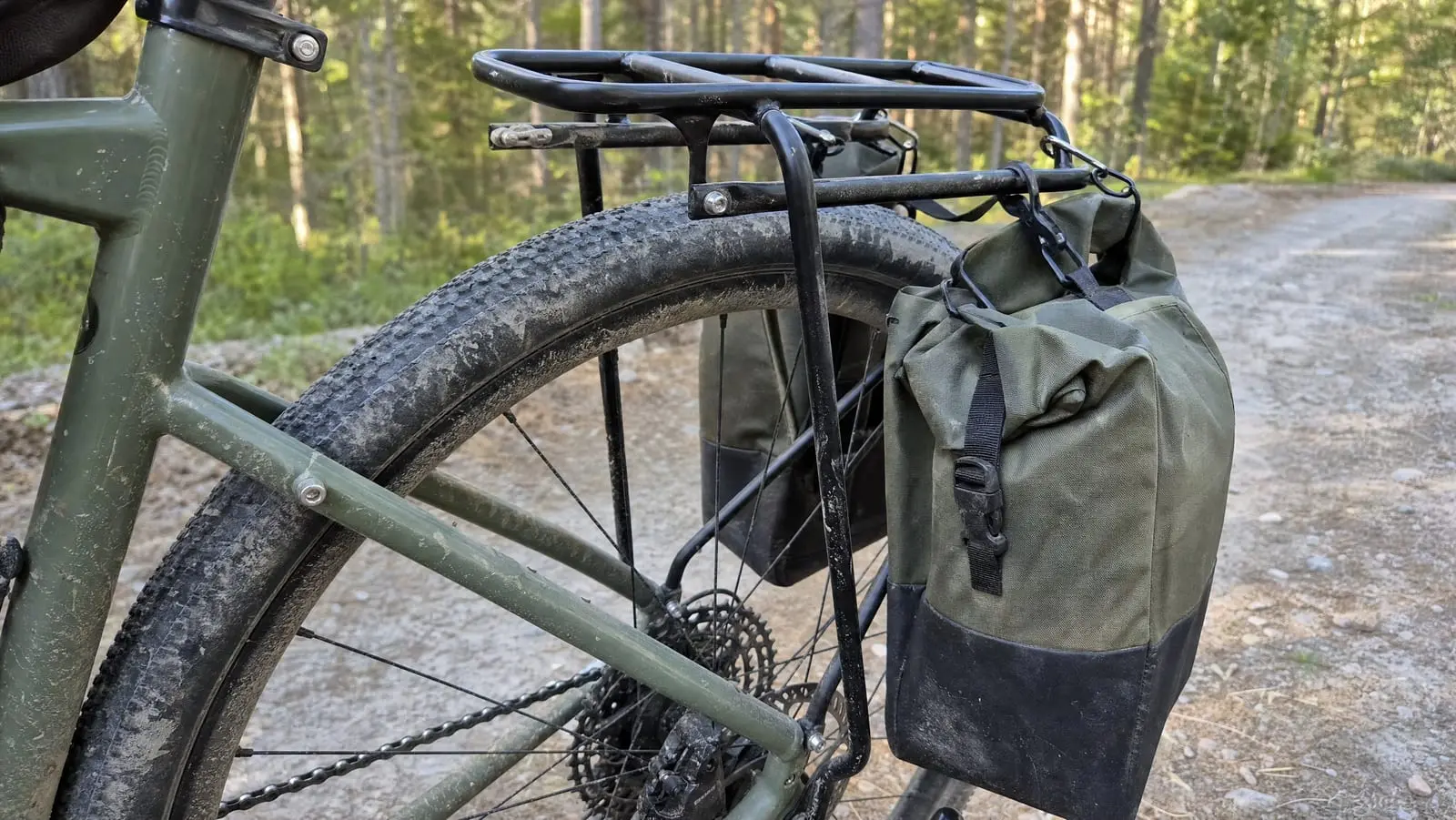
A rear rack is not a shelf. It is a lever. Weight sits on a platform usually under 40 cm long, held up by two thin stays running down to the dropout eyelets, and every bump feeds that load through the stays and out through four small bolts. The sequence is usually the same: bolts work loose, the rack moves, movement concentrates stress at a weld or a stay bend, and something snaps — usually a stay, sometimes the eyelet.
So the fastener, rather than the tube, tends to be the weak point. Tubus, which has built steel touring racks for decades, is specific in its own instructions for fitting a carrier to the dropout: M5 socket screws at each dropout tightened to 5-6 Nm with a medium-strength threadlocking fluid, and 4.5 Nm for the M5 flat head screws at the mudguard stays, with the first two threads started by hand and all of them finished with a torque wrench — and its model-specific manuals give different figures again, 4.3 Nm for the M5 screws on the FAT. Those are Tubus figures for a Tubus rack. Check your own rack's documentation before borrowing a torque number from anywhere, including us — we work through the arithmetic in rack weight limits and bolt torque.
The listings hint at it themselves. CXWXC's own copy advises checking whether screws in various parts have come loose after a period of use — a maker telling you what vibration does to its hardware. Threads are finite too: riders on the BikeRadar forums discussing stripped rack eyelets point to an M5 helicoil as the repair that restores the thread, which makes the eyelet a consumable.
Why capacity ratings differ so wildly
Because almost nobody says what they measured. The relevant standard is ISO 11243. The ISO catalogue describes ISO 11243:2023 as specifying safety and performance requirements for the design and testing of luggage carriers positioned above and adjacent to the wheels of cycles, covering both user-mounted carriers and those supplied on complete bikes, with test methods including static vertical load, lateral load, dynamic load, strength at high and low temperature, and crack detection. The older European standard EN 14872:2006 covered permanently mounted carriers and has since been superseded by EN ISO 11243.
That is why Topeak citing EN 14872 / ISO 11243 means something and a bare "60 lbs" does not. A standard-tested number survived a dynamic load cycle and a sideways pull. Where two racks list different capacities and only one names a standard, the lower standard-backed number is the more useful of the two.
Does Your Bike Even Take a Rear Rack?
Four things decide it, and these listings are explicit about two of them.
Eyelets. The Topeak listing states plainly that installation requires threaded rear rack eyelets and that the rack is not compatible with full-suspension bicycles or frames without them. The AEROE listing states the opposite just as plainly: it fits any MTB or eMTB with no inbuilt mounts and no axle mounting, including small and full-suspension frames, with full dropper-post use and zero attachment to the seat post. Hardtail or gravel frame with four eyelets, and you have the whole market; full-suspension, and you have the AEROE plus the workarounds in mounting racks without eyelets.
Disc brake clearance. Topeak's listing promises extra clearance for many disc brake bicycles while still fitting many non-disc frames, and the Ibera here is the disc brake mount version. A non-disc rack on a disc bike fouls the caliper, and the improvised shim stack that fixes it is how racks come loose.
Dropper posts. A seatpost-clamped rack and a dropper are mutually exclusive, which is why the AEROE's zero seat post attachment is the specification that matters most on a modern trail bike.
Small frames and heel strike. Short chainstays put your heel where the pannier wants to be. Topeak ships 26.5 cm mounting arms and sells optional TRK-R023 extended arms at 34.5 cm for smaller frames, so measure first. Whole racks exist to solve this: Soma's Rakku 2 is sold on the basis that its platform sits farther behind the rear axle than most racks for extra heel clearance on short-chainstay road, gravel and cross frames, and Riteway's offset carrier moves the bag roughly 10 cm rearward to prevent heel strike. Moving load back buys clearance and costs handling — the trade in how a load changes bike fit.
The Five Rear Racks We Would Buy
We have not ridden, loaded or weighed any of these racks. Every specification below is the maker's; our contribution is judgement about which frame and trip each suits.
Topeak Explorer Disc Rack MTX 2.0 (Without Spring) — the standard-backed pick
Topeak Explorer Disc Rack MTX 2.0 (Without Spring)
Tubular 6061 T-6 hollow aluminum with the integrated MTX QuickTrack platform. The listing states support up to 26 kg (57 lbs) and that the rack meets EN 14872 / ISO 11243 — the only capacity figure in this roundup tied to a named standard.
- Listing states 26 kg (57 lbs) support and compliance with EN 14872 / ISO 11243
- Extra clearance for many disc brake bikes, also fits many non-disc frames
- MTX QuickTrack slide-and-lock for MTX TrunkBags, baskets and panniers
- Fits compatible 26 inch, 27.5/650B and 700C bikes
This is the rack for the rider whose frame has eyelets and whose trip is long. Not because of the tubing, which is unremarkable 6061 T-6, the same alloy the budget CXWXC listing names, but because the 26 kg figure has a test behind it. Every other number here is a number someone typed.
Two honest limits. The fitment wall first: eyelets required, no full-suspension frames, per Topeak's own listing, which excludes a lot of the bikes people own. Then the variant — this is the "Without Spring" model, so there is no sprung top clamp and a dry bag on the platform is entirely your straps' problem. Buy two or three cam straps alongside it and run them through the platform rails in both axes.
Skip it if you are already inside Ibera's bag ecosystem, or if you want rack-top bags that click on without buying into MTX. QuickTrack is excellent and it is also lock-in.
AEROE Spider Rear Bike Rack — the answer when the frame has no eyelets
AEROE Spider Rear Bike Rack
A quick-release rack that the listing says fits any MTB or eMTB with no inbuilt mounts and no axle mounting, including small and full-suspension frames, with full dropper-post use and zero attachment to the seat post. Stated capacity 35 lbs, and the included cradle takes any brand of dry bag.
- Listing states it fits small and full-suspension frames with no inbuilt mounts
- Full dropper-post use and zero seat post attachment per the listing
- Stated 35 lb capacity
- Ships with one cradle, mountable on the top or the sides
At $169.00 as of October 2026 this is five times the ZTZ, and on paper it looks worse: 35 lbs stated against racks claiming 57 and 60. Judge it on a different axis. The money buys mounting, not capacity — it is the only rack here whose listing claims a full-suspension frame, a small frame and a working dropper post, which is the bike a great many people are actually riding off-road in 2026. For that rider the alternative is not a cheaper rack, it is no rack.
Note what it is not. It is a dry-bag platform with one cradle included; extra cradles, bags and accessories are sold separately, so a two-cradle setup costs more than the headline. There is no pannier rail system and no promise of one.
If your frame has four rack eyelets and no rear suspension, this is not your rack — buy the Topeak and spend the $100 difference on bags.
Ibera Bicycle Touring Carrier Plus+ (Disc Brake Mount) — best value, with a gap in the spec
Ibera Bicycle Touring Carrier Plus+ (Disc Brake Mount)
Frame-mounted aluminum carrier with disc mounts, built for heavier top and side loads per the listing, height adjustable to fit most 26-29 inch and 700c frames. Stated weight 760 g, with a quick-release bag system aimed at Ibera's own bags.
- Frame-mounted with disc mounts for heavier top and side loads per the listing
- Height adjustable, fits most 26-29 inch and 700c frames
- Stated weight 760 g
- Quick-release mounting for named Ibera bags alongside Ibera panniers
This is the most adaptable rack here under $50. Height adjustability genuinely helps on a mixed fleet or a bike you are still setting up. For a disc-brake hardtail that wants panniers plus a bag on top, $49.99 as of October 2026 is well spent.
Then the gap: the Ibera listing states no weight capacity at all. Not a conservative figure, not an optimistic one — none. "Built for heavier top and side loads" is a comparative with nothing on the other side of it. Treat it as an unrated rack: dense items in panniers down low rather than stacked on the platform.
Read the compatibility list before buying, too. The listing names the Ibera bags the Plus+ accepts alongside its panniers — IB-BA1, IB-BA2, IB-BA3, IB-BA11, IB-BA14, IB-BA15, IB-BA9, IB-BA6 and IB-BA12 — and advises checking measurements first. That is a well-documented ecosystem and also a narrow one.
CXWXC Rear Bike Rack — the budget pick that admits its own weakness
CXWXC Rear Bike Rack
Adjustable 6061-T6 aluminum rack that the listing says fits 26-29 inch and 700c wheels with disc or non-disc brakes, carries up to 60 lbs of gear, and stays narrow to keep weight near the centreline. The listing also claims heel clearance with panniers plus a trunk bag on top.
- 6061-T6 aluminum, listing states up to 60 lbs of gear
- Adjustable for 26-29 inch and 700c, disc and non-disc
- Narrow width keeps weight near the centreline
- Space to attach a rear reflector
At $42.29 as of October 2026, down from a $44.64 list price, this is the cheapest rack here we would willingly load. Two of its claims are the right kind: a narrow platform keeps the load near the centreline, where you want it on loose ground, and heel clearance is the practical problem most budget racks ignore.
The 60 lb figure cites nothing. It is about 1 kg above the standard-tested Topeak number — 60 lb is 27.2 kg against Topeak's 26 kg — on tubing described in the same alloy family, and it arrives with no test behind it: a discrepancy that resolves as optimism rather than engineering. We would treat it as a 20 kg rack. And take the listing's own maintenance note literally: on washboard, check those screws every day.
ZTZ Universal Adjustable Bike Rear Rack — the claim we do not believe
ZTZ Universal Adjustable Bike Rear Rack (2025 Upgraded)
An adjustable rack with telescopic support rods and three-point fixation, a 38.5 x 14.5 cm platform and triangular side bars that keep a bag off the spokes. The listing claims 110-165 lbs of capacity and cites no standard for it, which is why we read that number as marketing rather than a rating.
- Aluminium alloy with stainless steel screws per the listing
- Platform stated at 38.5 cm long by 14.5 cm wide
- Telescopic support rods adjustable 3-15 cm, three-point fixation
- Two triangular side bars keep a bag clear of the wheel and spokes
Start with the number, because it is why this rack is in the article. The listing claims 110 to 165 lbs — 50 to 75 kg — and adds that it can "even carry the people". That is two to three times the Topeak's standard-tested 26 kg, on a cheaper rack with a smaller platform.
Three things are wrong with it. A 55 lb span is not a rating; a rating is one number with a test behind it. No standard is named, so there is nothing to check it against. And a figure that invites you to carry a passenger describes a use case the ISO 11243 load tests were never written for. We would not run a claimed 165 lbs on any $32.99 rack, and we would not load this one past about 15 kg.
What would change our mind: a named standard, a single maximum load figure instead of a range, that figure marked on the rack where a buyer can see it, and documentation of the static vertical, lateral and dynamic load tests the ISO scope describes. None of it is present.
The rack is not worthless at $32.99 as of October 2026. Telescopic rods adjustable over 3-15 cm with three-point fixation is real adjustability, and the side bars that keep a bag out of the spokes are a genuine safety feature. Buy it as a light-duty rack for a commute or an overnight — not for the big number.
A capacity figure with no standard behind it is not a specification. It is a sentence written to win a comparison table.
Matching the Rack to Your Panniers
Panniers do not fit racks; hooks fit tubes. Measure your rack's top rail before buying bags, because the adapter lottery is where most rack-and-pannier purchases go wrong. Ortlieb shows the range involved: its QL2.1 replacement hooks are sized for 16 mm rail and ship with inserts for 8, 10 and 12 mm tubing so one bag clamps snugly on thin or fat rails. A hook that merely rests on an undersized rail is the failure mode we keep returning to in the best panniers for bikepacking.
Then decide how much proprietary lock-in you will accept, because these racks answer the bag question three ways. Topeak's MTX QuickTrack slides and locks MTX TrunkBags, baskets and compatible panniers onto the platform: fast, secure, MTX only. Ibera's Plus+ promises its quick-release properly for the named Ibera bags alongside Ibera panniers, and tells you to check measurements first — a narrower promise than "universal". The AEROE Spider goes the other way: its cradle holds AEROE's IP65 dry bags or any brand of dry bag, so the consumable is a strap system rather than a bag family.
Our order of preference off-road: a positive mechanical lock, then conventional hooks with correctly sized inserts, then straps over a dry bag — though straps are the most vibration-proof of the three and the only option on the Spider. Where the load sits matters as much as how it attaches, which is the argument in how to pack bikepacking bags for weight distribution.
How to Choose, in Order
Frame first. Eyelets or none, rear suspension or not, dropper or not, disc or rim, chainstay length. It is a yes/no gate and it eliminates most of the market before price becomes relevant. The Topeak and the AEROE sit on opposite sides of that gate, and neither is a compromise for the other's rider.
Standard-backed capacity second. A named standard beats a bigger number every time. Where none is cited, assume the real figure sits well under the claim — and remember the eyelets and frame have their own ceiling.
Bag compatibility third. Choose between a proprietary lock, conventional hooks and dry-bag cradles before you buy the rack, not after. Changing your mind later means buying twice.
Weight last. The Ibera's stated 760 g against a rack a few hundred grams heavier is noise next to the three kilos of water you will carry over the same ground. If grams genuinely matter, the saving is in deleting the rear rack and going soft — see our complete bikepacking bag and storage guide — or moving load forward with front racks and low-riders.
The Verdict
Topeak Explorer Disc MTX 2.0 (Without Spring) at $67.32 as of October 2026 if your frame has eyelets: the only rack here whose 26 kg claim is tied to EN 14872 / ISO 11243, and the missing spring clamp is a strap purchase, not a dealbreaker. AEROE Spider at $169.00 as of October 2026 if your frame has no eyelets, has rear suspension or runs a dropper — that is what the five-times price difference buys, and nothing else. The Ibera Plus+ for adjustability under $50, loaded conservatively because the listing publishes no capacity. The CXWXC if the budget is hard, with its screws checked daily. The ZTZ as a light-duty rack only, with its headline number ignored.
The pattern: the number you can verify beats the number you cannot, and the bolts matter more than the tubing. Check your rack's documentation for torque, use threadlocker where the maker tells you to, and put a hand on all four mounting bolts at every resupply.
For how the rear rack fits the whole carrying system — front versus rear split, panniers versus soft bags, and when to skip racks altogether — read our bikepacking rack and pannier guide.