Bikepacking Bags vs Panniers: Which Carry System Suits Your Trip
20+ years testing gear in Colorado backcountry
Bikepacking Bags vs Panniers, Answered First
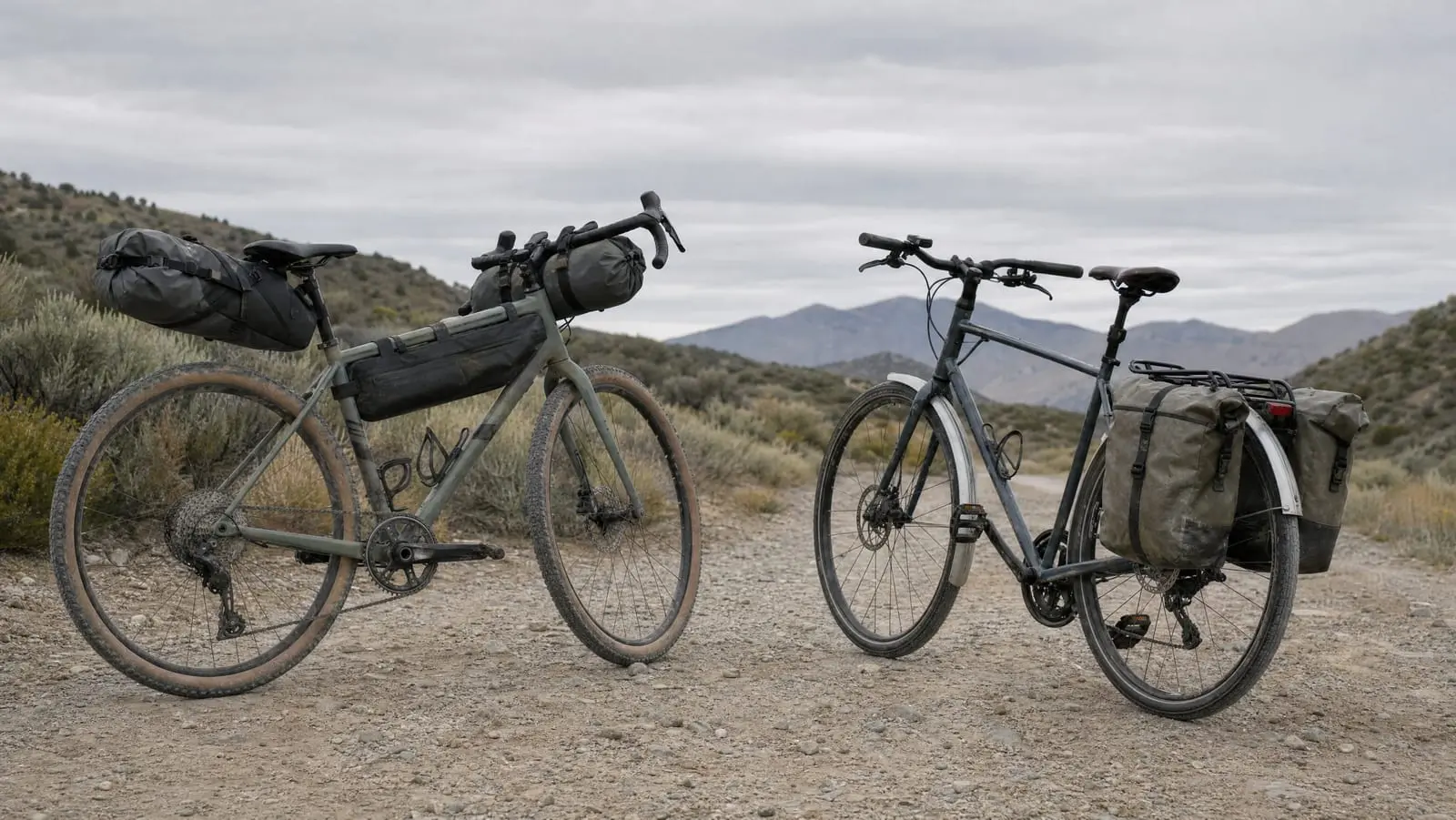
Run soft bikepacking bags when the route is technical, when your kit fits in roughly 40 litres, and when you want the bike to turn like a bike. Run a rack and panniers when you need 60 litres or more, when resupply is days apart, and when you will break and rebuild a camp every morning for weeks.
Now the uncomfortable part, because almost every version of this comparison skips it: soft bags are not lighter than panniers in any way that matters. Compare like volumes instead of like traditions and the advantage can run the other way. CyclingAbout's volume-matched tally puts 38 litres of rear panniers — a 30-litre pannier pair, a titanium rack, an 8-litre dry bag and straps — at 853 grams, against 1,079 grams for a 37.5-litre bikepacking set of handlebar pack, seat pack and frame bag. In that comparison the panniers win by 226 grams.
So the weight argument is mostly folklore. The real differences are packing ergonomics, off-road handling and cost per litre, and only one of those three favours soft bags without an argument. Forget the tribal question of bikepacker or tourer. Three practical ones decide this: the surface you will ride, the volume you genuinely need, and whether your frame can take a rack at all. If the hardware is unfamiliar, our guide to rack-based carry systems covers racks and mounting; this piece is about the choice.
The Three Questions That Actually Decide It
1. What surface will you genuinely ride?
Be honest about the route before you spend anything: this question alone can rule a system out. Panniers widen the bike by the thickness of two bags, they catch brush and rut edges, and they hang weight outboard where it argues with every direction change. On chunky singletrack that is not a preference, it is a tax you pay in every corner.
Soft bags exist because of that tax. Juliet Elliott, writing for We Love Cycling, makes the case plainly: rackless setups keep the load "evenly distributed and in line with the bike's frame", which is what makes a loaded bike feel agile rather than reluctant. Add hike-a-bike and the gap widens: you can shoulder a bike wearing soft bags.
The inverse is where soft-bag evangelism falls apart. On gravel roads, forest roads and pavement, the handling penalty of panniers is small and the volume reward is large. If your route is a dirt-road tour rather than a trail ride, choosing soft bags costs you litres and buys you almost nothing.
2. How many litres do you genuinely need?
This is where the two systems stop being comparable. BIKEPACKING.com's side-by-side of a traditional four-pannier touring kit against a standard bikepacking kit puts the touring setup at 102 litres of capacity for 5,019 g (11 lb) of bags and racks, against 42.7 litres for 1,779 g (3.9 lb) of soft bags. The same article notes what that ceiling does: cutting space from 102 litres to 43 cuts potential carried weight from 51 kg (112 lb) to 21.5 kg (47.4 lb).
Read those two sources together and a crossover appears. At around 38 litres, the pannier system in CyclingAbout's tally was the lighter of the two. At 50 litres it was not — four panniers and two racks came to 2,913 g against 2,123 g for an equivalent soft-bag kit, because the second rack and second pair of bags arrive at once. Above roughly 60 litres the comparison ends, because strap-on bags simply do not go there.
So the volume question has three answers. Under about 40 litres, choose on handling, because weight is a wash. Between 40 and 60, soft bags win on grams and lose on access. Above 60 — winter bag, four days of food, a stove, 6 litres of water — buy a rack.
3. Can your frame take a rack at all?
This question ends the debate for a lot of riders, and it belongs before any purchase. An eyelet-mounted steel rear rack is a serious piece of structure: the Tubus Logo Evo is listed by SJS Cycles at an additional load of 40 kg for a rack weighing about 600 g. Nothing you can strap to a saddle comes close to that.
Take the eyelets away and the numbers change hard. Seatpost-clamp racks are the usual workaround, and they tend to be rated a fraction as much: road.cc's review of one lists a 10 kg maximum load and the maker's warning that beyond it "the pannier rack may pivot and the stays could twist". The reviewer adds that they "wouldn't put this rack anywhere near an aero or carbon seatpost." A full-suspension frame or a bike with no mounts pushes you toward soft bags whether you like the idea or not.
Before concluding your bike cannot take a rack, read the best rear racks for bikepacking for what modern mounting looks like, and mounting racks without eyelets for the clamp, axle and seat-collar options. If the only rack your frame accepts is rated to 10 kg, you do not have a volume advantage any more and the decision is already made.
Handling, Honestly — Where the Weight Sits
Two things move when you switch systems: how high the weight sits, and how far out. Panniers put mass low and outboard, near the axles; soft bags put it inboard and, in the seat pack and bar roll, considerably higher. Low and outboard resists being shoved around on washboard but adds inertia to every turn and bar correction. High and inboard keeps the bike narrow and willing, but a heavy seat pack sways under out-of-saddle efforts and unweights the front wheel on steep climbs.
Panniers put the weight low and wide; soft bags put it high and narrow. Neither is free — you are choosing which failure mode you would rather ride.
The seat pack's own spec sheet sets the ceiling. SJS Cycles lists the Ortlieb Seat-Pack at 16.5 litres, 490 g and a maximum load of 5 kg (11 lb). That is a density limit as much as a weight limit: 16.5 litres that may only hold 5 kg means a seat pack is for sleeping bags and insulation, never for food, water or tools. Riders who ignore that number are the ones whose seat packs wag.
Where the weight sits is also fixable without changing systems. Moving dense items down and forward — into a frame bag, or onto front racks and low-riders — does more for handling than either camp claims, and our guide to packing and weight distribution sets out that order.
The speed component is real but small. CyclingAbout measured an aerodynamic advantage of "6% in my case" for bikepacking bags over four panniers — roughly 17 minutes across 100 km of hilly riding — and reckons each extra kilogram costs 10 seconds on the flat to 90 seconds in the hills over that distance. Seventeen minutes decides a race. On a four-day tour it is one unhurried coffee.
Volume and Cost Per Litre
Panniers win on litres per dollar, and the margin is not subtle. The Next Challenge's survey of bikepacking bags gives averages of 14 litres at £72 for handlebar bags, 13 litres at £96 for saddle bags and 7 litres at £78 for frame bags. Do the division: roughly £5 per litre on the bars, £7 under the saddle, £11 inside the frame. A soft-bag kit is three or four purchases at those rates, and the frame bag — the one piece you most want, because it carries low — is the worst value per litre of the lot.
Panniers invert that. Volume on a rack is bought in 20-to-40-litre increments, in a bag whose only complicated part is its mounting hardware, and the rack is a one-time purchase. Our roundup of the best panniers for bikepacking includes a genuine 20-litre pair for less than the average frame bag above.
Soft bags earn the premium back in a different currency: nothing is wasted. A frame bag fills a triangle of air no pannier can reach. Pay the per-litre premium for a frame bag, because it is the most useful volume on the bike; be sceptical about paying it twice more for litres a rack would sell you cheaply. Our complete bikepacking bag and storage guide lays that system out piece by piece.
Packing and Camp Life: The Pannier Can Be Opened
Here is the advantage nobody puts on a spec sheet: a pannier is a box with a lid. You open it beside the bike, find one thing, close it and ride on, or unclip it and carry it into a hut in one hand. Elliott's point that panniers "can be quickly removed and reattached, making setup and breakdown at campsites more efficient" sounds minor until you have done it eighteen evenings in a row.
A seat pack is the opposite: a tapered tube, loaded from one end and compressed to stop it swaying. Riders who switch commonly report the consequence; one of BIKEPACKING.com's authors puts it as "I literally can't remember how many times I packed, shifted everything around, unpacked and packed again". The organisational cost tends to follow: panniers let you dedicate a bag to food, one to cooking, one to clothing, while soft bags push gear wherever it fits — stove in one bag, fuel in another. Panniers cost width and buy access; soft bags do the reverse.
Durability, Repairability and What Actually Fails
The two systems fail in different places, and only one is governed by a published standard. Racks have one: BSI records BS EN 14872:2006 as published on 27 February 2006 and withdrawn on 31 July 2016, replaced by EN ISO 11243, "Cycles — Luggage carriers for bicycles — Requirements and test methods". Test-rig maker Hegewald and Peschke describes its dynamic test as vertical sinusoidal vibration ramped to 7 Hz and stopped automatically after 100,000 cycles. That is a tell about the expected failure mode: a rack tends to be worn out by hours of chatter rather than finished by a single overload.
We could find no equivalent published standard for a strap-on seat pack, which is worth remembering when a maker quotes you a load figure. On the rack side, hooks, stays and mounting bolts are exactly what that vibration test simulates, so they are what you re-check at every resupply. On the soft-bag side it is seams, roll-tops and zips; BIKEPACKING.com flags zipper failure on fully-packed frame bags as a risk of the system.
Repairability cuts both ways. A cracked rack stay can be splinted with a hose clamp and ridden out; a snapped pannier hook usually cannot be improvised at all. Soft bags fail in stitching and fabric, which tape and a needle hold together for days — so fabric choice matters more than brand, which is why we treat it separately in bag materials and durability.
The Hybrid Most Experienced Riders Actually Run
Watch what riders on long routes actually bolt on and the dogma collapses: a frame bag for dense items, fork bags or cargo cages for water low at the front, a small bar roll for sleep kit, and a rear rack carrying a dry bag or a compact pair of panniers for the bulk. That is not a cop-out: it is the only configuration that puts each item where its mass belongs rather than where its tradition belongs.
The reasoning is simple once you stop picking teams. Water is the densest thing you carry, so it wants to be low and near the axles — which is what fork bags and cargo cages deliver. Sleeping bags are bulky and light, so they are the only things that belong high up, on the bars and under the saddle. Food is dense, awkward and opened three times a day, which is a pannier's job description.
Practically: build the soft-bag core first, because it fits any frame and moves to your next bike. Add a rear rack when a specific trip demands litres you cannot otherwise carry, and take it off again afterwards. Buying a rack for the one three-week trip is cheaper than buying a second soft-bag system you will outgrow.
A Decision Checklist Before You Spend
Run these in order. Each has a consequence, not a score.
- Does the route include sustained singletrack or hike-a-bike? Yes: soft bags, and stop here.
- Does your frame have rear rack eyelets, or a mount rated above 10 kg? No: soft bags, or a clamp-on rack carrying very little.
- Will you need more than about 60 litres? Yes: a rack is in your future regardless of preference.
- Is resupply more than two days apart at any point? Yes: you are carrying food volume, which favours panniers.
- Will you sleep somewhere you must carry gear into each night? Yes: panniers, because they detach and have handles.
- Is the trip two or three nights, close to home, on mixed surfaces? Yes: soft bags, for less.
- Are you buying for the trip you are taking, or the trip you imagine? Buy for the real one.
So, Bikepacking Bags or Panniers?
Soft bags for technical ground, short trips and narrow bikes. Racks and panniers for volume, long remote carries and daily camp routines. Between those extremes the systems weigh about the same, so choose on access, width and cost per litre rather than grams — and most riders are best served by a soft-bag core with a rack added for the trips that need one.
The one answer to avoid is buying a system to match an identity. Measure your kit, look at your frame, look at the surface, then buy. When you get to the hardware — eyelets, stays, load ratings and hooks that lock rather than rest — our complete guide to bikepacking racks and panniers picks the story up there.