Hybrid Setups: Combining Racks With Bikepacking Bags
20+ years testing gear in Colorado backcountry
Combining racks with bikepacking bags: the setup to start from
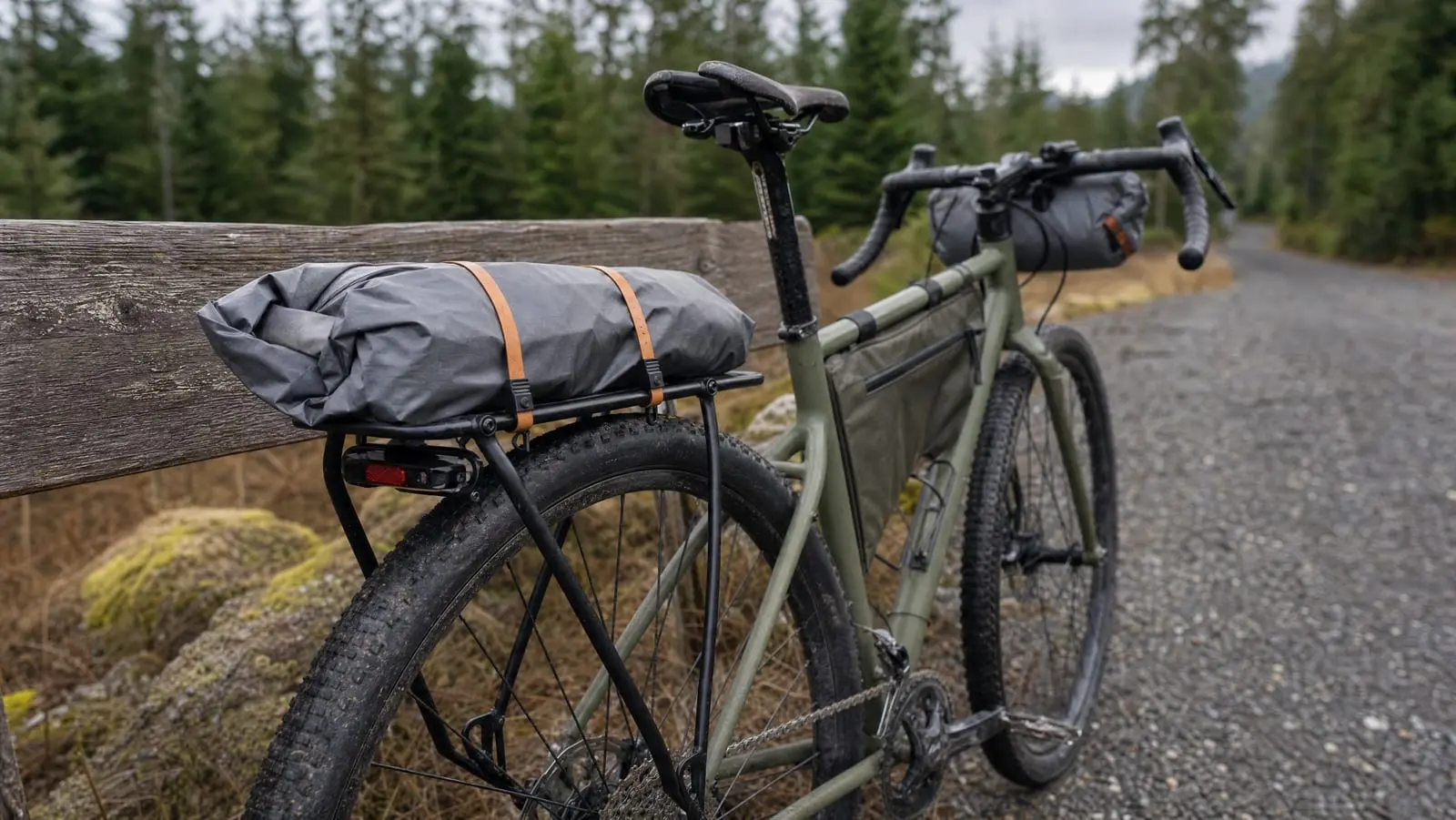
Run a rear rack with a roll-top dry bag for your sleep kit, a half-frame bag for dense items and water, and a bar roll for the shelter. Fit panniers only when food or water carry forces it. One rule decides everything else: rigid deck for bulky and light, inside-the-wheelbase soft bags for dense and heavy.
Most hybrids are not designed. They are accumulated. A rider owns a soft-bag kit, runs out of room, bolts a rack onto the back of it, keeps the seat pack anyway, and now carries two systems' worth of hardware to solve one system's problem. A hybrid earns its weight only when each half removes a job from the other. If you could take the rack off and nothing would change except total volume, you did not build a hybrid — you built a heavier soft-bag kit. The bikepacking racks and panniers decision gets posed as a choice between camps, and for most riders it is neither.
Why hybrids win: each part doing the job it is genuinely better at
The bikepacking bags versus panniers framing presents two pure systems and asks you to pick a tribe. Your packing list has no tribes. It holds two physically different kinds of object — a sleeping bag that is nearly all volume and no mass, and water and food that are the reverse — and no one carry system is good at both.
A rigid deck is good at bulk. Volume on tubing does not sag, because the deck rather than the fabric carries the load. The same volume hung off saddle rails has nothing underneath it, which is why large seat packs sway under out-of-saddle pedalling and why so much seat-pack design goes into bracing. Bikepacking.com makes the same argument in its review of the Ride Forward Designs J-Bag, reckoning that a fixed rack is steadier than a soft saddle-mounted bag and that a light rack can weigh less than a dropper-compatible seat pack. That is the honest case for the rack half of a hybrid: not more capacity, better behaved capacity.
Soft bags inside the wheelbase are good at density. Alpkit's packing guide calls the frame bag the ideal home for heavy kit — food, tools, water bottles, fuel canisters — because it sits at the bike's centre of gravity, and Polygon's guide states the principle plainly: the further weight moves from the centre, the more it affects balance. Mass out at the ends of the bike raises the effort needed to change direction, so a loaded deck and a loaded bar roll both make steering feel slow, while the same kilogram in a half-frame bag barely registers. The rear has its own failure mode — Alpkit's guide puts it as high, rearward weight creating a pendulum effect, especially on technical terrain.
The hybrid is a division of labour, not a compromise, and we take the mass question further in packing for weight distribution.
What goes on the deck, what goes in the soft bags, and what can go either way
Sort your kit by density before size. Anything light for its volume wants the deck, the only place that holds a big soft object in shape without strapping it to something that moves. Anything heavy for its volume wants to be low, central and inside the wheelbase.
- Rack deck, in a roll-top dry bag: sleeping bag or quilt, sleeping mat, spare insulation, camp shoes, a wet fly you want away from everything dry.
- Half-frame bag: water bladder or bottles, dense food, tools, spares, pump, stove fuel, battery pack.
- Bar roll: shelter body and poles, or the sleep kit if the deck is carrying food instead.
- Panniers, when fitted: resupply food and water volume, bear canister, anything bulky you picked up mid-trip.
- Either way, decide by trip: cook kit, clothing, camera gear. The swing items tell you whether you needed the rack at all.
If the swing items all fit in the soft bags, the rack is carrying only the sleep kit.
The space above the rear tyre: a rack usually deletes the seat pack
A rack deck and a seat pack both occupy the air above the rear tyre, and only one of them can have it. Run both and the pack sits on the deck, loses its compression and traps the load underneath, so you cannot open either without unpacking both. In a hybrid, the rack replaces the seat pack — it does not join it.
The clearance figures are tighter than people expect. Bikepacking.com's index of dropper-post seat bags puts the requirement for most dropper-specific packs at roughly 13 to 23 cm between the rear tyre and the saddle, and notes that larger packs risk tyre contact or leave you helping the post back to full height. Riders on the eMTB forums make the point from the other direction: the rear tyre rises towards a saddle pouch as the shock compresses, with or without a dropper. On the Bear Bones forum, one rider using a Wolf Tooth collar to limit dropper travel reported getting only about a third of the travel back. A rack sidesteps all of it by hanging the load off the frame and axle instead of the post, which is why full-suspension and small-frame bikes are where the hybrid stops being a preference. We cover that case in racks on full-suspension bikes.
The second conflict in the same centimetres is mounting hardware. Seat-pack and dropper-collar mounts want the saddle rails and exposed post; rack struts and their seat-tube or seatstay clamps want almost the same space. Symptom: the pack's rail hook will not seat because a strut head is in the way, or the strut bolt is unreachable with the pack fitted. Fix: mount the rack first, bolts torqued, then decide what else can live back there.
Tube diameters, heel strike, and the real estate you quietly lose
Strap keepers care about your rack's tubing. Voile's rack strap is sold in 20, 25 and 32 inch lengths, and in two hook sizes: its own listing for the 10 mm version says the strap snap-fits 10 mm tubing and is compatible with most bikepacking racks, baskets and cargo systems, and it sells a separate 13 mm-hook version for fatter tube. BIKEPACKING.com, covering the strap's launch, describes the pair as one fixed anchor hook and one floating adjustable hook. Hook size is not something you can split the difference on: measure your rack's tube before buying straps for it. A hook on the edge of seating fails on washboard, not in the car park.
Heel strike arrives when packing pushes rearward. Add a frame bag and your packing centre moves back; add panniers and your heels find them. Riders on CycleChat report a consistent set of fixes: mounting the bags as far back on the rail as they will go, a more offset rack for short chainstays, checking the bag is fitted the right way round so a front pocket is not in the path of your heel, and tubular rather than square bag shapes. The caveat is ours rather than theirs — every centimetre you move a loaded bag rearward puts mass further from the middle of the bike, which is the handling cost the rack was meant to avoid.
Frame-bag straps and rack mounts want the same tube. A rack with a seat-tube clamp and a frame bag whose rear straps wrap that tube will fight each other: the strap rides up onto the clamp and slackens, or the clamp cannot be tightened over webbing without the webbing creeping. Route those straps above or below the clamp, never across it, and re-check tension after the first hour.
And the deck eats your lighting. A dry bag strapped over the back of a rack covers exactly the area where a rear light, a mudguard and a reflector live. The retail listing for Tubus's Logo Evo says it suits rear lights with a 50 mm bolt spacing, which only helps if the mount is still visible with the bag on. If it is not, the light moves to the seatstay or onto the bag before the trip, not after dark.
Strapping a load to a deck so that it is still there at the end of the day
Use webbing with a cam buckle, or a rubber composite strap. Voile sells its straps as the alternative to duct tape, nylon straps and bungee cords — a maker claim, but the mechanics hold up: a cam or a stretched rubber strap holds tension at a set length, while a bungee's tension varies with every bump and nothing stops its hooks unhooking. A bungee cord is a tensioner, not a fastener, and a dry bag on a rack deck needs a fastener.
Strap over the deck rails rather than around the frame tubing where you can. Over the rails clamps the load onto the deck, the direction you want the force to go; around tubing lets the load rotate on the tube as a hinge. Two straps minimum, spaced apart: one strap gives the load an axis to pivot around, two give it none. Then fold the tails back under the strap or tuck them into the dry bag closure, so nothing hangs.
Then do the parking-lot shake test: lift the bike by the saddle, drop it a few centimetres, and try to rotate the load fore and aft. If it shifts in your hand, it will shift on the trail, and a load that walks rearward finds the tyre.
A deck load counts against the rack's rating, not around it. ISO 11243, the luggage-carrier standard that superseded EN 14872 in Europe, tests the carrier with static vertical and lateral loads and dynamic loading, and its scope explicitly excludes removable bags and baskets. The number on the spec sheet describes the carrier, not your strap job. That distinction, and the bolt torques that keep the rack attached, is why rack weight limits and bolt torque is its own guide.
The weight question, honestly
A rack is hardware you are adding, and the published figures we can check cluster in a narrow band. Tubus's Logo Evo is listed at about 738 g with a 26 kg maximum load, and the same listing explains the odd rating: a rack rated 27 kg or above counts as child-seat approved under ISO 11243:2016, so this one is held at 26 kg despite passing the test at 40 kg. Old Man Mountain gives the Elkhorn as 623 g short and 652 g tall, both with 6 inch extenders, rated to 25 lb or 11.34 kg, while Tour Magazin gives its own Elkhorn setup as 838 g “ready to ride”, without saying what that included. A Backpacking Light forum poster comparing the two quotes 690 g for the rack alone against 420 g for a seat bag. Treat 400 to 900 g as the planning range and check your own rack's spec sheet.
That is a real tax, and on a short trip it buys nothing. If you are out for one night, riding technical singletrack, or running a frame with no rack provision, do not buy the rack — a pure soft-bag kit is lighter, quieter and cheaper, and the honest answer is that you do not need a hybrid. The rack starts paying when the load is bulky enough to sag a seat pack, long enough to need resupply volume, or awkward enough that your frame cannot host a seat pack at all.
A hybrid that duplicates jobs is not a system. It is just a heavier bike.
Three worked setups, and the module you add or drop
Overnighter, no resupply. No rack. Bar roll for the sleep kit, half-frame bag for water, tools and food, small seat pack or none at all. One night of food fits inside the wheelbase, so the rack would carry nothing the frame bag cannot. This is the two-day essentials kit, and the setup most people over-build.
Long weekend, two to three nights. Rack on, seat pack off. Sleep kit in a roll-top dry bag on the deck under two straps; shelter on the bars; frame bag holding water, food and tools. The rack is doing a job the seat pack did badly, and handling improves rather than degrades because the dense items never left the middle of the bike. No panniers: deck plus frame bag covers three days.
Multi-week with resupply gaps. Same spine, with panniers fitted only for the legs that need them. This is where panniers stop being a lifestyle and become a part — hooks on for the long stretch with one shop, hooks off when resupply is daily. Choose them for mounting hardware rather than volume, which is the argument of our guide to the best panniers for bikepacking. Put food and water in the panniers, keep the deck for the sleep kit regardless, and re-check heel clearance the first time they go on loaded.
The modularity is the point: one rack, one frame bag, one bar roll, one dry bag, and panniers that live in a cupboard between the trips needing them.
The bottom line
Build the hybrid deliberately: bulky light gear on the deck, dense heavy gear in the soft bags, delete whichever part is doing a job twice, fit panniers per trip rather than per bike. Everything that goes wrong with a hybrid goes wrong in the few centimetres above the rear tyre or at the end of a strap, so measure clearance loaded and check your tails. Still deciding whether you want a deck back there at all? Start with choosing a rack and pannier setup and work back from your longest resupply gap.