High-Visibility Gear for Bikepacking: Be Seen on the Road
20+ years testing gear in Colorado backcountry
The High-Visibility Gear That Actually Works, in Order
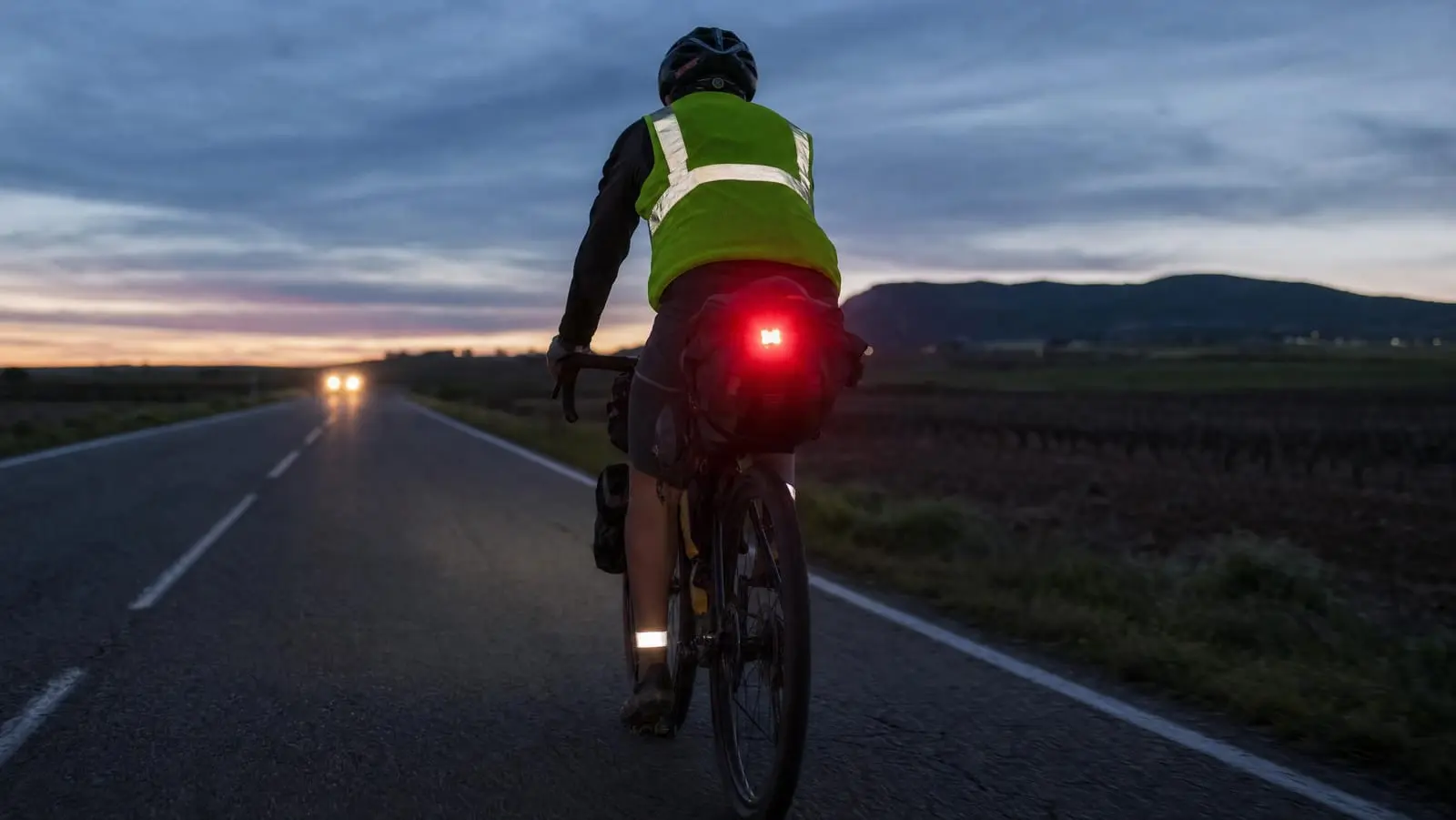
For a loaded bikepacker, high-visibility gear works in this order: a daytime-capable rear light first, reflective bands on your moving ankles second, a fluorescent layer third. The reflective vest most riders buy first is the weakest of the four — it does nothing in daylight, and after dark it loses to nine dollars of ankle bands.
This article contains affiliate links. We may earn a commission if you make a purchase through our links, at no extra cost to you.
That order is roughly the reverse of how high visibility gear for bikepacking gets sold. The vest is the purchase that looks like safety. The rear light is the one that changes what a driver at 55 mph does with the steering wheel a quarter mile back. Below: the two technologies at work, the research behind the ankle-band claim, and the six items we would strap to a loaded bike. This article is the conspicuity half of safe bikepacking.
Why Bikepackers Are Harder to See Than Commuters
A commuter in a city is a known quantity: drivers expect bikes on that road, at that hour, at that speed. A loaded bikepacker on a rural two-lane at 7 a.m. is an unexpected object, moving slower than everything around it, on a road where nobody is scanning for cyclists.
Four things make it worse, and all four come from how we pack:
- Earth tones are the house style. Olive, coyote, slate, charcoal, black — kit that photographs beautifully and disappears against a tree line and a gray shoulder. Our bikepacking clothing guide covers layering, but the color question belongs here: the most technical jersey you own may be the least visible thing you wear.
- Your bags cover the bike's reflectors. A seat pack sits exactly where the factory rear reflector lives, a frame bag hides the down tube, a rack bag swallows the wheel reflectors. Most loaded bikes have less passive reflectivity than they did in the shop.
- We ride the bad light on purpose. Dawn starts beat the heat; evening miles close the gap to camp. That habit puts us on the road when contrast is worst and drivers are squinting into low sun.
- Rural roads are unlit and fast. Fifty-five mph traffic, no streetlights, a gravel shoulder — a driver gets a few seconds to see, identify, and decide. Everything on this page buys that driver more seconds.
The data backs this up. According to NHTSA's Bicyclists and Other Cyclists: 2023 Data fact sheet, more pedalcyclist fatalities occurred in the dark (53 percent) than in daylight (42 percent), dusk (3 percent), or dawn (2 percent). Read that both ways: darkness is the worst condition by a clear margin, and 42 percent of those deaths still happened in full daylight. Daytime conspicuity is not optional.
Daylight vs. Darkness: Two Different Technologies
This is the part most buying guides skip, and it explains why so many riders own the wrong thing.
Fluorescent color works in daylight. Fluorescent pigments take ultraviolet light from the sun and re-emit it as visible light, which is why hi-vis yellow looks lit from inside on an overcast morning. It needs sunlight to do that. At night, a fluorescent jacket is just a jacket.
Retroreflective material works at night. It bounces light straight back toward its source, so it flares when a headlight hits it — and does essentially nothing in daylight, when no beam is pointed at you. A reflective vest at two in the afternoon is a mesh vest.
You need both, and neither substitutes for the other. NHTSA splits its own advice the same way in that fact sheet: it tells cyclists to increase their visibility by wearing fluorescent or brightly colored clothing during the day and at dawn and dusk, and to use a front light plus a red reflector or flashing rear light, with retroreflective tape or markings on equipment or clothing, to be noticed at night.
Biomotion: Why Your Ankles Beat Your Torso
Here is the finding that should reorganize your kit. Human vision is exceptionally good at detecting biological motion — the rhythmic pattern of moving joints that reads as "person" before the brain has resolved a shape. Put reflective material on the parts that move and a driver does not just see a light source; they recognize a human on a bicycle, which is a faster and far more useful judgment.
The research is specific about it. Wood and colleagues at Queensland University of Technology tested this on a closed road at night, published in Accident Analysis and Prevention in 2012: drivers recognized a cyclist wearing a reflective vest plus ankle and knee reflectors at significantly longer distances than the same cyclist wearing the vest alone or dark clothing. QUT's own summary of that program of work puts the effect of adding retroreflective strips in a modified biomotion configuration at the ankles and knees at roughly six times the visibility distance compared with no retroreflective markings at all.
The same study contains an uncomfortable finding for anyone who feels safe because they run lights. In that test, the presence of a bicycle light on the handlebars — steady or flashing — did not improve how well drivers recognized the cyclist, and the authors warn that riders using a light may become overconfident about their own conspicuity. A light says "something is there." Moving ankles say "that is a person on a bike, and here is how fast they are going."
The effect is not limited to darkness. In a 2020 Accident Analysis and Prevention study by Edewaard and colleagues at Clemson — funded, we should note, by a contract from Trek Bicycle Corporation — passengers recognized a cyclist wearing a fluorescent yellow jersey with matching fluorescent leg covers from 3.3 times greater distance than the same jersey without the leg covers. Same jersey, same rider. The difference was material on the moving part.
Nine dollars of reflective material on your ankles is doing more work than the twenty-dollar vest on your chest. That is not a value judgment about the vest. It is where your legs are.
Daytime Running Lights for Bikes: The Highest-Value Purchase
If you buy one thing on this page, buy a rear light bright enough to matter at noon. A daytime running light for a bike is not a night light turned up; it is a high-output flash designed to stand out against a sunlit background, which is a far harder problem than being seen in the dark.
The strongest evidence we found is a controlled experiment in Odense, Denmark, by Madsen, Andersen, and Lahrmann, published in Accident Analysis and Prevention. Of 3,845 cyclists, 1,845 had permanent running lights fitted and were tracked for 12 months against a 2,000-rider control group. The incidence rate of accidents with personal injury was 19 percent lower for the lit group; for multiparty accidents with personal injury it was 47 percent lower. Two caveats from the paper itself: crashes were self-reported through a website, and the lights were magnet-powered permanent units, not modern USB taillights. Read those numbers as strong support for the habit, not a guarantee about any product.
For lights that help you see, this is the wrong article — our guide to the best bike lights for overnight bikepacking covers headlights, and our night riding gear guide covers the rest of the after-dark system. What follows is strictly about being seen from behind.
Best Daytime Running Light: Cygolite Hotshot Pro 200
This is the one we would buy first. At 200 lumens it is genuinely visible in daylight, and Cygolite's own Daylightning mode is the pattern to run on a sunny road. Its Steady Pulse mode — a steady beam with overlapping pulses — is better in dusk traffic, because the steady component gives a driver something to range on while the pulses grab attention. About $30 as of August 2026, averaging 4.4 out of 5 stars on Amazon across roughly 1,320 ratings.
Cygolite Hotshot Pro 200
A 200-lumen rear light with six modes, including Cygolite's Daylightning flash for daytime use and Steady Pulse, which combines a steady beam with overlapping pulses so drivers can judge your distance. The flexible mount fits aero and standard seatposts. The tradeoff is its IP64 rating: splash and spray resistant, not submersible, so it is the pick for riders who expect showers rather than all-day downpours.
- 200 lumens, bright enough for daylight use
- Daylightning daytime flash mode
- Steady Pulse mode helps drivers judge distance
- 6 modes with adjustable flash tempo
- Flexible aero-compatible mount, USB rechargeable
Price may vary
Cygolite quotes 2 to 210 hours of runtime, which is entirely mode-dependent — the 210-hour figure belongs to a low-power flash, never to full brightness. Plan charging around the bottom of that range if you run the bright modes all day.
Most Weatherproof Taillight: CECO-USA 150
The CECO gives up 50 lumens to the Cygolite and gains what matters most on a multi-day trip in real weather: an IP67 waterproof rating rather than IP64 splash resistance. If your route includes days of rain or a bike that gets hosed down at a campground, this is the more durable choice. About $24 as of August 2026, averaging 4.6 out of 5 stars on Amazon across roughly 195 ratings.
CECO-USA 150 Lumen Taillight
A 150-lumen rear light with a high-output red LED and a collimator lens for long-distance punch, plus daytime running light modes for open roads. The differentiator is durability: IP67 waterproof and FL-1 drop impact resistant, which is a meaningful step up from splash-resistant taillights on a week-long trip. Check your seatpost first — the flexible mount fits posts up to 4 inches in circumference.
- IP67 waterproof and FL-1 impact resistant
- 150 lumens with collimator for distance
- Daytime running light modes
- 4 flash modes, 2 steady modes, plus a group-friendly low
- Mounts to seatpost, seatstay, or helmet
Price may vary
Best Budget Backup Pair: Ascher 2-Pack
Two lights for about $13 as of August 2026, which is the right price for redundancy. We do not run these as a primary daytime running light — Ascher publishes no lumen figure, and the IPX4 rating is splash resistance only, the weakest of the three lights here. Their job is backup: one on the seat pack, one on a helmet or bar bag, so when the main light dies at hour nine you are still lit. They average 4.6 out of 5 stars on Amazon across more than 9,000 ratings.
Ascher USB Rechargeable Tail Lights (2-Pack)
Two rechargeable rear lights for the price of one cheap dinner, which makes them the easiest redundancy in bikepacking: run one on the seatpost and clip the other to a bag or helmet. Silicone strap mounts go on and off in seconds. The honest limits are an IPX4 rating, which is splash resistance only, and no published lumen output — so treat these as backups and bag lights, not as your primary daytime running light.
- Two lights per pack for instant redundancy
- 330 mAh battery, charges from any USB port or power bank
- Four modes: full, half, fast flash, slow flash
- Silicone strap mount fits bars and seatposts
- One-touch dismount
Price may vary
Reflective Wearables: The Best Reflective Vest for Cycling vs. $9 of Ankle Bands
A vest still earns a place: it puts reflective area high on your body, goes over any layer, and packs to nothing. Pick one in a fluorescent color and it covers daylight too. It is simply not the first thing to buy.
Best Reflective Vest: Salzmann 3M Scotchlite
We would pick the Salzmann because it uses genuine 3M Scotchlite and has mesh panels that keep it tolerable at effort. About $20 as of August 2026, averaging 4.4 out of 5 stars on Amazon across roughly 1,525 ratings. Size it to go over your layers, not to fit your chest.
Salzmann 3M Scotchlite Reflective Vest
A lightweight over-layer made with genuine 3M Scotchlite reflective material, with breathable mesh panels on the back and sides so it does not turn into a sauna on a climb. A rear zip pocket takes a phone or a wallet. Remember what it is: a visibility layer with no weather protection, and it is worn over your kit, so size it accordingly using Salzmann's guide.
- Genuine 3M Scotchlite reflective material
- Breathable mesh back and side panels
- Large rear zip pocket
- Packs down to almost nothing
- Four sizes, worn over layers
Price may vary
Best Value for Biomotion: Leg Shield Ankle Bands
For under $10 as of August 2026, these are the best conspicuity value in the article, and the research above is exactly why. A 1.8-inch 3M Scotchlite strip wraps 360 degrees around the ankle, so it reads from behind, from the side, and from the front. Leg Shield says its own testing shows visibility up to 1,000 feet — the maker's claim, not an independent measurement. They average 4.5 out of 5 stars on Amazon across roughly 1,075 ratings.
Leg Shield Reflective Ankle Bands
An extra-wide 1.8-inch 3M Scotchlite strip that wraps the full 360 degrees around each ankle, putting reflective material exactly where a driver's eye reads human motion. Soft nylon over stretchable neoprene with hook-and-loop closure, and they double as pant-leg keepers to save your trousers from the chain. They are reflective, not glow-in-the-dark, so they need a headlight to work and do nothing for daytime visibility.
- 1.8 in 3M Scotchlite strip, 360-degree coverage
- Doubles as a pant-leg keeper
- Neoprene and nylon with hook-and-loop closure
- Fits ankles 7.5 to 12.5 inches
- Weighs and packs like nothing
Price may vary
Two honest limits: they are sized for the ankle, not the calf, so they can be a stretch over heavy winter layers, and they do nothing in daylight. Pair them with fluorescent color, not instead of it.
The Bikepacking Mirror: Seeing, Not Being Seen
A mirror is the exception on this page, and we want to be clear about why. It does nothing to make you more visible. It changes the other half of the equation: what you know, and when.
On a rural highway, the useful window is the ten seconds before a vehicle reaches you. With a mirror you see the truck-and-trailer coming and act — take the lane briefly to discourage a squeeze pass, or drift onto the shoulder before the driver has to decide anything. You move early and deliberately instead of reacting to a horn. That behavior change is worth more than most gear, and it pairs with our guide to bikepacking road safety.
Wittkop Handlebar Bike Mirror
A convex real-glass mirror with a wide field of view that rotates a full 360 degrees and folds flat against the bar when you are not using it. It bolts on with the supplied screw and can mount above or below the handlebar, which matters on a loaded bar bag setup. Wittkop, a German maker that says it dates to 1898, states it uses over 20 percent reinforced materials for break resistance.
- Convex real glass with a large field of view
- 360-degree rotation and tilt
- Folds in against the bar for transport
- Mounts above or below the handlebar
- Screw-on clamp, not a friction fit
Price may vary
About $13 as of August 2026, averaging 4.3 out of 5 stars on Amazon across roughly 5,350 ratings. The real tradeoff is the glass: loaded bikes fall over — gas stations, fences, soft ground — and glass on a bar is glass on a bar. The folding mount is the mitigation. Fold it in before you lean the bike anywhere.
Free Visibility That Costs Nothing
Some of the best conspicuity on a loaded bike is a packing decision:
- Put the bright thing on the outside. Your one fluorescent layer lives on top of the load or on top of your body, not stuffed in a dry bag because it clashes. A yellow or orange dry bag strapped to the top of the rear load is a large daytime target at exactly the height drivers scan.
- Reflective tape on the fork and stays. A few dollars of tape restores the passive reflectivity your bags stole, and low side reflectivity is what makes you visible at intersections and driveways.
- Hold a line. A rider who wobbles when a car approaches teaches the driver nothing. A straight line a consistent distance from the edge is easy to plan a pass around.
- Take the lane when the shoulder disappears. Being visible and being positioned are the same skill; riding the white line on a blind curve puts you where drivers have the least time to react.
- Charge on a schedule. Lights die because charging is unstructured. Ours go on the charger at every meal stop with an outlet, which folds into the routine in our bikepacking packing list and checklist.
- Visibility cuts both ways after dark. A bike covered in reflective tape is easy to find in the dark — for you and for anyone else — worth a thought for camp security when you are pitched near a road.
None of this replaces a rear light. All of it is free.
What We Would Actually Carry
For a mixed-surface trip with paved connectors, the kit is small:
- One daytime-capable rear light on the seatpost or seat pack — the Cygolite for the brightest daytime flash, the CECO if the forecast is wet.
- One backup light from the Ascher pair on a bag or helmet. A dead primary at dusk is the actual failure mode.
- Reflective ankle bands. Nine dollars, no weight penalty, best-supported item here. If you buy nothing else, buy the ankle bands.
- One fluorescent layer worn outermost in daylight — the Salzmann vest, or a hi-vis jersey you already own.
- A mirror if your route is road-heavy. Optional on singletrack, close to essential on a highway shoulder.
Riding alone changes the calculus: nobody rides behind you, nobody flags a car down. Our guide to solo bikepacking covers that problem, and the best satellite messengers for bikepacking covers what happens after the crash you could not prevent.
How to Choose, by Rider Type
- Mostly gravel, little pavement. One good rear light and ankle bands. Skip the vest; carry a bright buff or a fluorescent dry bag for connector days.
- Road-heavy touring. Rear light plus backup, ankle bands, a fluorescent layer worn outermost, and the mirror. The full kit — the most complete setup here, and the one worth the extra bulk when you are sharing pavement with traffic all day.
- Dawn patrol and evening miles. Favor the steady-plus-pulse mode over pure flash, add ankle bands, wear fluorescent — dawn and dusk are when both technologies are working at once.
- Genuinely riding at night. Ankle bands and reflective tape do the heavy lifting, and remember the QUT finding that a handlebar-mounted light alone did not improve recognition. A real headlight for seeing becomes the priority here too.
- On a budget. Ankle bands plus the Ascher two-pack runs about $22 as of August 2026 and covers both redundancy and biomotion. Upgrade the primary light later.
Spend on the light and the ankles, treat the vest as a supplement, let free habits do the rest. Visibility gear does not prevent crashes — no product does, and none of it substitutes for road position and judgment. What it buys is time, and on a two-lane at dusk a few extra seconds of a driver's attention is the whole game. For the rest of the system, start with our bikepacking safety guide.