Camp Security and Stealth Camping Safety for Bikepackers
20+ years testing gear in Colorado backcountry
Bikepacking Camp Security: Sleep Where Nobody Knows You Are
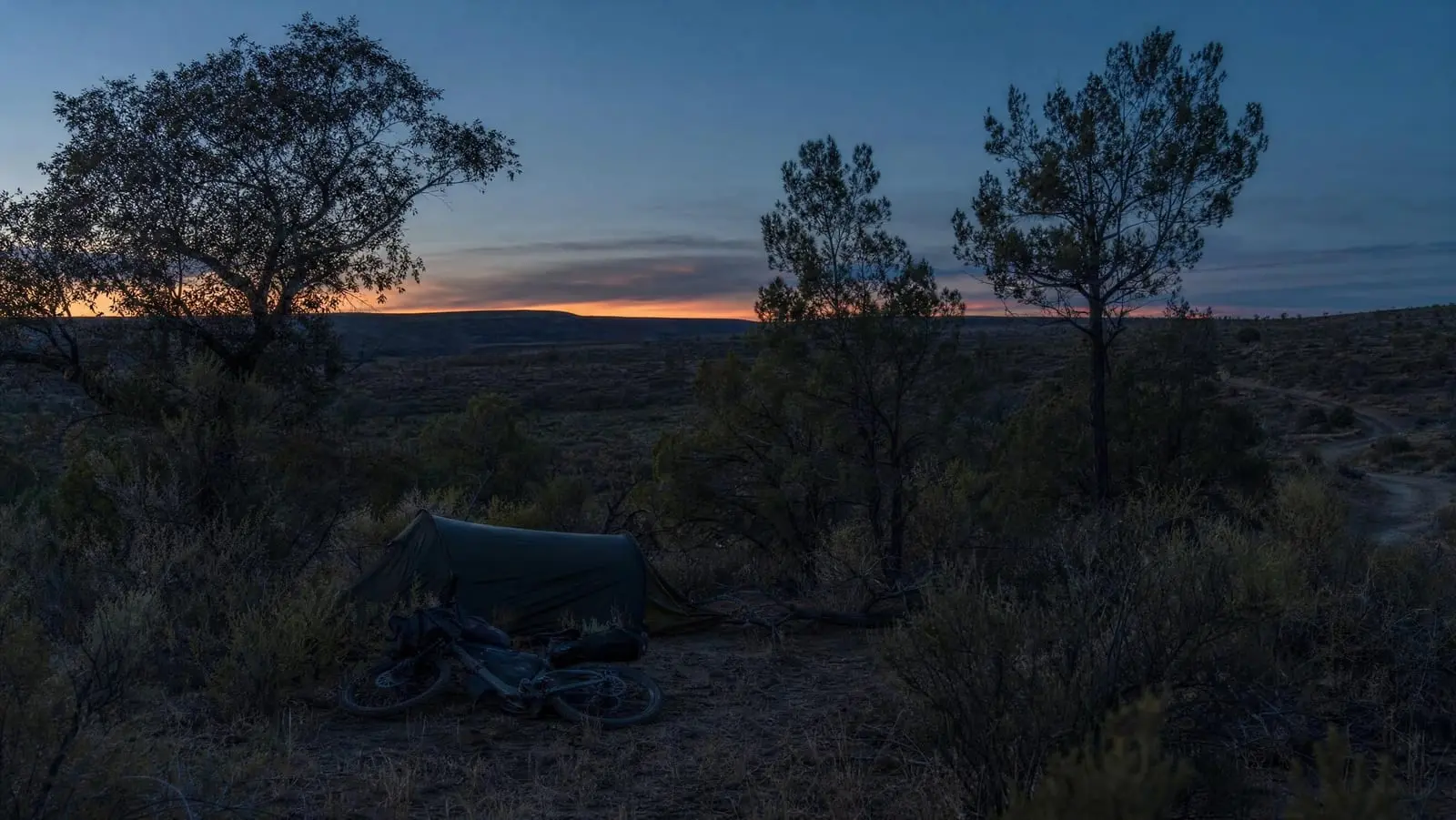
Bikepacking camp security comes down to a site nobody can see. Pick a pitch screened from the road and from any house, roll in close to dark, keep the bike within arm's reach, leave at first light, and leave nothing behind. If a spot feels wrong, move on — that instinct is the best security gear you own, and it is free.
Everything below is detail. The most effective thing you can do at an unofficial camp is choose it well, and that costs nothing: no lock, no alarm, no clever gadget. If nobody knows you are there, nothing else has to work.
What follows is the routine we actually use — one piece of the larger system in our complete guide to bikepacking safety.
The Fear and the Real Risk Are Not the Same Thing
Ask a rider what frightens them about camping somewhere unofficial and you get one answer: a stranger unzipping the tent at 2 a.m. That is the fear, and it is almost never what happens. What does happen, trip after trip, is duller:
- A landowner or a ranger walks up at 7 a.m. and asks you to move. You move.
- The sprinklers come on at 4 a.m., because the flat mown strip was mown for a reason.
- The road you could not hear at dusk carries gravel trucks from 5 a.m.
- The wind lays the bike over at midnight and bends a derailleur hanger.
- You are cold, because you took the flat spot instead of the sheltered one.
Every one of those is a site-selection error fixed by the same five minutes of thought. And the encounters riders actually report are far more often curious, official, or awkward than hostile — a farmer, a dog walker, a deputy who wants you off the county right-of-way.
The thing you are afraid of is a person. The thing that will actually ruin your night is a drainage, a sprinkler head, or a gust of wind. Fix the second list and the first one gets quieter.
If the anxiety itself is the problem — and on the first few nights out it usually is — our guide to managing fear and anxiety on bikepacking trips deals with it directly. Competence is the cure, and the routine below is the competence.
Stealth Camping Is a Legal Question Before It Is a Safety Question
Most stealth camping articles skip straight to tactics. Start with the law instead, because it decides how much stealth you need — and it varies enormously.
On much US public land, dispersed camping is a normal permitted activity with conditions attached. According to the Bureau of Land Management, dispersed camping is generally limited to 14 days within any 28-day period, though specific stay limits vary by state and field office; the BLM also asks campers to stay at least 200 feet from lakes, rivers, and streams, to camp in spots that are already disturbed, and to verify specifics with the local BLM office.
National forests are similar but not identical, and the difference is the point. Forest Service guidance for the Mount Baker-Snoqualmie National Forest allows camping in a single location for up to 14 consecutive days and no more than 28 days total on that forest per calendar year, asks campers to stay at least 100 feet from the shoreline of lakes and streams, and states that certain areas are closed to dispersed camping — with a direct instruction to contact your local Ranger District for details.
Two agencies, two sets of numbers, one identical message: the rule that applies to you is the one the specific unit publishes.
Outside the US it shifts again. According to Ordnance Survey's guide to wild camping, wild camping is not legal in England and Wales without the landowner's permission — even for a bivvy or a tarp — while Scotland permits responsible wild camping, and Dartmoor is a specific exception following a Supreme Court ruling. Three answers within a few hundred miles.
And where the answer is simply no — a posted sign, a locked gate, a park that closes at dusk — treat it as an answer, not a puzzle.
Site Selection Is the Whole Ballgame
Here is the useful part. Forest Service dispersed camping guidance for Mount Baker-Snoqualmie tells campers to choose an existing dispersed site rather than create a new one, and to camp out of view from major roads and trails where possible. That is not stealth advice. It is land management advice that happens to be identical.
Our checklist, in the order we run it:
- Out of sight of the road, and of any house. Not "far from" — out of sight of. Fifty yards behind a rise beats a quarter mile across an open field.
- Use terrain, not distance. Past a bend, over a lip, behind a berm, inside a treeline. Screening does the work; walking does not.
- Off the desire lines. People and dogs walk predictable routes — the mown path, the two-track, the shortcut to the water.
- On durable ground. According to the National Park Service's summary of the Leave No Trace principles, good campsites are found, not made, and durable surfaces include maintained trails and designated campsites, rock, gravel, sand, dry grasses, or snow. A site you had to improve is a site someone will notice.
- Not east-facing and open. A pitch invisible at 9 p.m. can be lit like a stage at 6 a.m.
- Not under standing deadwood. Look up before you look around. Dead limbs are a boring way to get badly hurt.
- Not in a drainage. See below. This one is not negotiable.
Never camp in a wash or a drainage
The obviously perfect spot in desert country is flat, sandy, and sheltered because water made it that way. According to National Weather Service flood safety guidance, you should not camp or park along streams and washes, particularly during threatening conditions — and the same page notes flash flooding at an Arizona arroyo that took only 58 seconds to develop.
The rain does not even have to be over you. According to the National Park Service at Chiricahua National Monument, during monsoon season campers should never camp in washes or low-lying areas where flooding could happen, and rain may occur away from you and still create a flash flood that travels for miles downslope.
Pitch on the bench above the wash, not in it. Our guide to severe weather safety covers the forecast side of the call.
The headlight test
Before you commit, walk to the road at dusk and look back at your spot with a light. Would a sweeping headlight find you?
This is also the one night you do not want high-visibility gear doing its job. Reflective panels, a bright tail light, a white tent fly — all designed to be spotted from a distance, and all of them work. Turn the reflective bits inward, kill the blinkies, and pack the drabbest shelter you own on trips where you expect to camp rough.
Timing: Late In, Early Out
Stealth camping safety is a schedule as much as a place.
- Scout in daylight, commit at dusk. Spot a good line of trees at 4 p.m., note it, keep riding, come back when the light goes.
- Arrive 20 to 30 minutes before dark. Early enough to pitch without a headlamp, late enough that nobody is out.
- Do not cook where you sleep. Eat at a pullout a few miles back, wash up there, then ride on and camp clean. A stove hisses, food smells carry, and cooking is the most visible thing a camper does. Our guide to wildlife safety for bikepackers recommends the same split for different reasons — and in bear country food goes into proper storage regardless, which we cover in bear canisters versus hanging bags.
- No fire. Light, smoke, smell, a scar on the ground, and in much of the West a fire restriction you may not know about.
- Run a dark camp. Red mode on the headlamp, screen brightness down. A lit tent is a paper lantern.
- Alarm at first light, rolling in 20 minutes. Pack the night before, eat breakfast down the road.
The Bike at Camp
The bike is the expensive thing, and it is also the thing that gives you away.
- Lay it down or bring it in. A loaded bike against a tree is a silhouette with a very recognizable shape. Vestibule is better; on its side, off the skyline, is fine.
- Bags off and inside. Anything with food or electronics. That solves theft, rodents, and rain in one move.
- Lock it anyway. Even where theft is genuinely unlikely, a cable through both wheels and the frame turns an opportunistic grab into a project. Our guide to bike security and theft prevention covers what is worth carrying and what is dead weight.
- Use the bell trick. A cord from the bike to a tent stake, or a bell hung where the bike will pull it over, is a passive alarm for nothing.
Be honest about the threat model. In remote country the bike is far more likely to be knocked flat by wind than taken by a person, and a bent hanger fifty miles from a road is a real problem. Near town and at trailheads, invert that — and ask whether the spot is worth using at all.
Situational Awareness Without Paranoia
Situational awareness at camp is not scanning the treeline all night. It is reading five things on the way in, then going to sleep. Notice, in the last mile:
- Vehicle tracks. Fresh, wide prints in soft ground mean someone drives here, probably at dawn.
- Trash and fire rings. Weathered and faded means old use. Fresh cans and warm ash mean return visits.
- Maintained paths. A mown strip, a brushed line, footprints going one way — someone owns that route.
- Infrastructure. Troughs, gates, hunting stands, trail cameras, irrigation. Somebody services all of it, usually early.
- Dogs. If you can hear a dog, a dog can hear you. Move until you cannot.
Then the rule that overrides everything else: if it feels wrong, move. Not "it is probably fine." Move. The math is never close — leaving costs twenty minutes and a slightly worse pitch, while staying somewhere your gut has flagged costs a full night of shallow, listening non-sleep. A tired rider makes worse decisions tomorrow than a rested one makes on a mediocre campsite tonight.
If Someone Finds You
Assume it happens eventually, and assume the person is curious or official rather than dangerous. Have the script ready.
- Be visible and human, fast. Turn a light on, speak first, get out of the tent if you can. Hiding reads as threatening; a cyclist with bed hair does not.
- Lead with the story. "Sorry — touring cyclist, got in late, gone at first light." That sentence answers every question they were about to ask.
- Be polite and slightly apologetic, whether or not you think you are in the right.
- Offer to move immediately, and mean it. Most of the time they will tell you not to bother.
- Do not argue about the law at midnight. Being correct in a dark field, alone, is worth very little. Pack up, ride on, look it up later.
- If it is official, ask where you can camp. Rangers and deputies usually know a legal spot within a few miles, often better than yours.
Solo Riders and Camping Alone as a Woman
Camping alone is a normal, good thing to do, and the adjustments are small.
- Somebody should know roughly where you slept. A nightly check-in turns a missed morning into an early phone call rather than a week of silence. Where there is no cell signal, that is what the best satellite messengers for bikepacking are for.
- Do not broadcast a solo status in real time. Not to strangers at a gas station, not on social media while you are still out there. Post the ride a day late. Plenty of solo riders default to the vague plural — "we are camping up the road" — and it costs nothing to say.
- Trade comfort for peace of mind when the trade is worth it. A paid campground, a fire-station yard with permission, a cheap motel on the night the weather and the vibe both turn. That is judgment, not failure.
- Weight site selection toward unseen over comfortable. A lumpy pitch behind brush beats a beautiful open bench by a road.
We cover the wider version in our guides to solo bikepacking and riding alone and to bikepacking as a woman.
Leave No Trace Is Also Camp Security
The ethics and the security overlap almost perfectly, which is convenient. According to the National Park Service's Leave No Trace summary, good campsites are found rather than made, altering a site is not necessary, and riparian areas should be protected by camping at least 200 feet from lakes and streams. Forest Service dispersed camping guidance is equally direct: pack out all trash and all objects you brought with you, and leave your camp area cleaner than when you found it.
Read as security advice, that says the same thing:
- A clean camp is an invisible camp. No fire ring, no flattened vegetation, no cut branches. Nothing to see from the road tomorrow.
- Nothing outside means nothing to defend. Packed gear cannot be walked off with, rained on, or chewed by a rodent.
- Human waste goes 200 feet from water, camp, and trails. The same NPS summary specifies a cathole 6 to 8 inches deep, covered and disguised, with toilet paper packed out. It is the most common way riders leave a spot obviously used.
- The next rider inherits your reputation. Spots stay quietly tolerated because the last twenty people left nothing.
The Takeaway
Camp security is a routine, not a nerve. Ours fits on one line: check the rules, eat somewhere else, pitch out of sight near dark, keep the bike down and close, leave at first light.
- Site selection is the whole thing, and it is free.
- Check the actual land manager. The numbers vary by unit and by country.
- Late in, early out, cold camp. Cook down the road.
- If it feels wrong, move. Twenty minutes, no debate.
- Leave it cleaner than you found it — for the next rider, and for yourself.
The first two or three nights you will lie there cataloguing every sound. By the fifth or sixth it stops being frightening and becomes what it actually is: a quiet, cheap, weirdly satisfying way to end a day on a bike, somewhere nobody knows you are. For the rest of the system, start with our complete bikepacking safety guide.