The Best Dynamo Hubs for Bikepacking
20+ years testing gear in Colorado backcountry
The Best Dynamo Hub for Bikepacking: The Short Answer
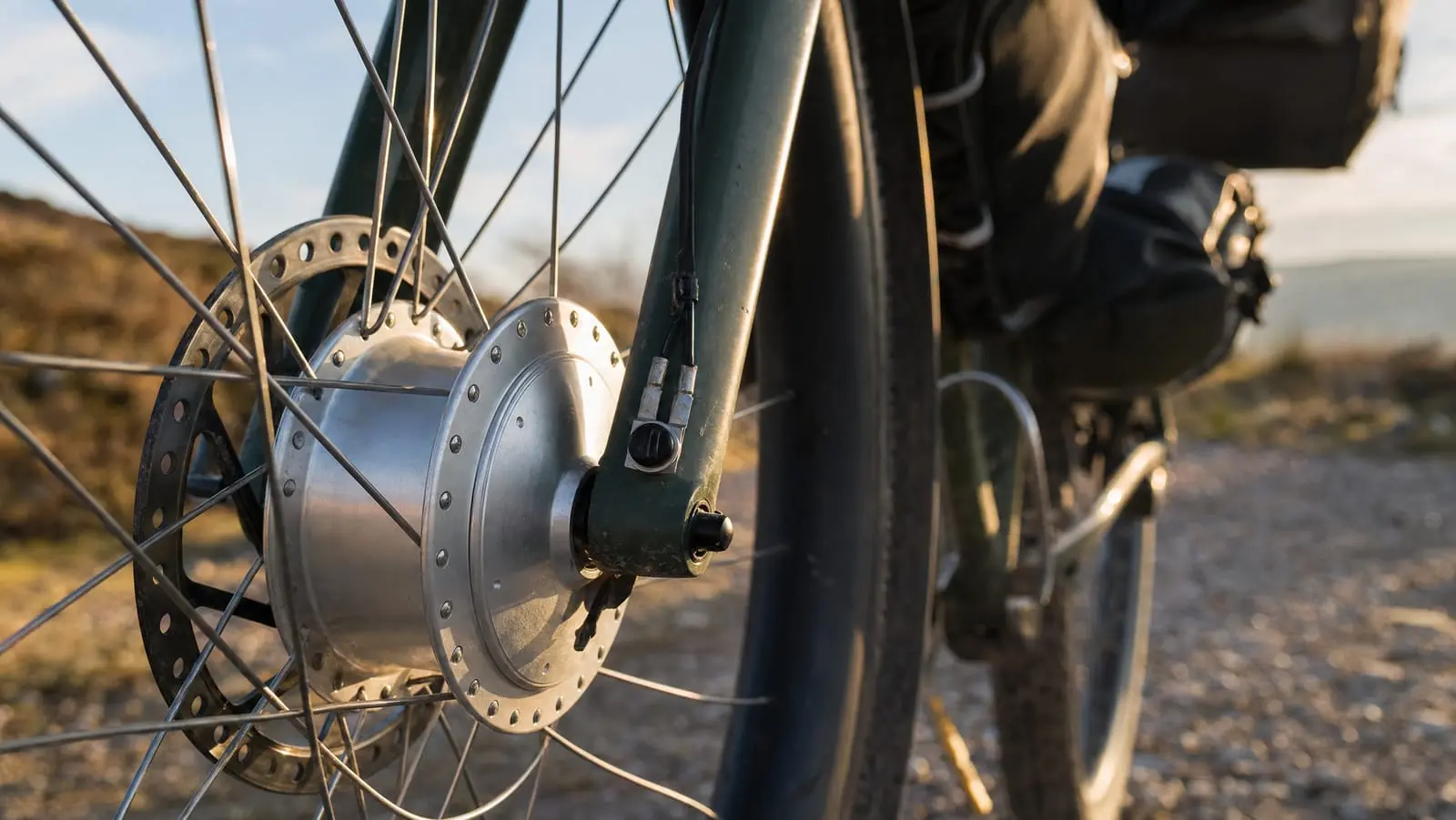
Buy a Schmidt SON 28 if the budget allows. In the only instrumented comparison of modern hubs we could find, it had the lowest drag of the four tested. If it is too expensive, buy a Shimano DH-UR700-3D or DH-3D32: identical rated output, roughly half the money, far easier to source.
This article contains affiliate links. We may earn a commission if you make a purchase through our links, at no extra cost to you.
Two things to settle first. This article assumes you have already decided to generate power rather than carry it; if not, start with our comparison of a dynamo hub versus power bank. And the hub is only one of three parts in a working bikepacking power and charging setup — hub, converter, buffer battery — and not the part that decides how fast your phone charges.
Now the awkward part. The two best hub families are not sold on Amazon. Schmidt and Shutter Precision sell through bike shops and distributors, not our affiliate links, and we earn nothing from recommending them. Only the Shimano hubs below pay us anything — which is why you should know it before you read our opinion of them.
Why Every Dynamo Hub Makes the Same Power
Start here, because it kills most of the marketing. A hub dynamo is built to a nominal 6 volts and 3 watts, and the makers say so themselves. Schmidt's SON Range of Products 2024 catalogue lists 6 Volts - 3 Watts, states that the SON 28 generates 3 watts nominal power at 15 km/h while the SONdelux does so at 20 km/h in 700c and 29 inch wheels, and says the hub conforms to German StVZO regulations. Shutter Precision's 8-series page says flatly that "SP respects the 6V3W German standard," and its 7-series page says the same of those hubs.
That rating is a ceiling at the rated speed, not a cap at every speed — Schmidt notes that at high riding speed a hub can deliver significantly more than 3 watts. But at the 15 to 20 km/h a loaded bike actually averages, you live near the rating, and the rating is the same for everybody.
One caveat: lower-output hubs exist alongside the 3 W ones. Shutter Precision's S-8 series is described on its own page as ready for 700c wheels at 6V2.4W output. If you are buying for charging rather than only lights, buy a full 3 W hub.
Dynamo Hub Drag: What It Actually Costs You
This is the number that should decide your purchase, and the one most often invented. Here is where ours comes from.
The only instrumented comparison of current hubs we could find is a lab test by the Norwegian experimenter Skjegg, reported in detail by Alee Denham at CyclingAbout. The method matters: a dynamo front wheel is clamped in a fork on a steel plate and driven by a chain from a motor on a laboratory DC supply, with a plain non-dynamo hub measured first so chain, cog and bearing losses can be subtracted. Denham reports the drag figures as accurate to within plus or minus 1 watt, and notes the test used "quick-release hubs only" — so thru-axle versions are not covered.
With the light and USB charger switched off, from 10 to 30 km/h, that test reports:
- Schmidt SON 28: 1.4 to 1.9 W
- Shimano DH-UR700: 1.4 to 4.5 W
- Shimano DH-3D32: 1.9 to 4.3 W
- SP PD-8: 1.9 to 5.2 W
Those are no-load figures, and the conditions do most of the work. The same source reports that "between 5 and 10 km/h, all hubs perform similarly, with drag differences within 0.5 watts" — so at hike-a-bike speeds the hub barely matters.
Switch something on and the picture changes. CyclingAbout reports the UR700 reaching 14.5 W of drag at 15 km/h driving a Busch + Müller IQ-X headlight, and that above 20 km/h the SON 28 runs 3 to 4 watts less drag than both the PD-8 and the UR700. On a kLite Bikepacker Ultra V2 at maximum power, the SON 28 was lowest at 18 W while the PD-8 reached 24.5 W at full brightness. Feeding a Busch + Müller USB-Werk charger, the SON 28 is reported at around 40 percent less drag than the others. On charging efficiency — averaged across 15 to 30 km/h, and measured separately through four different USB converters — the same test puts the SON 28 between 48.5 and 60.2 percent, the two Shimano hubs between 38.6 and 44.5 percent and the SP PD-8 between 31.7 and 34.4 percent, depending on which converter was fitted.
The line to remember: CyclingAbout writes that "if you're generating 4 watts of USB power, using an SP PD-8 instead of a SON 28 could result in over 5 watts of additional hub drag."
What we cannot tell you. The SP hub in that test was the PD-8. Neither the PV-8 nor the current PL-7 was measured, and no SONdelux was either. We will not interpolate figures for them, so where those hubs appear below we rank them on manufacturer-published weight and efficiency only.
Translating watts into minutes
Denham's companion piece, How Much Do Hub Dynamos Really Slow You Down?, converts the same data into time with Bike Calculator, simulating 60 kg and 90 kg riders on 25 kg bikes at 120 and 180 watts, on the flat and on a 5 percent gradient. Per hour of riding, the modelled cost is 10 to 30 seconds for the most efficient hub with nothing connected, 1 to 2 minutes with a USB charger and 1.5 to 2.5 minutes with a bright light; for the least efficient hub, 0.5 to 1 minute, 2.5 to 3 minutes and 2.5 to 4 minutes.
Denham puts his own Schmidt hub at "probably slowing me down only 7-seconds per hour" with nothing drawing current, and around 1.5 minutes per hour charging a smartphone. Those are calculated rather than stopwatch figures, but the shape is clear. An unloaded dynamo hub is nearly free. A dynamo hub with a bright light on it is not. Denham estimates bright dynamo lights could cost a front-of-field ultra racer 25 to 40 minutes in an overnight push — the trade-off we weigh in our overnight lighting roundup.
And the other way to generate power on a bike: solar avoids the drag tax entirely and still loses on most bikepacking routes, on panel area, mounting angle and cloud rather than physics — our write-up on solar charging for bikepacking does that arithmetic.
SON 28 vs Shutter Precision vs Shimano: The Three Families
Three makers cover almost the whole market. Pick the family first, then the model.
Schmidt SON — the one that measures best
Schmidt Maschinenbau in Tübingen, Germany, makes the hubs most long-distance riders eventually buy. Its catalogue lists double-sided sealed SKF bearings, a pressure compensation system that lets air move in and out as the hub cools so water is not sucked through the seals, and a 5 year guarantee. Published weights from that catalogue: 440 g for a non-disc SON 28, 460 g for the disc 6-bolt, 430 g for the disc center lock, 400 g for the SON 28 12 thru-axle disc 6-bolt and 390 g for the non-disc SONdelux.
Retailer spec sheets repeating Schmidt's data, such as bike-components, add 65 percent efficiency at 15 km/h in a 700c wheel and a no-load power input of 0.5 W at the same speed. Schmidt's own guidance is rarely quoted and genuinely useful: for charging strong consumers like smartphones it recommends a hub with the SON 28 generator. The SONdelux is described as extra light and optimised for fast riding and small wheels — the wrong pick for a slow, heavy, charging-heavy bike, despite being the one people reach for to save grams.
Usually, a SON hub dynamo will last a bike's complete life cycle. A cheap hub dynamo produces the same power, but it often doesn't take long until it has to be completely replaced due to bearing damage.
That is a manufacturer talking about its competitors. The drag data above is the independent part.
Shutter Precision — the lightest, and the one with a reputation to manage
Shutter Precision builds in Taiwan and undercuts Schmidt on weight and price. Its 8-series comparison table lists 375 g for the PV-8, 395 g for the PD-8 and 385 g for the PL-8, all quick-release with 100 mm over-locknut dimensions, and calls the P-8 series "the most efficient on the market attaining 72% at 15km/hr." The thru-axle 7-series lists 375 g for the PL-7 and 385 g for the PD-7, both 12 mm and 100 mm, in 24 to 36 hole drillings, with 110 mm Boost variants at 390 g and 400 g.
One honest flag: retailers do not repeat that 375 g. Listings carrying SP's distributor copy, such as Tree Fort Bikes, give 409 g for the PL-7 instead, and other shops do the same. The published figures disagree with each other, so treat any SP weight as approximate rather than a tiebreaker.
Reliability is harder to answer well. SP publishes nothing about bearings, sealing or service intervals, and the independent evidence is forum anecdote, not data. Riders commonly report occasional bearing failures on SP hubs and comparatively few on SON and Shimano, alongside plenty of SP hubs that have run for years untroubled — and those threads note the selection bias themselves. We would buy an SP hub to save weight on a bike facing one or two big trips, and a SON on a bike meant to tour for a decade.
Shimano — the value option, and the easy one to buy
Shimano's hubs are heavier and measurably less efficient than a SON. They are also a fraction of the price, stocked worldwide, and a sound choice for a first dynamo build. Shimano lists the DH-UR700-3D at an average 476 g without the quick release, for 26 to 28 inch wheels. We could not find a Shimano-published weight for the DH-3D32; retailer listings for the 36-hole disc version, such as Taylor Wheels, put it at 690 g, and other sellers quote figures between roughly 685 and 705 g — retailer-supplied numbers rather than a factory spec, so weigh yours. CyclingAbout notes the UR700, despite generating more potential power than the 3D32, "can actually run with slightly less drag" — so the newer hub wins on both counts.
The Shimano Dynamo Hubs You Can Actually Buy
These are our affiliate-linked picks, and the stock situation is most of the story.
Shimano DH-3D32 — 163.14 dollars as of November 2026, in stock. Six-bolt disc, quick-release, 36 hole. The cheapest genuinely-stocked 6V/3W hub we found, and 36 spokes under a loaded front end is no bad thing. It is also the heaviest and highest-drag hub here. Buy it if budget is the constraint and your fork takes a quick-release axle.
Shimano Nexus DH-UR700-3D — 216.49 dollars as of November 2026, with only one left in stock at the time of writing. Center-Lock disc, 100 mm quick-release, 32 hole. On the data above this is the best Shimano of the four and the one we would build into a wheel. Check the listing rather than trusting this paragraph.
Shimano Nexus DH-UR705-3D — 168.48 dollars as of November 2026, and backordered. The 12x100 mm thru-axle version — the spec most modern gravel bikes need, and the one you cannot have: the listing shows a 6 to 7 month lead time. We link it because the price is right and the queue is worth knowing about, not because you can buy it this week.
Shimano Nexus DH-UR708-3D — 192.32 dollars as of November 2026, also backordered at 6 to 7 months. The 15x100 mm thru-axle spacing. Same caveat, same queue.
Axle Standards: The Mistake That Wastes the Most Money
The commonest dynamo buying error is ordering the wrong axle. A hub is not adaptable between the big standards, and the packaging will not save you.
Write down three things before you order. The axle type and diameter your fork takes (9 mm quick-release, 12 mm thru-axle or 15 mm thru-axle), the hub spacing (100 mm on road, gravel and most touring forks; 110 mm on Boost mountain forks), and the rotor interface (6-bolt or Center-Lock).
Spacing is the unforgiving one. Schmidt builds separate 110 mm Boost models — its catalogue lists the SON 28 12 110 and SON 28 15 110 as distinct products at distinct prices — and SP lists separate PD-7-110 and PL-7-110 hubs. A 100 mm hub does not become a 110 mm hub. Some non-dynamo hubs swap end caps between 12 mm and 15 mm at the same spacing, but retailer listings for thru-axle adapters, such as SJS Cycles, warn that fit must be verified with the hub maker and name brands — DT Swiss and Stan's 15 mm end caps — that are excluded outright. Assume your dynamo hub is not convertible unless its maker says it is.
Spoke count and lacing belong to another article. Flange spacing differs between models — Schmidt lists 62 mm for the non-disc SON 28, 50 mm for the disc versions and 68 mm for the SONdelux wide body — so your spoke lengths change with the hub, not just the rim. Our guide to installing and wiring a dynamo hub covers hole counts, spoke length, connectors and routing; read it before you order spokes, and our notes on wheel truing and spoke repair cover keeping the wheel round afterwards.
Bearings, Service and What Actually Fails
Dynamo hubs rarely fail electrically. They fail at the bearings, and that is where the three families genuinely differ.
Schmidt's catalogue says its double-sided sealed SKF bearings ensure a very long lifetime without maintenance, and Bikepacking.com's factory visit to Schmidt Maschinenbau in Tübingen reports a firm of around 50 employees building hubs with no electronics to fail and standard SKF industrial bearings inside. Retailer listings name the part, an SKF 629 2RSH deep-groove bearing, and at least one US seller says the hub is designed for at least 50,000 km between services — a seller's figure, not one we found in Schmidt's own documents, so we would not plan around it.
The catch is that a SON service is not a roadside job. Riders consistently report that bearing replacement means sending the hub back to Germany, and that on older hubs the wheel had to be un-built to do it. One owner in that thread quotes 40 euros for a complete service and then points out that it is the shipping that breaks the bank. The work is cheap; the logistics are not. SP publishes nothing about service, and riders report that its bearings cannot be replaced outside the factory — in one thread the UK importer swapped a failed hub for a refurbished unit rather than repairing it. Shimano hubs get replaced rather than repaired, which at these prices is defensible. So the test before you buy is simple: ask whoever sells you the hub what happens in year five.
What to Buy, by Rider
- Quick-release fork, most riders: Schmidt SON 28 disc — 460 g for the 6-bolt per Schmidt's catalogue, lowest measured drag of the four tested, 5 year guarantee. Dealer purchase; we earn nothing on it.
- Modern thru-axle gravel bike: Schmidt SON 28 12 disc 6-bolt at 400 g, or a Shutter Precision PL-7 if weight and price beat service access. The equivalent Shimano is backordered six to seven months.
- Value pick, available today: the Shimano DH-3D32 at 163.14 dollars as of November 2026 — heavier and draggier, but in stock.
- Best Shimano on the data: the DH-UR700-3D, 476 g per Shimano, lower drag than the 3D32, 216.49 dollars as of November 2026 and down to its last unit.
- Lightest: Shutter Precision PV-8 or PL-7 at a published 375 g, with the caveat that retailer listings say 409 g for the PL-7 and nobody has independently measured their drag.
- Serviceability above all: SON. No hub here is genuinely field-serviceable.
Skip the SONdelux unless you ride fast or on small wheels — Schmidt says it needs a higher speed for the same output, and loaded bikepacking is slow.
The Bottom Line
Dynamo hubs do not compete on power. All are built to a nominal 6 volts and 3 watts, so the honest comparison is drag, weight, bearing life and axle fit. On the one independent test we could find, the SON 28 wins on drag and charging efficiency — by a small margin unloaded, a large one with a light or charger pulling current. Shimano wins on price and availability. Shutter Precision wins on the scale and loses on documentation.
Our order of operations is unglamorous: confirm the axle standard, pick the converter, then the hub, then get the wheel built. Get that sequence wrong and the hub is the cheapest of your mistakes. For the rest of the system, work through our complete guide to bikepacking power and charging, then go ride somewhere the sockets are a week away.